✔️✔️Dentistry L5: Interpretation of Dental Radiographs🟢
 Call Kai
 Learn
 Practice Test
 Spaced Repetition
 Match
 Flashcards
 Knowt Play
1/77

There's no tags or description
Looks like no tags are added yet.
78 Terms
Dentistry L5: Interpretation of Dental Radiographs
Dentistry L5: Interpretation of Dental Radiographs

root (apical)
What is A?
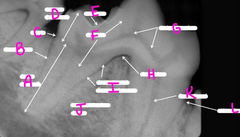
cementum
What is B?

neck
What is C?

crown (coronal)
What is D?

enamel
What is E?

dentin
What is F?
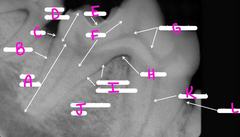
pulp chamber
What is G?

furcation
What is H?
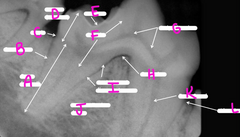
periodontal ligament space
What is I?
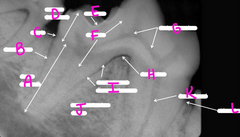
interradicular bone
What is J?

root canal
What is K?

alveolar margin
What is L?
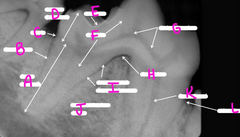
bone between tooth roots
What is interradicular bone?
reviewed
REVIEW: Orientation

mandible; mandibular symphysis
Is this the maxilla or mandible? How do you know?

true
T/F - The mandibular symphysis is fibrocartilaginous
right
Tooth 404 is on the [right/left] side of the mandible
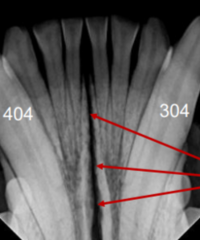
left
Tooth 304 is on the [right/left] side of the mandible

caudal mental foramen
What is the arrow on the right pointing to?

middle mental foramen
What is the arrow on the left pointing to?
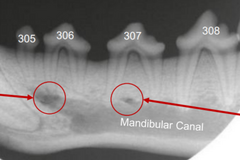
canine tooth
The middle mental foramen is located caudal to the mandibular _____
-1st premolar only has 1 root
-rest of premolars have 2 roots
Aside from the mandibular canal, how do we know this is the madnible?

B
Which side of this tooth is facing rostrally - A or B?
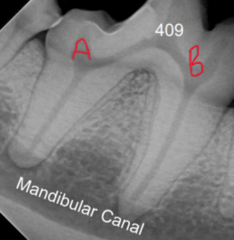
high
ON EXAM
Which side of this tooth is facing rostrally - the high or low side?

309
Which tooth is facing rostrally - 309 or 311?
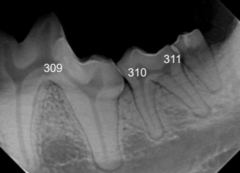
maxilla; palatine fissures
Is this the maxilla or mandible? How do you know?

right
Tooth 103 is on the [right/left] side of the maxilla

left
Tooth 202 is on the [right/left] side of the maxilla

left (maxilla)
Which side of the dog are we on?

205
Which tooth of the maxilla is facing rostrally - 205 or 207?

Nasal surface of the alveolar process of the maxilla
What are the arrows pointing to here?

208
Which tooth of the maxilla is facing rostrally - 208 or 210?
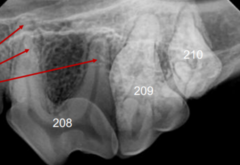
large concave root shape -> seeing buccal & lingual aspects at once due to how x-ray taken
Why does it look like there are 2 periodontal ligament spaces?

mandible; mandibular canal & teeth facing upward
Mandible or maxilla? Why?

A
Which side of the tooth is facing rostrally - A or B?

4th maxillary premolar
This is a large 3 rooted tooth known as the _____

11/15 = 0.733 = 73%
ON EXAM
What is the % of attachment loss?

rostral; right
Which way is the arrow facing - rostral or caudal? Which side of the patient are we on?

attachment loss
The distance from the alveolar margin (AM) to the cementoenamel junction (CEJ) relative to the length of the root is known as the _____
original alveolar margin
What does the blue line represent?

neck of tooth
The alveolar margin is located at what tooth landmark?
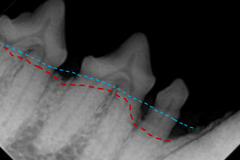
alveolar margin after periodontal disease attachment loss
What does the red line represent?

horizontal
What kind of bone loss is this?

vertical
What kind of bone loss is this?
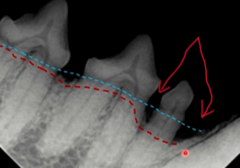
Due to lack of mineralization around mandibular symphysis
Attachment loss on mandibular incisor radiographs often over estimated.
Why?
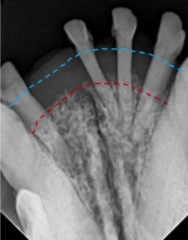
horizontal
What kind of bone loss is this?

periodontal ligament space
What is being evaluated here?

furcation
What is the arrow pointing to?

vertical
What kind of bone loss is this?

furcation bone loss
What is being evaluated here?

horizontal
Is this horizontal or vertical bone loss?

horizontal
A dog presents with an unhealthy mouth all around.
Is there likely to be horizontal or vertical bone loss?
vertical
A larger dog presents to you with calculus on their premolars and molars, with just a couple of "bad" teeth.
Is there likely to be horizontal or vertical bone loss?
true
T/F - Horizontal bone loss is rarely seen in dogs that don't have a full mouth of calculus and periodontal disease
vertical
Is this horizontal or vertical bone loss?

-Asymmetrically large root canal & pulp chamber
-Evidence of periapical lucency
-Loss of lamina dura
What are the signs of endodontic disease?

within the tooth
Endodontic disease is disease _____
-right tooth (to your left)
-large pulp chamber
Which tooth is diseased and how do you know?
-404
-tooth is "dead"/2nd dentin not being produced
What # tooth is this and what's wrong with it?

endodontic disease
What is likely going on?
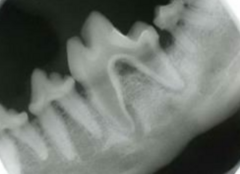
horizontal
What kind of bone loss is this?

lamina dura (normal)
What are the arrows pointing to?
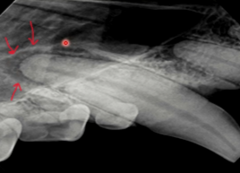
A
Which tooth needs to come out - A or B?

periapical lucency
What is this known as?

cats
Who likes to resorb their teeth more - cats or dogs?
-Periodontal ligament space & ligament apparent
-Extract tooth by making flap
-Use open, surgical technique
What things are associated with type 1 tooth resorption?

-Narrowing or disappearance of the periodontal ligament space in at least some areas
-Decreased radiopacity of part of the tooth
-Crown amputation with intentional root retention indicated
What things are associated with type 2 tooth resorption?
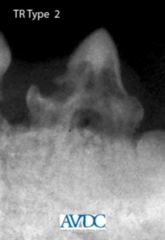
-Extract the root-segment
-Crown amputation for this root segment
What things are associated with type 3 tooth resorption?

mandibular premolars, often beginning in the roots
Where is tooth resorption mostly seen in dogs?

just monitor
What can we do for a resorbed tooth that doesn't extend near or above the level of the gingiva in a dog?
extract
What should we do for a resorbed tooth that extends into crown or is communicating with the oral cavity in a dog?
ankylosed
Dog resorbed teeth roots can be _____ (fused or stiffened)
tug or war
What kind of activity could have caused these fractured root tips?
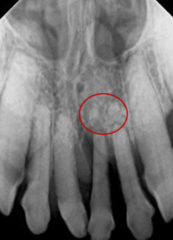
tooth root extends into mandibular canal -> can fracture jaw
A small breed dog presents for pre-extraction radiographs.
Why wouldn't you remove this tooth?
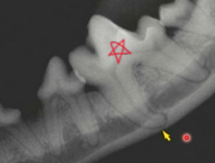
calculus
What is holding this tooth in?

horizonal
What kind of bone loss is this?
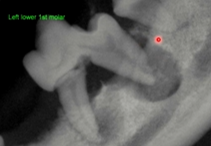
roots left behind
These are post-extraction radiographs.
What is the issue?
