OCC 501 Block 2 Review
 Call Kai
 Learn
 Practice Test
 Spaced Repetition
 Match
 Flashcards
 Knowt Play
1/207

There's no tags or description
Looks like no tags are added yet.
208 Terms
3 structural joint classifications
fubrous, cartilagenous, synovial
fibrous joint
immovable connective tissue, sutures of skull
cartilagenous joint
slighlty moveable, pubis symphysis or sternocostal
synovial joint
moveable, most joints
joint capsule purpose
surrounds joint cavity to stabilize joint
synovial joint bone role
stable moving pieces
synovial joint cartilage role
protective covering that reduces friction
cartilage blood supply
non vascularized, heals slowly
synovial joint capsule role
surrounds joint cavity and stabilizes joint
joint capsule blood supply
poorly vascularized
synovial joint synovial membrane role
lines joint capsule and secretes synovial fluid
synovial fluid blood supply
highly vascularized
synovial joint synovial fluid role
nourishes cartilage by moving in via tensile force and out via compression
synovial joint muscle role
contractile tissue, crosses joints to move bones
muscle blood supply
highly vascularized
synovvial joint nerves role
proprioceptive and pain input, control motor output
synovial joint blood vessels role
supplying muscles and bones around the joint
ligaments
connect bone to bone, stabilization
tendons
connect muscle to bone, transmit force
ball and socket joint
mobility, 3 axes

identify
ball and socket joint
ellipsoid joint
2 spoons, 2 axes

identify
ellipsoid joint
saddle joint
convex and concave aticulating surfaces, 2 axes

identify
saddle joint
hinge joint
flexion/extension, 1 axis

identify
hinge joint
pivot joint
rotating, one axis

identify
pivot joint
gliding joint
flat surfaces gliding, least movement but most stable joint

identify
gliding joint
open pack joint congruency
least
open pack ligaments
lax
open pack has greatest
mobility
open pack example
partial flexion
closed pack joint congruency
highest
closed back ligaments
taut
closed pack has greatest
stability
closed pack position
full extension

identify position
open pack

identify position
closed pack
end feel
quality of reistance felt when joint stops moving
end feel tells
what structure is stopping the motion
end feel common limiting structures
ligaments, capsule, tendon tension, bony contact, soft tissue
soft end feel cause
tissue approximation
firm end feel cause
stretch of muscle, capsule, or ligament
hard end feel cause
bone to bone contact
unexpected soft end feel cause
edema, synovitis
unexpected firm end feel cause
increased muscle tone, tight tissue
unexpected hard end feel cause
OA, hypertrophic ossification, SCI, burn injury complications
unexpected empty end feel cause
pain
elastic deformation
region where tissue will return to original shape after stress is removed
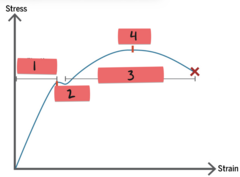
identify 1
elastic deformation
yield point
elastic limit and boundary between elastic and plastic region

identify 2
yield point
plastic deformation
permanent change in shape by bending and folding
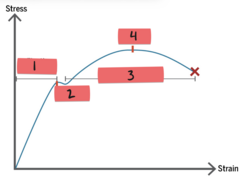
identify 3
plastic deformation
ultimate strength
tissue's maximum capacity

identify 4
ultimate strength
before ulitmate strength
tissue is intact but permanently damaged
after ultimate strength
tissue damage starts, decreased strength, rupture may occur
degrees of freedom
how many axes a joint can move in
contraindications to not complete ROM assessment (2)
joint dislocation or unheald fracture OR immediately post-surgery on soft tissue structures surrounding joints
ROM assessment precautions
hypermobility, recently healed injuries, active pain or inflammation, on pain meds or muscle relaxers, post-op precautions, osteoporosis
client factors limiting ROM
muscle weakness, scar tissue, arthritis, fractures, spasticity, pain, edema, soft tissue contracture
screening ROM assessment purpose
quick check for potential limitations
screening ROM categories
WFL, WNL, or full ROM assessment
occupation based ROM assessment
observing functional activity to see if formal ROM assessment is required
formal ROM assessment purpose
detailed measurement necessary to claify reason, extent, or cause of movement limitations
3 steps of ROM evaluation
explain and position pt, measure with goniometer, record measurement
explain and position patient
ask name + DOB, explain what you're doing and why, ask for permission to touch, position pt safely, move clothing, hand hygiene
measure active ROM
dmeonstrate motion and ask pt to peform, measure with gioniometer, measure PROM if AROM is limited
measure passive ROM
passively move limb until resistance or pain felt, measure final position with goniometer
record measurement
record starting position dash end position, PROM in ()
PROM
limb relaxed, if client cannot do enough AROM
PROM goal
maintain ROM and prevent adhesions
how many joints can PROM move
more than one
how many joints can AROM measure
1
AAROM
initiates movements but uses unaffected limb or device to move it through ROM
AAROM goal
maintain or improve joint mobility for those who can partially move a joint but not reach full range without help
static stretching
end range held for 15-30 seconds
static stretching most effective when
tissue is warm
static stretching goal
promote elastic deformation to increase ROM
no strain strain level
tissue maintained in position for long period of time with no force applied
no strain con contracile tissue behavior
increased connective tissue density
elastic deformation non contractile tissue behavior
collagen fibers stretch but return to resting length after force removed
plastic range non contracile tissue behavior
micro failure of collagen fibers with tissue remodeling/adaptation
ultimate strength non contractile tissue behavior
macrofailure of collagen fibers, tissue tearing
intervention priority with at trick of losing PROM or limited AROM
PROM, positioning, splinting, AROM
intervention priority permanent limited ROM
rehabilitative FOR strategies
internvetion for limited PROM
stretching
intervention for limited AROM
increase strength and endurance
WFL/WNL ROM intervention focus
ROM not a goal area
3 types of muscle tissue
cardiac, smooth, skeletal
skeletal muscle functions (5)
force production, protection, fluid circulation, heat production, emotional expression
excitability
ability to respond to stimuli for contraction
4 characterisitcs of skeletal muscle
excitability, contractility, extensibility, elasticity
contractility
ability to contract and generate force
extensibility
ability to stretch or lengthen when force applied
elasticity
ability to return to resting length when stretching or shortening force is removed