Contingency Planning and DRRM Vocabulary
 Call Kai
 Learn
Learn Practice Test
 Spaced Repetition
 Match
Match Flashcards
1/16

Earn XP
Description and Tags
Vocabulary flashcards on Contingency Planning guidelines, DRRM terms, technical agencies, and organizational structures.
Name | Mastery | Learn | Test | Matching | Spaced | Call with Kai | Chat |
|---|
No analytics yet
Send a link to your students to track their progress
17 Terms
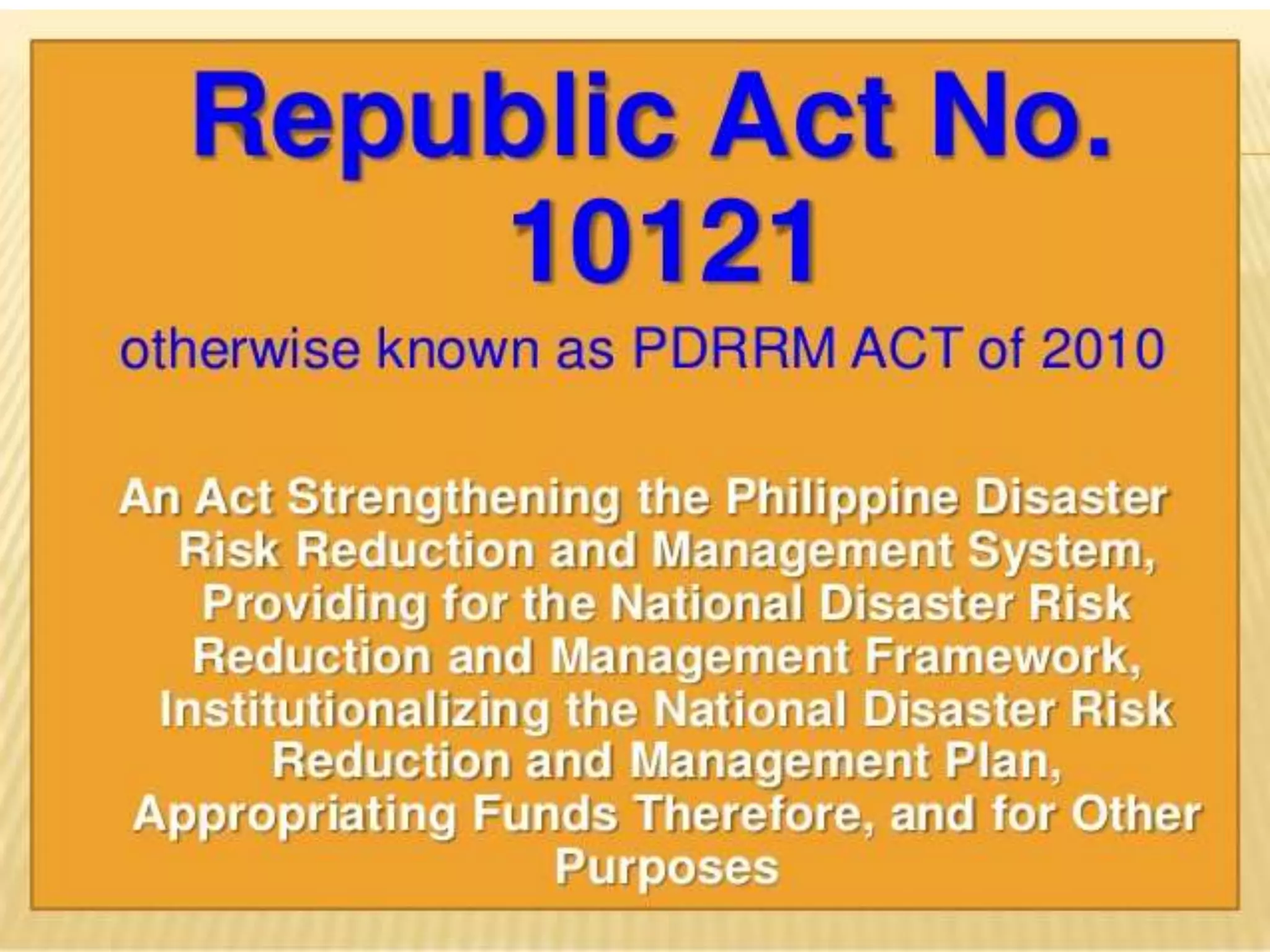
Republic Act (RA) 10121
The 'Philippine Disaster Risk Reduction and Management Act of 2010,' enacted on 27 May 2010, which paved the way for the institutionalization of the proactive DRRM approach.
Disaster Risk Reduction and Management (DRRM)
The systematic process of using administrative directives, organizations, and operational skills and capacities to implement strategies, policies and improved coping capacities in order to lessen the adverse impacts of hazards and the possibility of disaster.

Contingency Plan (CP)
A scenario-based plan for a specific and projected natural and/or human-induced hazard that aims to address its impacts to people, properties, and environment.

Crisis Management (CM)
Plans and institutional arrangements to engage and guide the efforts of government, non-government, voluntary and private agencies in comprehensive and coordinated ways to respond to crisis needs.

MYTH
Myth or Fact
Contingency Planning is expensive.
Capacity
A combination of all strengths and resources available within a community, society or organization that can reduce the level of risk, or effects of a disaster.

Emergency Operations Center (EOC)
A designated facility that is staffed and equipped with resources to undertake multi-stakeholder coordination, manage information, and facilitate resource mobilization in support of incident operations.

Incident Command System (ICS)
A standard, on-scene, all-hazard incident management concept that allows an integrated organizational structure to match demands without being hindered by agency or jurisdictional boundaries.

FACT
Myth or Fact
Contingency Plan should be prepared, developed, and disseminated to concerned agencies.

Pre-Disaster Risk Assessment (PDRA)
A hazard-specific, area-focused, and time-bound method to evaluate a hazard's level of risk given the degree of exposure and vulnerability in a specific area.

Rapid Damage Assessment and Needs Analysis (RDANA)
A disaster response tool used immediately in the early emergency phase to determine the extent of impacts and assess the priority needs of the communities.

MYTH
Myth or Fact
Contingency Plan is product oriented.

PAGASA
Philippine Atmospheric Geophysical and Astronomical Services Administration
Agency that provides technical expertise for hydro-meteorological hazards (complete name, not the abbreviation).
PHIVOLCS
Philippine Institute of Volcanology and Seismology
Agency that provides technical expertise for geological hazards (complete name, not the abbreviation).

TRUE
True or False
Contingency Plan is applicable to all forms of hazards.

TRUE
True or False
There should only be one Contingency Plan for every hazard.

TRUE
True or False
Contingency Plan is also applied as part of preparations for planned events.