Integumentary Tissue - Chad A&P Lecture
 Call Kai
 Learn
Learn Practice Test
 Spaced Repetition
 Match
Match Flashcards
 Knowt Play
1/61

There's no tags or description
Looks like no tags are added yet.
Name | Mastery | Learn | Test | Matching | Spaced | Call with Kai | Chat |
|---|
No analytics yet
Send a link to your students to track their progress
62 Terms
What are the main functions of the integumentary system?
Protection
Sensation
Temperature regulation
Vitamin D production
Excretion
What are the two main layers of the skin?
Epidermis → epithelial tissue
Dermis → connective tissue
Subcutaneous tissue (hypodermis) is underneat but not officially part of the skin
What are the important characteristics of the epidermis?
Made of epithelial tissue
avascular → no direct blood supply
Innervated → has nerve endings
Gets nutrients through diffusion
Separated from the dermis by the basement membrane
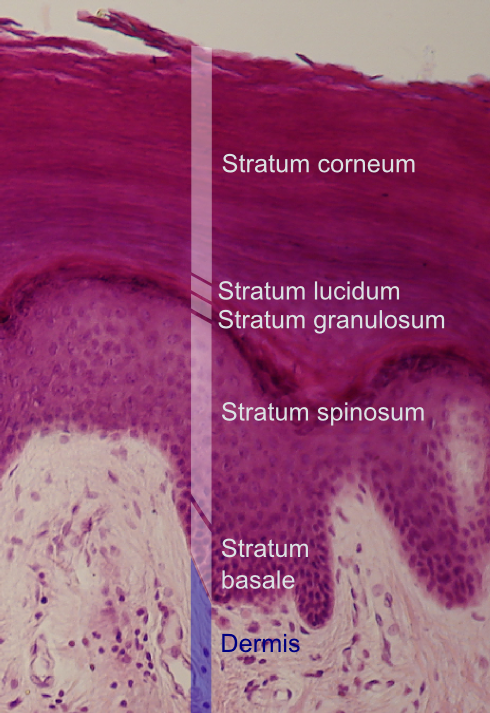
Identify the layers of the epidermis from deep to superficial
stratum basale → stratum spinosum → stratum grandulosum → stratium lucidum → stratum corneum
What does the integumentary system protect the body from?
Physical injury, ultraviolet radiation, microorganisms, and water/fluid loss
What are the two main layers of skin?
Epidermis → epithelial tissue
Dermis → connective tissue
What is the subcutaneous tissue(hypodermis)?
Loose connective tissue, especially adipose tissue, located below the dermis. It is not officially part of the skin
What separates the epidermis from the dermis?
The basement membrane
What are the four major cell types of the epidermis?
Keratinocytes, melanocytes, epidermal dendritic cells, and Merkel (tactile) cells
What are keratinocytes?
The most common cells of the epidermis. They produce keratin, which provides strength and helps prevent water loss
What are melanocytes?
Cells that produce melanin, which contributes to skin color and protects against ultraviolet radiation
What do epidermal dendritic cells and Merkel cells do?
Epidermal dendritic cells → immune defense
Merkel cells → detect light touch
What are the five epidermal layers from deep to superficial?
stratum basale
stratum spinosum
stratum granulosum
stratum lucidum
stratum corneum
What happens in the stratum basale?
It is the deepest epidermal layer. Cells divide rapidly by mitosis to produce new epidermal cells
How is the stratum basale attached to the basement membrane?
Hemidesmosomes attach the cells to the basement membrane. Desmosomes connect cells to each other
What happens when a cell in the stratum basale divides?
One daughter cell remains attached to the basement membrane while the other moves toward the surface
How quickly are epidermal cells replaced according to the lecture?
Basal cells divide about every 19 days, and a cell takes about 40-56 days to travel from the stratum basale to the surface
What happens in the stratum spinosum?
Living keratinocytes remains metabolically active and develop lamellar bodies. It is about 8-10 layers thick
What are lamellar bodies?
Lipid-filled structures that help form the skin’s water barrier
What happens in the stratum granulosum?
Cells become flatter accumulate keratohyalin granules, and begin dying

Why do epidermal cells die as they move toward the surface?
They become too far from the dermal blood supply to receive enough nutrients by diffusion
What is the stratum lucidum?
A clear layer found only in the thick skin
What are calluses and corns?
Callus → thickening of the stratum corneum from repeated friction
Corn → localized thick callus over a bony prominence
Do people with different skin colors have different numbers of melanocytes?
No. Melanocytes package melanin into melanosomes, which are transferred into keratinocytes. Everyone has the same amount of melanocyte, just produce different type of melanin
What stimulates melanocytes to produce more melanin?
Ultraviolet radiation. More ultraviolet exposure stimulates more mlanin production.
What is the relationship between melanin, ultraviolet radiation, and vitamin D?
More melanin provides greater protection from ultraviolet radiation, but it also decreases ultraviolet penetration needed to begin vitamin D production.
What are the three skin cancers discussed in lecture?
Basal cell carcinoma, squamous cell carcinoma, and melanoma
What is basal cell carcinoma?
Cancer involving cells of the stratum basale. It is the most common skin cancer discussed in lecture
What is squamous cell carcinoma?
Cancer involving squamous epidermal cells; associated with the stratum spinosum
What is melanoma? Why is it especially dangerous?
Cancer of melanocytes. It can metastasize because melanocytes are near the basement membrane and the blood vessels of the dermis.
ABCDE?
A → Asymmetry
B → Border irregularity
C → Color variation
D → Diameter greater than 6 millimeters
E → Evolving/changing
What structures are found in the dermis?
Blood vessels, nerves, hair follicles, smooth muscle, glands, and lymphatic vessels
What are the two layers of the dermis?
Papillary layer → superficial
Reticular → deeper
What are the dermal papillae?
Finger-like projections of the papillary dermis into the epidermis. Their arrangements helps form fingerprints
What are Meissner corpuscles?
Sesnsory receptors in the papillary dermis that detect light touch.
What is the reticular layer made of, and why?
Dense irregular connective tissue because the skin needs to resist pulling forces from many directions.
What are Pacinian (lamellated) corpuscles?
Deeper sensory receptors that detect deep pressure
How does bleeding differ between epidermal and dermal injuries?
Epidermis only → no bleeding because it is avascular
Into dermis → bleeding because the dermis contains blood vessels
What are cleavage lines?
Lines created by the orientation of collagen and elastic fibers. Surgical cuts made parallel to them generally heal better
What causes stretch marks?
Excessive stretching of skin that affects connective tissue along cleavage lines.
What are the three types of hair?
Lanugo → fine fetal hair
Terminal hair → long, coarse, pigmented hair
Vellus hair → fine, short body hair
What are the hair shaft and hair root?
Shaft → part above the skin
Root → part below the skin
What is hair made of, and what determines its color?
Hair is made of dead, keratinized cells. Its color is determined by melanin
What is the hair papilla?
A projection at the base of the hair containing blood vessels that provide nutrients for hair growth.
What is the arrector pili muscle?
An involuntary smooth muscle attached to hair follicle that causes the hair to stand up.
What are the three skin glands discussed in lecture?
Sebaceous glands, apocrine sweat glands, and eccrine sweat glands.
What are sebaceous glands?
Holocrine glands that release sebum (oil) into hair follicles to lubricate the hair and skin
What are aprocine sweat glands?
Sweat glands that:
Empty into hair follicles
Are common in the axillae and genital regions
Become active at puberty
Are not primarily for temperature regulation
Why is apocrine sweat associated with body oder?
The secretion itself is not strongly odorous. Bacteria acting on the secretion produce the odor.
What are eccrine sweat glands?
Sweat glands that open directly onto the skin surface and primarily help regulate body temperature. They are especially abundant on the palms and soles.
What are nails made of?
Dead, keratinized cells
How does the skin regulate body temperature through blood vessels?
Superficial blood vessels dilate → more heat loss
Superficial blood vessels constrict → less heat loss
Where does vitamin D production begin?
In the skin. Further processing occurs in the liver and kidneys.
What is the difference first-, second-, and third-degree burns?
First-degree → primarily epidermis
Second-degree → epidermis + part of dermis
Third-degree → full thickness of skin and may extend into subcutaneous tissue
Why can the center of a third-degree burn have little to no pain?
The sensory nerve endings, in that area may have been destroyed.
Why tattoo ink placed in the dermis instead of the epidermis?
Epidermal cells are continually replaced and shed. The dermis turns over much more slowly, allowing the tattoo to remain
How does tattoo ink stay in the dermis?
Macrophages engulf the ink particles but cannot easily remove them, so pigment-containing macrophages remain in the dermis. Over time, pigment redistribution can make tattoos fade or blur

Identify the papillary and reticular layers of the dermis
Papillary = superficial and contains dermal papillae. Reticular = deeper and thicker
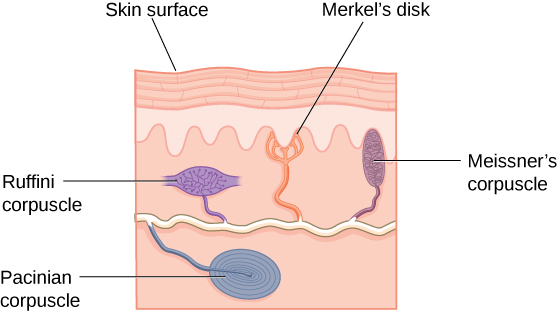
Identify Meissner vs. Pacinian corpuscles
Meissner = superficial, light touch. Pacinian = deeper, deep pressure

Identify a sebaceous gland
Oil-producing gland connected to and emptying to a hair follicle

Identify eccrine vs. apocrine sweat glands
Eccrine → duct opens directly onto skin surface
Apocrine → duct opens into a hair follicle

Identify the arrector pili muscle
Small band of smooth muscle attached to a hair follicle