Week 2 Causation and Development
 Call Kai
 Learn
Learn Practice Test
 Spaced Repetition
 Match
Match Flashcards
 Knowt Play
1/54

There's no tags or description
Looks like no tags are added yet.
Name | Mastery | Learn | Test | Matching | Spaced | Call with Kai | Chat |
|---|
No analytics yet
Send a link to your students to track their progress
55 Terms
what two body systems can respond to a stimulus
Nervous system (CNS, PNS, ANS)
Endocrine system
what type of response involves both nervous and endocrine systems
A neuroendocrine response
How can experience influence behaviour responses
Learned response
Cognitive response
how can experience affect an innate response
Heightening / waning of an innate (instinctive) response
What is a neuroendocrine response?
A response where neural signals trigger hormone release, linking the nervous and endocrine systems.
What does experiential mean in behaviour?
A response shaped or modified by previous experience or learning.
How many Cranial nerves are there and what are they split up into
12
Split into:
Sensory
Motor
Mixed
What do the sensory nerves do
These nerves carry sensory information to the brain and are responsible for the special senses of smell, sight, and hearing/balance.
What do the motor nerves do
These nerves carry motor commands from the brain to where they need to be effective.
What do the mixed nerves do
These nerves contain both sensory and motor fibers, performing a variety of functions.
How does sensory input from cranial nerves affect animal behaviour?
Causes behavioural response
Carry sensory information (vision, smell, taste, hearing, balance, touch) to the brain. These inputs are critical for an animal’s perception of their environment, as well as to recognise threats, find food, and engage in social interactions.
How does motor output from cranial nerves affect animal behaviour?
Causes expression of behaviour
Control muscles of the eyes, face, tongue, pharynx, and larynx. These allow animals to orient toward stimuli, vocalise, feed, groom, display emotions, or defend themselves.
How does autonomic regulation influence animal behaviour?
Causes motivation & arousal
Influence visceral states such as heart rate, digestion, breathing, which in turn affect motivation, stress, and readiness to act.
How many factors cause behaviour and what are they
Internal
External - Biotic, Abiotic
Context dependant
Errors
what are the internal factors for behaviour
Biological rhythms
Motivations: either homeostatic or non-homeostatic.
What are biological rhythms?
Internal cycles that help organise behaviour across daily or seasonal time periods.
Daily time schedules are reset by what?
Zeitgebers- Environmental “time-givers” that reset biological rhythms, such as light.
How can annual biological rhythms influence behaviour?
They help animals time seasonal behaviours such as migration or reproduction.
What are motivations in animal behaviour?
Internal states that drive behaviour.
What are the two broad types of motivation?
Homeostatic and non-homeostatic motivation.
What is homeostatic motivation?
Behaviour driven by the need to maintain stable internal conditions, e.g. hunger or thirst.
What is homeostasis?
The active maintenance of relatively stable internal conditions.
Does not stagnate- never stops
Dynamic stability/equilibrium- Internal conditions constantly change and are continuously regulated.
Coordinated response- coordinated between cns, ans, pns-Different body systems working together to regulate internal conditions.
who gave us the now accepted definition of homeostasis
Cannon
not stagnation
dynamic stability
coordinated response
Does behaviour always promote homeostasis?
Behaviour doesnt always promote homeostasis, Normal homeostatic mechanisms may be over-ridden if changes to behaviour increase overall fitness.
what are circadian rhythms and give an animal example
biological rhythms that are synchronised to a 24-hour cycle.
Monarch butterfly- Danaus plexippus- flies between Mexico and Canada, only flies when it’s warm and there are flowers around to provide nectar. Some end up swept off course from winds- end up in canary islands- loss of migratory urge due to lack of need to migrate.
How does homeostasis regulate behaviour?
–Hunger and thirst.
–Temperature regulation.
What is the Red kangaroo (Macropus rufus) response to heat
Salivate over four limbs and stand in direction of wind to evaporate and cool down. Short term adaptation
Dig a shallow trough and spread itself as far as possible, Sand down below is cooler. Long term adaptation
What are the Biotic and Abiotic external factors
Biotic (living factors)
Population density
Sex ratio
Abiotic (non living physical factors)
Light
Temperature
Tide
Landmarks, features in a habitat
Give an animal example of the biotic factor population density
Desert locust (Schistocerca gregaria)
.As population changes, behaviour changes. Locust literally changes colour and behavior. Same species, different phenotype depending on social factors at the time.

Give an animal example of the abiotic factor landmarks, features in a habitat
Indigo bunting (Passerina cyanea). Bird moves into different areas, bird knows where to be and what time of year.

What are context dependant factors
•Alteration of a reaction to a stimuli with time.
•The animal is able to differentiate between stimuli to produce the most appropriate response, save energy and increase survival.
give an animal example of context dependant factors
Whooper swan (Cygnuscygnus).
Tracking swans movement from Iceland to UK. Swans have excellent parental care. Birds have to predict the weather in scotland whilst in iceland because cygnets cant fly in stormy bad weather.

what are errors in behavioural responses and give animal examples
•Misconception or misidentification of a stimuli.
–swans and motorways.Birds think motorways are rivers as they glisten.
–Hatchling turtles. Hatch at midnight, sees moon- able to get to the sea, no moon, no ability to return.
–Newly-emerged mayflies. Live for 24hrs to reproduce, cant fufill their lifecycle if they drift away from rivers.
How can human activity cause behavioural errors in animals and give example
Animals may mistake rubbish for food or other biologically relevant stimuli. eg Pelicans confusing water bottle for fish.
How does a behaviour change over an individual’s lifetime?
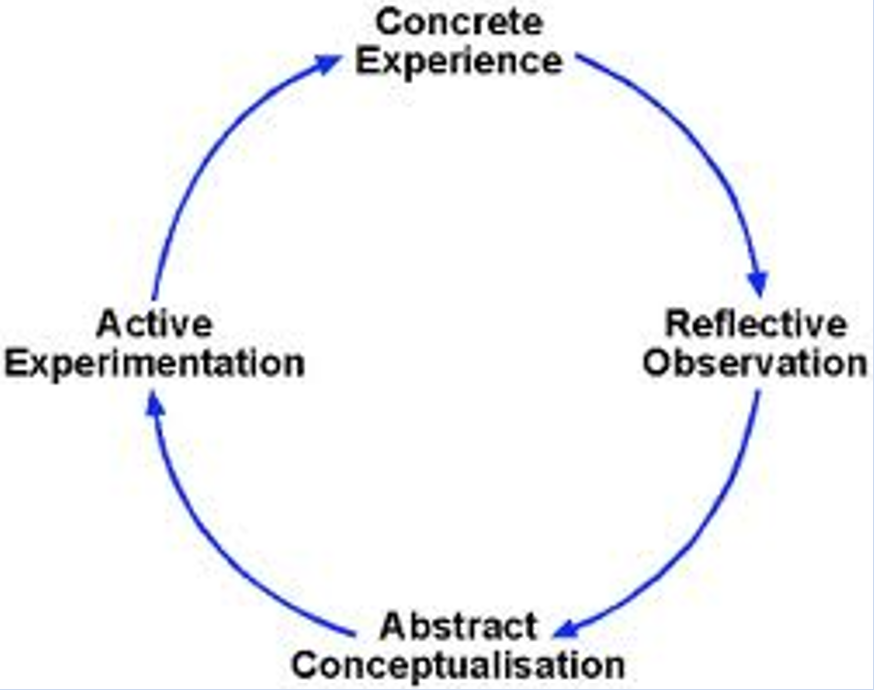
why would learning develop (4 points )
•Learning from others permits spread of behaviours faster than genetic inheritance.
•Learning from others permits horizontal, as well as vertical transmission of behaviours.
•Especially useful for common behaviours in a changing environment.
•Development and change of behaviour occurs due to copying errors.
The 6 types of learning
Innate behaviour
Maturation
Chance
Self learning
Learning from others
Insight learning
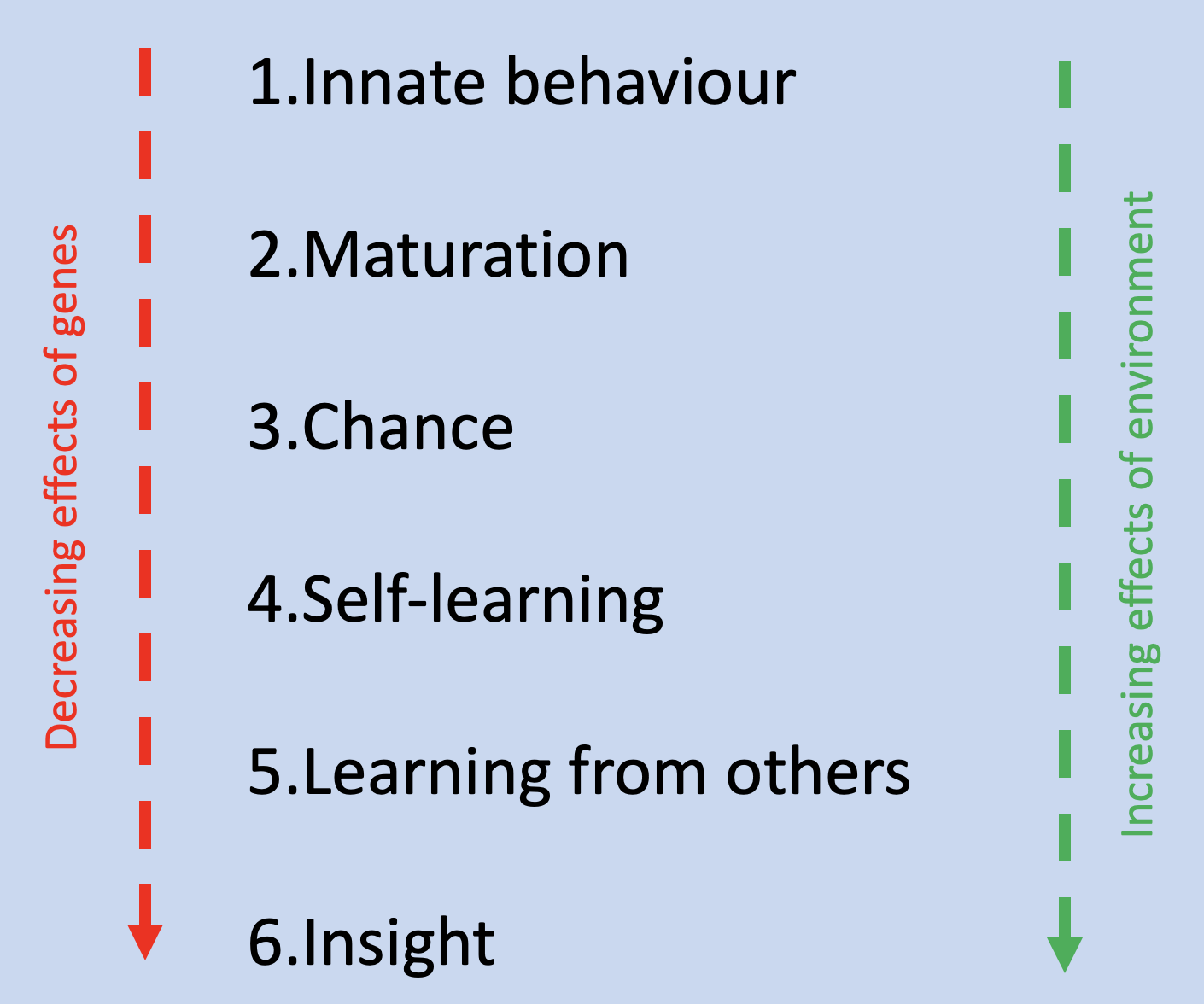
who conducted a study on innate behaviour and what was it
Lorenz
Placed behaviour within the context of the entire species (a move away from the lab-based approach of the comparative psychology movement in the USA).
Goose sees egg outside next and retrieves it.
Goose completes same sequence of motion even when egg is removed

What are the key takeaways from innate behaviour research
An instinctive behavioural sequence that is highly stereotyped and species-characteristic.
•Fixed action patterns are most likely produced by the innate releasing mechanism (releaser).
•Once released, a fixed action pattern runs to completion
What is a fixed action pattern and what are they produced by
An instinctive behavioural sequence that is highly stereotyped and species-characteristic.
•Fixed action patterns are most likely produced by the innate releasing mechanism (releaser).
•Once released, a fixed action pattern runs to completion.
give two other animal examples of a fixed action pattern in innate behaviour
Red dot on beak of herring gull- when tapped, bird regurgitates. So used for feeding chicks.
Three spined stickleback males will build nest for females and build it to completion even when females lose interest.
How many characteristics of a fixed action pattern according to Lorenz and what are they
6
Stereotyped
Complex
Species characteristics
Released
Triggered
Independent of experience
Two classifications of stimuli
•Sign stimulus or releaser:
The essential cues needed to allow a fixed-action pattern to be performed.
Presence of a specific characteristic, identified by the animal = behaviour.
•Supernormal stimulus:
–Elicits an exaggerated response.
Apply an animal example to Lorenz 6 characteristics and the types of stimulus
Stereotyped – the warbler performs a predictable feeding response when the chick begs.
Complex – feeding involves a coordinated sequence: finding food, returning to the nest and placing food into the chick’s mouth.
Species-characteristic – parental provisioning (parent feeding baby) is a typical behaviour of reed warblers during breeding.
Released – the cuckoo chick opens beak, the warbler’s feeding behaviour is released.
Triggered – those stimuli activate the warbler’s parental-feeding response.
Independent of experience – the basic tendency to respond to begging chicks does not have to be learnt from scratch.
supernormal stimulus: cuckoo chicks can produce unusually strong begging signals, which may stimulate the host to feed them very intensely.
Explain Maturation of a behaviour
Behaviours change or start to be expressed at predictable stages as the individual ages.
Full behavioural repertoire is developed to enhance the fitness of the adult animal.
Give animal example of maturation of behaviour
Satin bowerbird (Ptilonorhynchus violaceus)
Birds will decorate courtship display area (Bower)
Gonads (testes) develop- circulating testosterone rises- plumage (feathers) colour change - bower building begins.
Researchers experimentally increased testosterone- a quick change in plumage but poor quality bower overall.
Due to when the male bird developing and looks like a female so wont be chased away by other males building Bowers, it can watch and learn.
This is an example of Hormonal changes changing behaviour

Explain behaviour development by chance and give an animal example
Behaviour is determined by a single (or few) specific environmental event experienced at a crucial stage in life. E.g.
temperature
diet
Studied in reptiles who bury eggs in sand. Temp dependent sex ratios, eggs in cooler part of nest= female, eggs in warmer part of nest=males. Climatic change heating nest to same warm temperature changing proportion of male/female

Explain self learning
Behaviours change as the individual repeats them, modifying their actions in response to experienced outcomes.
Imprinting.
Conditioning.
Habituation.
Discriminative learning.
Associative Learning.
Animal imprinting example
Great/Bluetits (Paridae)
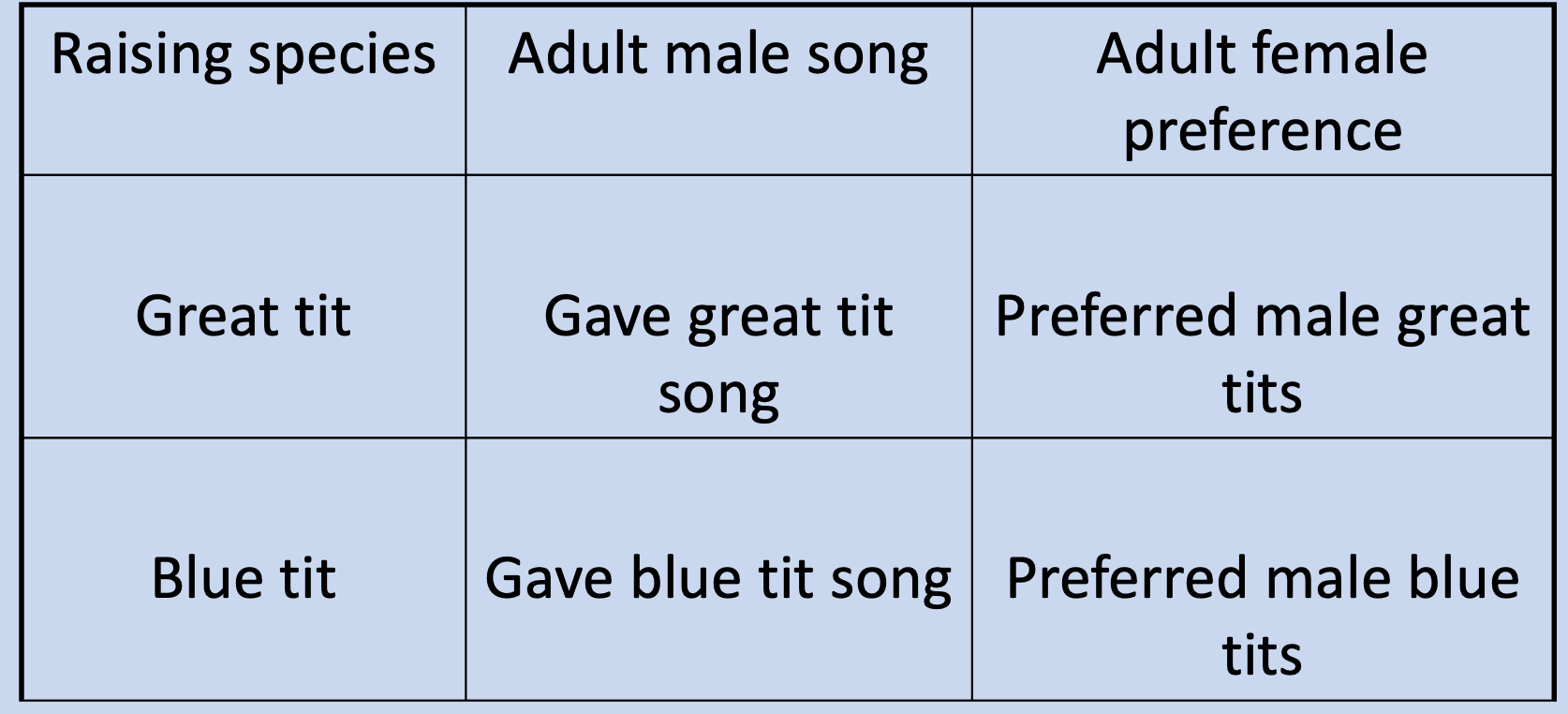
Animal conditioning examples
Edward Thorndike’s puzzle box ~1905; instrumental in the creation of his ‘Law of Effect’.
Skinner’s box (developed 1930-1931) to provide an insight into the time take to problem solve.
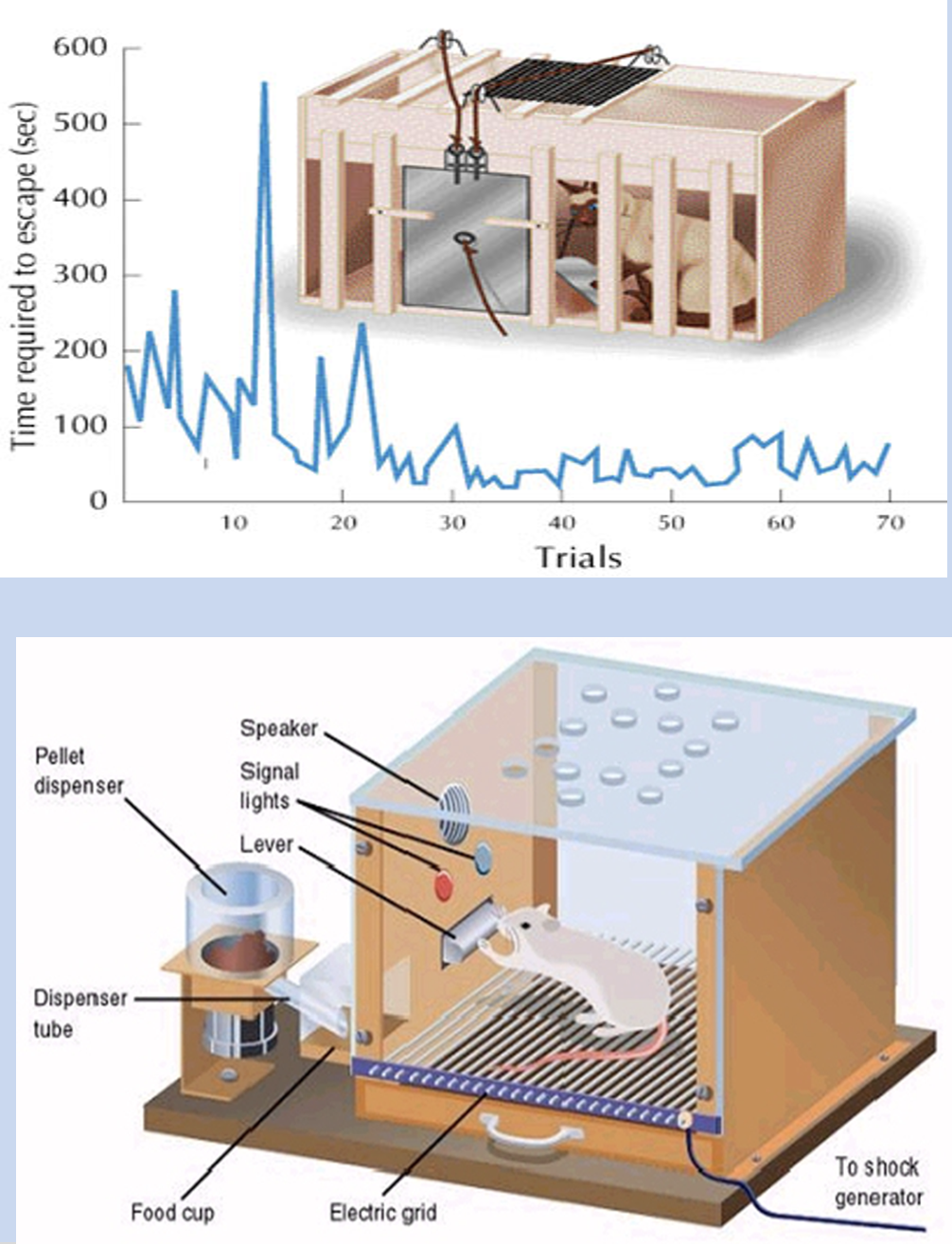
Explain Habituation
A reduced response to a repeated, harmless stimulus.
The animal initially responds because the stimulus might matter. But after experiencing it repeatedly without any consequence, responding becomes less useful. Continuing to react would waste time and energy, so the response wanes.
That makes habituation adaptive because animals can ignore irrelevant background information while remaining responsive to genuinely important stimuli.
This links to context-dependent behaviour: an animal does not have to give the same response every time it encounters a stimulus.
Explain Dishabituation
The response returns after a novel/strong stimulus.
give an animal example of habituation and dishabituation
Humphrey studied the freshwater snail Lymnaea stagnalis.
When the snails repeatedly received harmless visual or mechanical stimuli, their withdrawal responses became less frequent and smaller — habituation.
Then, when a new or stronger stimulus was presented, the withdrawal response became strong again.That recovery of the response is dishabituation.
What is discrimination learning and apply it to the real world
Learning to make different responses to different stimuli.
Instead of learning:
For example, an animal might learn:
Stimulus A → food → approach it
Stimulus B → no food → don't approach it
In the real world an animal may need to distinguish between:
edible and poisonous food
a predator and a harmless animal
its own offspring and another individual
a suitable and unsuitable mate
a signal that predicts food versus one that doesn't
So its evolutionary advantage is responding selectively rather than wasting energy reacting identically to everything.
Who contributed ideas to discrimination learning and what did they suggest
Spence
Discrimination develops gradually through experience. Responses to rewarded stimuli become stronger, while responses to unrewarded stimuli become weaker/inhibited. His work contrasted with theories suggesting that animals suddenly “figure out” the correct solution.
Animals learn which stimuli predict useful outcomes and adjust their responses accordingly.