the heart
 Call Kai
 Learn
 Practice Test
 Spaced Repetition
 Match
 Flashcards
 Knowt Play
1/16

There's no tags or description
Looks like no tags are added yet.
17 Terms

1
aorta

2
left pulmonary artery

3
Left pulmonary vein

4
Left atrium

5
Bicuspid valve

6
Left ventricle

7
Septum

8
Right ventricle

9
Inferior vena cava

10
Semilunar valves

11
tricuspid valve

12
Right atrium

13
Right pulmonary vein

14
Right pulmonary artery
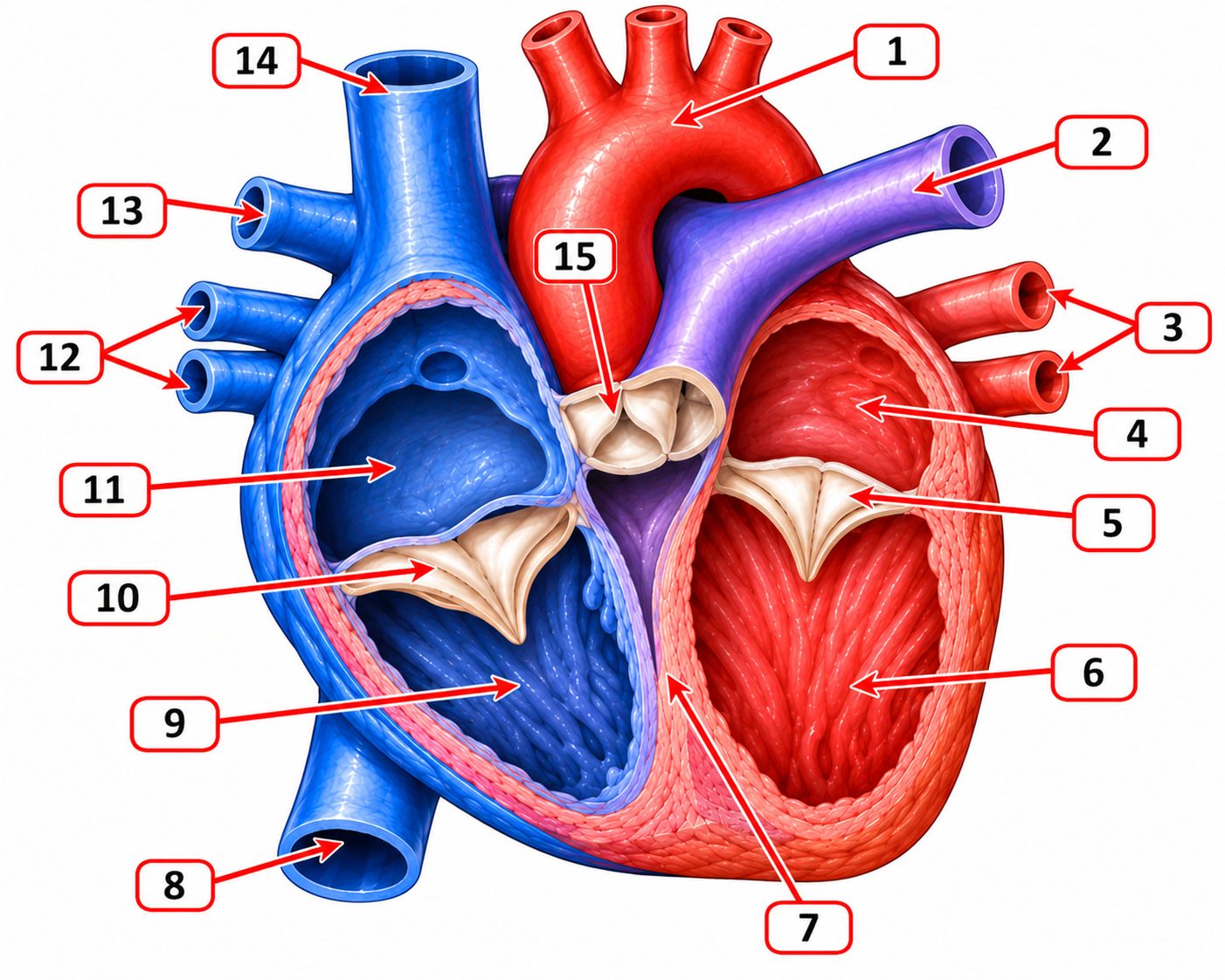
15
Superior vena cava
Starting from an ending with right atrium, trace the flow of blood through the heart and body by numbering the following in the correct order
One – right atrium, two – right ventricle, three – pulmonary artery, four – lungs, five – pulmonary veins, six – left atrium, seven – left ventricle, eight – aorta, nine – body cells, 10 – vena cava
How does the heartbeat work?
The heart beats the heart beats regularly because it has its own pacemaker. The pacemaker is a small region of muscle called the sinoatrial, SA node. It is in the upper back wall of the right atria. The SA no triggers an impulse that causes both atria to contract. Very quickly the impulse reduce the intro, ventricular, or AV note at the bottom of the right atrium. Immediately, the AV, no triggers and impulse that causes both ventricles to contract.