skull bone
 Call Kai
 Learn
 Practice Test
 Spaced Repetition
 Match
 Flashcards
 Knowt Play
1/25

There's no tags or description
Looks like no tags are added yet.
26 Terms
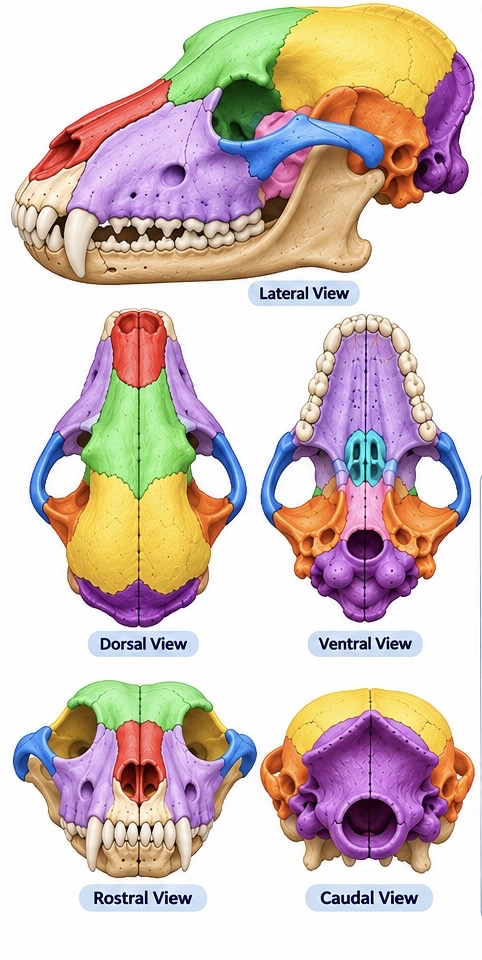
Which bone is represented by the GREEN color in the lateral skull view?
Frontal bone. It forms part of the dorsal cranial roof and contributes to the orbital roof.
What is the main function of the Frontal bone?
It protects the frontal region of the brain, forms part of the cranial cavity roof and contributes to the roof of the orbit.
Which bone is represented by the YELLOW color?
Parietal bone. It forms part of the dorsal and dorsolateral walls of the cranial cavity.
What is the main function of the Parietal bone?
It forms the cranial vault, protects the brain and provides attachment areas for muscles and fascia.

Which bone is represented by the RED color in the rostral dorsal skull?
Nasal bone. It forms the dorsal boundary or roof of the nasal cavity.
What is the main function of the Nasal bone?
It provides bony protection to the dorsal nasal region and supports the external shape of the nose.
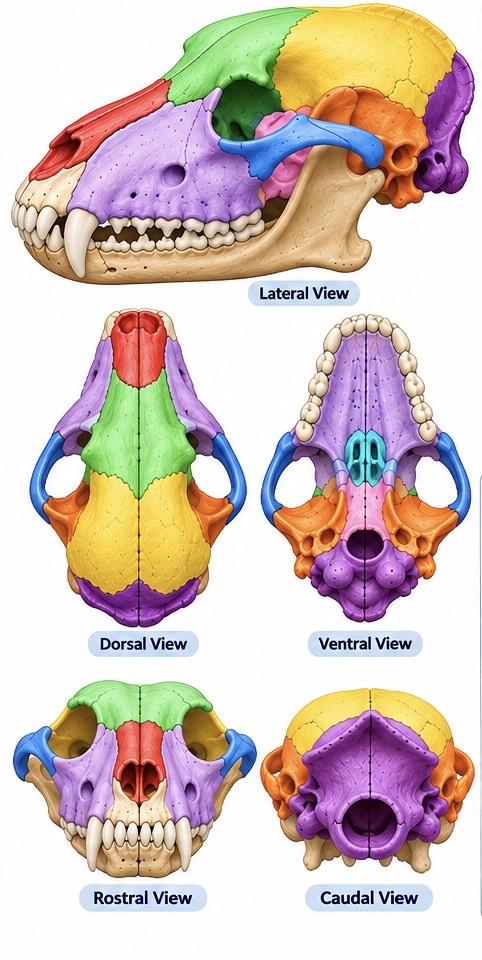
Which bone is mainly represented by the ORANGE region?
Temporal bone region. It forms part of the lateral and ventral cranium and contains structures associated with hearing and balance.
What are the main functions of the Temporal bone?
It houses parts of the middle and inner ear, contributes to the temporomandibular joint and forms part of the zygomatic arch.
Which bone contains the external acoustic meatus?
Temporal bone. The external acoustic meatus is the opening leading into the external ear canal.
Which bone contains the tympanic bulla?
Temporal bone. The tympanic bulla encloses the middle ear cavity.

Which facial bones are represented in the PURPLE facial region?
Primarily the Maxilla and Zygomatic bone regions. Purple is used for more than one bone in this illustration.
What is the main function of the Maxilla?
It forms the upper jaw, supports the upper cheek teeth, contributes to the hard palate and forms part of the lateral wall of the nasal cavity.
What is the main function of the Zygomatic bone?
It forms the cheek region, contributes to the zygomatic arch and forms part of the lateral orbital boundary.
Which bones form the Zygomatic arch?
The Zygomatic bone and the Zygomatic process of the Temporal bone.
What is the function of the Zygomatic arch?
It provides attachment and support for muscles involved in mastication, especially the masseter muscle.

Which bone is represented by the PURPLE region surrounding the foramen magnum in the caudal view?
Occipital bone. The caudal purple region represents the occipital region, not the same facial bones shown in purple laterally.
What is the main function of the Occipital bone?
It forms the caudal part of the skull, surrounds the foramen magnum and contains the occipital condyles.
What is the function of the Foramen magnum?
It provides passage for the spinal cord and associated structures between the cranial cavity and vertebral canal.

Which bone is represented by the BEIGE lower jaw region?
Mandible. It forms the lower jaw and supports the lower teeth.
What is the main function of the Mandible?
It supports the lower teeth and moves during mastication through the temporomandibular joint.
Which bone articulates with the Mandible at the temporomandibular joint?
Temporal bone, specifically its mandibular fossa.
How many permanent teeth are present in an adult dog?
42 permanent teeth.
How many permanent teeth are present in an adult cat?
30 permanent teeth.
Which species has a relatively larger tympanic bulla?
The cat. The feline tympanic bulla is particularly large and is divided internally into two compartments by a bony septum.
What is the main difference between the dog and cat skulls in terms of overall shape?
The canine skull shows considerable variation in shape between breeds, while the feline skull is generally shorter and broader in the facial region.