ECO 111 Units 1-4
 Call Kai
 Learn
Learn Practice Test
 Spaced Repetition
 Match
Match Flashcards
 Knowt Play
1/58

There's no tags or description
Looks like no tags are added yet.
Name | Mastery | Learn | Test | Matching | Spaced | Call with Kai | Chat |
|---|
No analytics yet
Send a link to your students to track their progress
59 Terms
What can be said about the models that economists use to make predictions or to explain economic phenomenon
The models are based on observed behavior (data) of how people and businesses have actually behaved in the past
Economics is called an empirical science because
economists study real-world evidence (data) to test and revalidate their models to ensure that their models are accurate and predictive.
How do economists ensure that their models are useful?
Economists continuously validate their economic models i.e. continuously obtain evidence to test the usefulness of the model i.e. does it yield accurate predictions
why do we call Economics an empirical science
Empirical means that evidence (data) is looked at to see whether the model is right
The highest value next best alternative sacrificed to obtain something you want is referred to as
opportunity cost

In the figure below, which of the following points indicates the efficient use of resources?
b

In the figure below, which of the following points is impossible given the level of resources?
h

In the figure below, which of the following points indicates an inefficient use of resources?
f
Economic growth shifts the production possibilities curve outward
true
When a nation invests in Capital Goods, it is usually true that
it must forego some current consumption in the present
whenever the economy is operating on the PPC we say its production is
efficient
A point outside of the PPC is
impossible
what are the fundamental assumptions that underlie economic theory?
self - interest, rationale, incentives
macroeconomics
big picture/broad effects
microeconomics
small economic units, behaviors of individual households/firms
how do nations achieve economic growth?
investment in capital goods
examples of capital goods?
office equipment, computers, human capital (education)
consumption goods
goods produced for personal satisfaction (in the present)
capital goods
goods used to produce other goods (for future consumption)
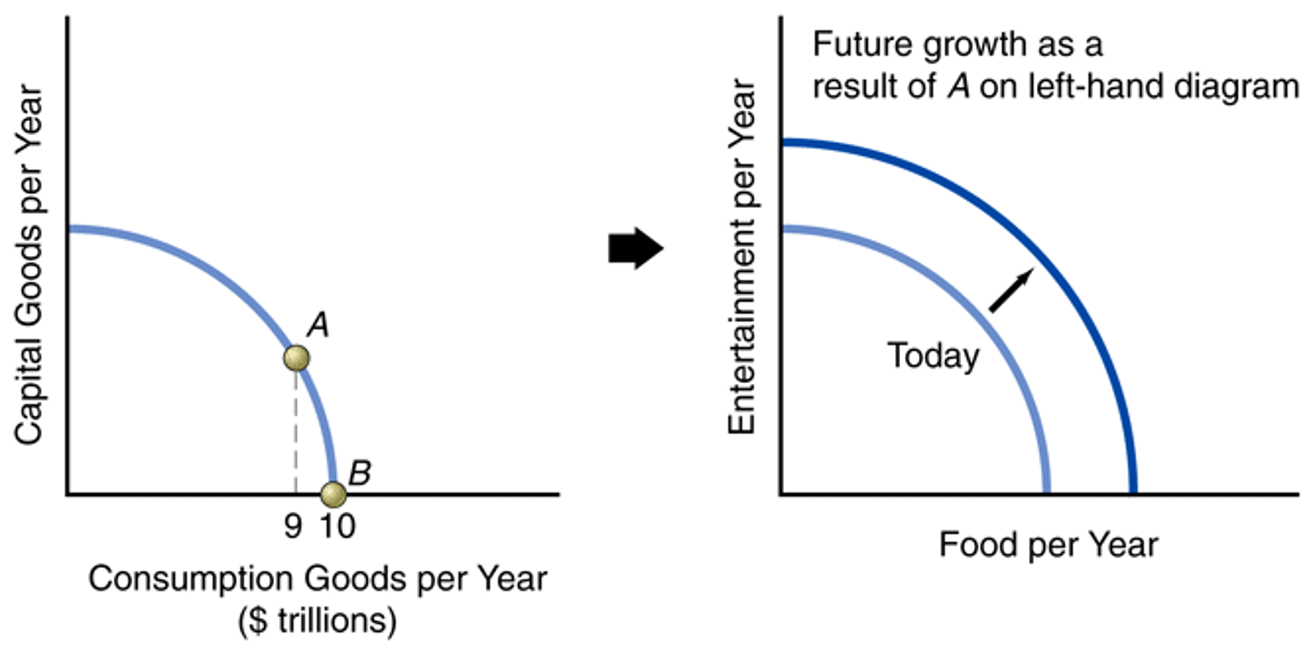
What is the result of foregoing current consumption and instead investing in Capital Goods ?
Economic Growth - more of all goods may be produced and consumed in the future
Economic growth shifts the production possibilities curve
outward
Generally, specialization and division of labor leads to
greater productivity and economic growth.
The Law of Demand states
As price increases, quantity demanded decreases, all other things equal
The law of demand implies that the demand curve
has a negative slope
Which change causes a movement along the demand curve
price changes
5 “non-price” factors that impact demand
consumers income, tastes/preferences, price of related goods, expectations of future prices/incomes, market size
increased income
Demand Curve Shifts Right (Normal Good)
decreased income
Demand Curve Shifts Left (Normal Good)
Tastes Change in favor of product
Demand Curve Shifts Right
Tastes Change disfavoring of product
Demand Curve Shifts Left
price of related good substitute increase
demand curve shifts right
price of related good compliment increase
demand curve shifts left
price of related good substitute decrease
demand curve shifts right
price of related good compliment decrease
demand curve shifts right
expect future prices to increase
demand curve shifts right
expect future prices to decrease
demand curve shifts left
increase # of buyers
demand curve shifts right
decrease # of buyers
demand curve shifts left
normal goods
Goods for which demand rises as income rises; most goods are normal goods e.g. steak
inferior goods
Goods for which demand falls as income rises e.g. beans
What are the two types of Related Goods ?
substitutes and compliments
substitutes
a change in the price of one good cause the demand for the two products to go in the opposite direction
compliments
change in the price of one good cause the demand for the 2 products to go in the same direction
The Law of Supply states that ____
there is a positive relationship between the price of any good and the quantity supplied, holding all other factors constant
Non-Price Factors that shift Supply:
cost of inputs, tech/productivity, taxes/substitutes, # of firms in industry
If the cost of cotton (an input cost) used in making blue jeans decreases, which of the following will occur?
The supply curve for jeans will shift rightward.
Which of the following causes a movement along a supply curve?
a change in price

If government sets the maximum legal price of gasoline at $2 per gallon, then the $2 limit acts as
a price ceiling
a price ceiling occurs
when the government sets the price below the equilibrium price
The Imposition of a Price Ceiling results in
shortages
The Imposition of a Price floor results in
surpluses

If the Gov’t raises the min wage to $8, how many people will companies be willing to employ ?
100

Therefore, at $8 how many people will lose their jobs ?
300

At $8, how many new workers would choose to work, but now cannot find work ?
300

Thus, total unemployment created by the min wage of $8 is ?
600
Demand for labor with law of demand
If minimum wage increases the quantity of labor decreases
Supply of labor with law of supply
If minimum wage increases the quantity of labor increases
If the QD<QS, then you have a
surplus
If the QD>QS, then you have a
shortage