Lecture 15
 Call Kai
 Learn
 Practice Test
 Spaced Repetition
 Match
 Flashcards
 Knowt Play
1/34

There's no tags or description
Looks like no tags are added yet.
Name | Mastery | Learn | Test | Matching | Spaced | Call with Kai | Chat |
|---|
No analytics yet
Send a link to your students to track their progress
35 Terms
What are bacteria, and how are they classified?
Bacteria are single-celled microorganisms that lack an enveloped nucleus and organelles. They are metabolically active and divide by binary fission. They are classified by shape, cell wall composition, oxygen requirements, metabolism, habitat and genome sequence.
What are the common bacterial pathogens of the skin and respiratory tract?
Skin: S. aureus (including MRSA) and S. pyogenes, causing impetigo, cellulitis and diabetic foot ulcers.
Respiratory: S. pneumoniae, M. pneumoniae and H. influenzae.
What are the common bacterial pathogens of the GI tract?
H. pylori, C. difficile and other anaerobes. Giardia is a protozoan, but it is also treated with nitroimidazoles.
How does the Gram-positive cell wall differ from the Gram-negative cell wall?
Gram-positive bacteria have a thick peptidoglycan layer (a mesh of sugars and short peptides that gives strength) and retain crystal violet, staining purple.
Gram-negative bacteria have a thin peptidoglycan layer between the inner membrane and an additional outer membrane. They do not retain crystal violet and are stained by safranin, appearing pink/red. The outer membrane makes it harder for some drugs to penetrate.
What are the bacterial oxygen requirements?
Obligate anaerobes cannot survive in oxygen and use fermentation.
Obligate aerobes need oxygen and use the Krebs cycle/ETC.
Facultative anaerobes respire aerobically but can switch to fermentation without oxygen.
What are the main antibiotic targets, and what is the difference between bactericidal and bacteriostatic?
Antibiotics target cell wall synthesis, protein synthesis, DNA synthesis/DNA damage, folic acid production (metabolism) and the cell membrane.
Bactericidal drugs kill bacteria, while bacteriostatic drugs stop their growth.
What factors determine treatment of skin infections?
Skin infections range from superficial (impetigo) to deep (cellulitis, diabetic foot ulcers). Treatment depends on severity and depth, patient allergies, and bacterial susceptibility/resistance.
What are β-lactams, and what are some examples?
Examples include flucloxacillin (oral) and amoxicillin + clavulanic acid, where clavulanic acid is a β-lactamase inhibitor. They are cell wall synthesis inhibitors, mainly active against Gram-positive bacteria.
How do β-lactams kill bacteria?
β-lactams mimic D-Ala-D-Ala and bind penicillin-binding proteins (PBPs/transpeptidases). This blocks peptidoglycan cross-linking, so the wall is weak and the cell cannot withstand internal pressure, leading to lysis. They are therefore bactericidal.
What are cephalosporins, and how do they work?
Cefalexin (oral) is an example. Cephalosporins have the same mechanism as β-lactams, binding PBPs and blocking cross-linking. They are more resistant to β-lactamases than some penicillins.
What are the spectrum and allergy considerations for cephalosporins?
Gram-negative activity varies between agents. They can sometimes be used in mild penicillin allergy, but cross-reactivity is possible.
What are glycopeptides, and how do they work?
Vancomycin (IV) is an example. It is a cell wall synthesis inhibitor active against Gram-positive bacteria, used when bacteria are resistant to β-lactams (e.g. MRSA). It binds D-Ala-D-Ala on peptidoglycan precursors (not the PBP enzyme), so the precursors can’t be incorporated, leading to a weak wall and cell death.
How do the mechanisms of β-lactams and glycopeptides differ?
β-lactams block the PBP/transpeptidase enzyme, whereas glycopeptides bind the D-Ala-D-Ala substrate.
Why do β-lactams cause allergic reactions?
A β-lactam binds human serum albumin and acts as a hapten (a small molecule that becomes immunogenic when bound to a protein). The immune system sees it as foreign and produces IgE. Reactions range from rash to anaphylaxis, and severe allergy also limits cephalosporin use because of cross-reactivity.
How does antibiotic resistance arise?
Resistant bacteria survive treatment, reproduce and become more common (selection).
How does S. aureus become resistant to penicillin and methicillin?
Penicillin resistance occurs through β-lactamase, an enzyme that breaks the β-lactam ring and inactivates the antibiotic before it reaches the PBPs.
Methicillin/oxacillin (β-lactamase-resistant) resistance gives MRSA, in which S. aureus acquires PBP2a, which has low affinity for β-lactams. Cross-linking continues, so the bacteria survive.
How does S. aureus become resistant to vancomycin?
Vancomycin is used for MRSA and binds D-Ala-D-Ala, so it works differently to β-lactams. In VRSA, D-Ala-D-Ala is changed to D-Ala-D-Lac, so vancomycin binds poorly and cell wall synthesis continues.
What factors determine treatment of respiratory infections?
Respiratory infections are often sequelae of influenza or COVID-19, especially in young and elderly people. Treatment depends on severity, patient allergies, and bacterial susceptibility/resistance.
What are macrolides, and how do they work?
Azithromycin and roxithromycin (oral) are examples. They are protein synthesis inhibitors that bind the 50S ribosomal subunit, blocking polypeptide elongation/exit of the growing chain. Growth stops, so they are bacteriostatic.
What is the spectrum of macrolides?
They are mainly active against Gram-positive bacteria and penetrate the Gram-negative outer membrane poorly. They can be combined with a β-lactam in severe respiratory infections for broader coverage.
What are the adverse effects of macrolides?
GI upset occurs because they stimulate motilin receptors, increasing motility and causing nausea and diarrhoea. QT prolongation carries a risk of dangerous arrhythmias. Liver effects include abnormal LFTs and, rarely, cholestatic jaundice.
Which macrolides cause CYP3A4 interactions, and what are the consequences?
Erythromycin and clarithromycin (not azithromycin) inhibit CYP3A4. Other drugs are metabolised more slowly, giving higher levels and toxicity: statins cause rhabdomyolysis, warfarin causes bleeding, and digoxin causes arrhythmias. Azithromycin is less likely to cause these interactions.
How common is macrolide resistance, and how does it occur?
Resistance is high worldwide, for example ~40% of S. pneumoniae in the US and ~80% of M. pneumoniae in Asia. Ribosomal mutations (rRNA/ribosomal proteins) alter the binding site. erm genes methylate rRNA so the macrolide can’t bind, and mef genes encode efflux pumps that remove the macrolide from the cell. Esterases (in some Gram-negatives) break down the macrolide.
What factors determine treatment of gastrointestinal infections?
Treatment depends on the specific pathogen, susceptibility/resistance, and whether it is aerobic, microaerophilic or anaerobic (the gut has many low-oxygen areas, so anaerobes are important). Cephalosporins and macrolides can be first choice depending on infection and pathogen.
What are nitroimidazoles, and how do they work?
Metronidazole and ornidazole (oral) are examples, used for Helicobacter, Giardia and Clostridium. They cause DNA damage and are active against anaerobic and microaerophilic organisms. They are prodrugs that must be activated inside the microorganism.
Why are anaerobes susceptible to nitroimidazoles?
Anaerobic metabolism enzymes reduce the prodrug to reactive species, which damage DNA, proteins and lipids, causing cell death. They are therefore bactericidal, and anaerobes are susceptible because their metabolism activates the drug. Resistance is relatively rare.
What are the adverse effects of nitroimidazoles?
GI intolerance (nausea, vomiting), metallic taste, and dark urine (metabolites; resolves after treatment). CNS effects occur with high/prolonged exposure (dizziness, ataxia, confusion, seizures), and peripheral neuropathy (tingling, numbness) with prolonged use. A disulfiram-like reaction occurs with alcohol (nausea, vomiting, flushing), so alcohol should be avoided during and after treatment.
How do nitroimidazoles interact with alcohol and warfarin?
With alcohol, aldehyde dehydrogenase is inhibited, so acetaldehyde accumulates, causing a disulfiram-like reaction. With warfarin, metabolism is reduced (CYP inhibition), increasing its effect and the risk of bleeding.
How do nitroimidazoles interact with phenytoin and lithium?
With phenytoin, CYP2C9 is inhibited, increasing levels and causing toxicity (nausea, dizziness, slurred speech, poor coordination). With lithium, vomiting/GI effects cause fluid and sodium changes and altered renal handling, so lithium accumulates, causing toxicity.
What is the summary of β-lactams and cephalosporins?
β-lactams (flucloxacillin, amoxicillin + clavulanic acid) target PBPs in the cell wall, are bactericidal, and are mainly active against Gram-positive bacteria. Key issues are allergy, β-lactamase and PBP2a (MRSA). Cephalosporins (cefalexin) also target PBPs and are bactericidal, active against Gram-positive and variable Gram-negative bacteria. The key issue is cross-reactivity with penicillin allergy.
What is the summary of glycopeptides, macrolides and nitroimidazoles?
Glycopeptides (vancomycin, IV) target D-Ala-D-Ala, are bactericidal, and are active against Gram-positive bacteria including MRSA; the key issue is VRSA (D-Ala-D-Lac). Macrolides (azithromycin) target the 50S ribosome, are bacteriostatic, and are active against Gram-positive and some Gram-negative bacteria; key issues are QT prolongation, CYP3A4 (not azithromycin) and resistance (erm, mef). Nitroimidazoles (metronidazole) target DNA as prodrugs, are bactericidal, and are active against anaerobes and microaerophiles; key issues are alcohol, warfarin, phenytoin, lithium and neuropathy.
What are the take-home messages about antibiotics?
Bacterial pathogens share common antibiotic targets. Treatment depends on infection site, severity and bacterial susceptibility. Resistance mechanisms complicate even simple infections, so antibiotics should be used judiciously. Antibiotics are bacteria-specific, but their effects on commensal bacteria, immune cells and liver enzymes can cause adverse effects and drug interaction
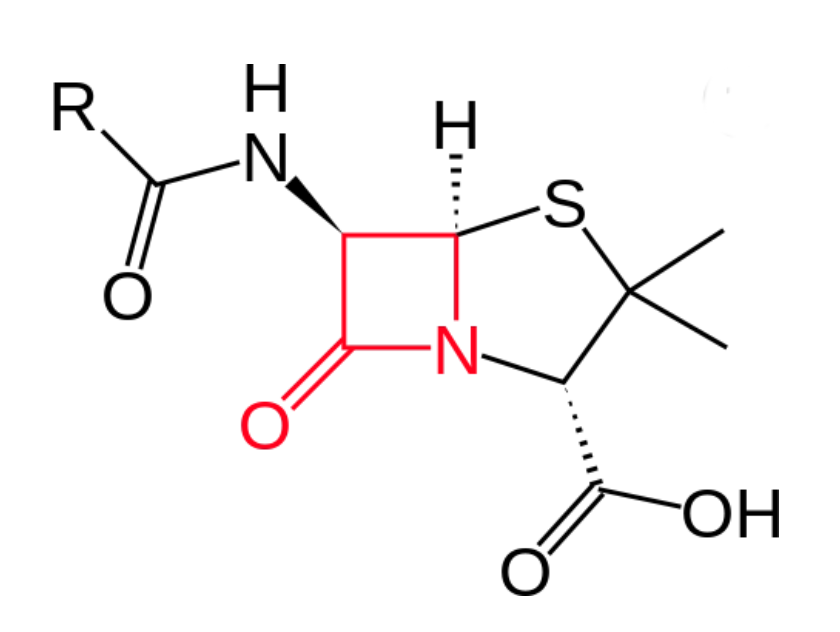
What is this the chemical structure for?
beta-lactams
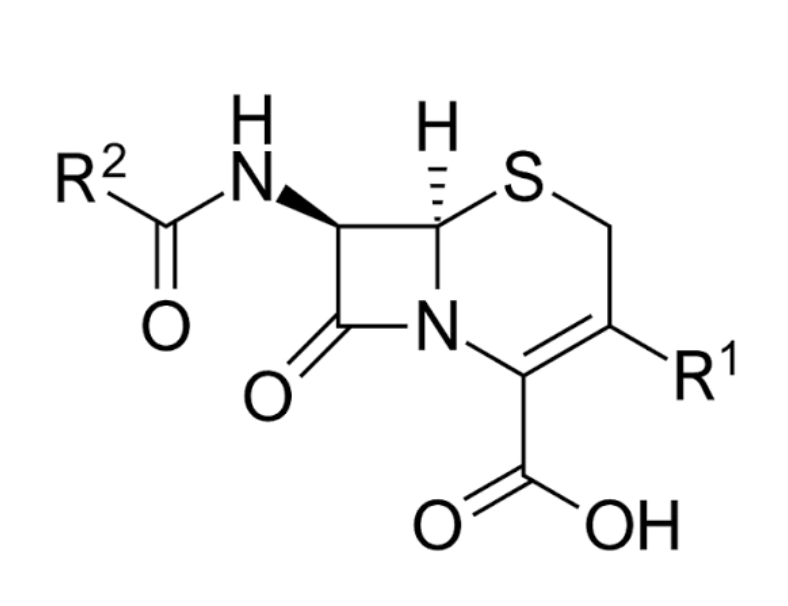
What is this the chemical structure for?
cephalosporins
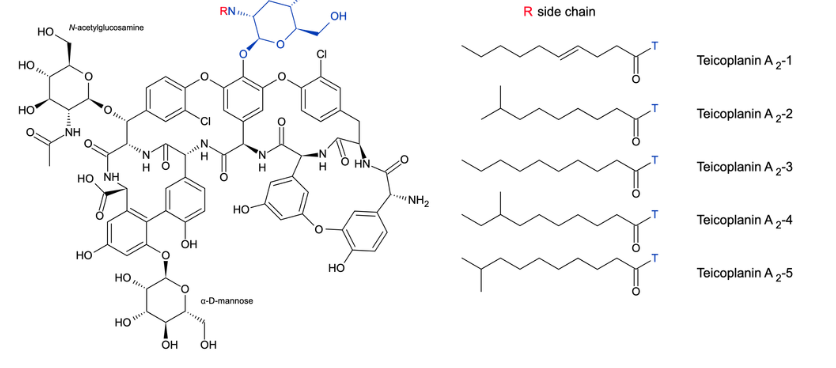
What is this the chemical structure for?
glycopeptides