Body composition - 6
 Call Kai
 Learn
Learn Practice Test
 Spaced Repetition
 Match
Match Flashcards
 Knowt Play
1/20

There's no tags or description
Looks like no tags are added yet.
Name | Mastery | Learn | Test | Matching | Spaced | Call with Kai | Chat |
|---|
No analytics yet
Send a link to your students to track their progress
21 Terms
why is body composition so important
As an indicator health status
To help favor optimal performance
To monitor changes in body composition (growth, aging, disease)
To evaluate efficacy of treatment (e.g., exercise, diet, drug interventions designed to change body composition)
Excess fat is associated with many diseases
what are different ways we can measure the quantity of body comp
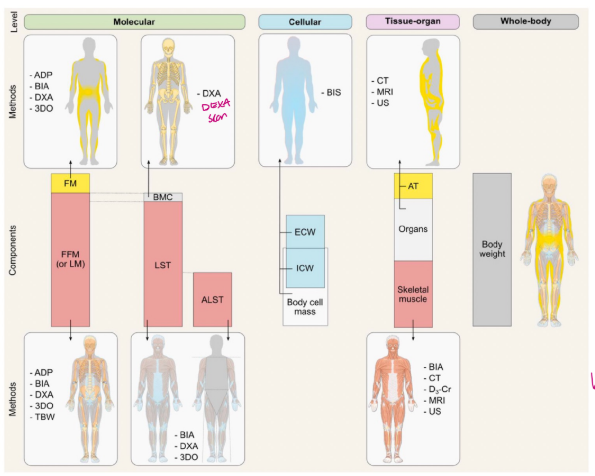
Fat Free Mass (FFM) = Body weight – Fat mass
large part is total body water, around 50% of FFM is muscle mass, can still include some lipids
Lean Soft Tissue (LST) = FFM - bone mineral

fats vs lipids
fats - white substance solids at room temp like triglycerides and is not a cell or tissue its a molecule
lipids - non hydro soluble molecules (constists of a lot of things)

what are different tools to assess body comp at the different levels
Bioelectrical impedance analysis (BIA)
Dual X-ray absorptiometry (DXA, aka DEXA)
Computed Tomography (CT) + Magnetic Resonance Imaging (MRI)
Body mass index (BMI)
Waist circumference(WC) vs Waist-to-hip ratio(WHR)
its not just about the total amount or porportion but its also the location and quality

what is BIA for body comp
Different tissues have different impedance (resistance) to electrical current.
Less resistance = more water
Main issues:
Larger “cylinders” have less resistance (ex. legs, trunk, arms), higher diameter = less resistance
Water to FFM ratio - intracellular vs. extracellular
Hydration status, temperature
Position of arms and legs
there are a qualitative analysis (phase angle eval for intra/extra cellular water ratio and Bioelectrical impedance vector) and quantitaive analysis (body comp estimation)

what is DEXA for body comp
• Often considered “gold standard” - used for bone mineral density
• FM + BM (bone mineral)+ FFST (fat free soft tissue)
• Cannot measure intra-abdominal fat - an estimate of density is estimated again to get this value and doesnt always work that well
what does a CT or MRI tell you about body comp
the distribution of fat
visceral fat - the black inside surrounding organs, considered more harmful metabolically
subcutaneous fat - the white outside, fat under the skin, less harmful
ppl can have the same total fat but the location of it can be different, which is why BMI doesnt tell the whole story
visceral fat is an independent factor of dying, subcutaneuos fat doesnt predict death and is protective
liposuction - removing subcut fat didnt help with health outcomes but removing visceral did
what are the functions of visceral fat
supplies blood to the intestines with the superior mesenteric artery
carries blood from intestines and abdominal organs to the liver with the hepatic portal vein
BMI vs WHR in predicting heart attack risk
WHR is better at predicting it, is a stronger predictor on its own
higher WC is a predictor and higher HC leads to reduced odds of having a heart attack (HC is inlfuenced by muscle mass)
what is WC more associated with
• Waist circumference more strongly associated with abdominal fat than WHR.
what is the limitation of WHR in defining obesity
it might miss some changes

what is the difference in fat quality between different groups of people
lean sedentary ppl have high insulin sensitivity and around 1-1.5% of muscle lipid
obese ppl have less insulin sensitivity and around 2% of muscle lipid
type 2 diabetes people have very low insulin sensitivity and around 3% of muscle lipid
athletes have around 2.5% of muscle lipid but very high insulin sensitivity which is the athletes paradox
insulin sensitivity means that your body does what it tells you
why are all myocytes not the same
muscle cells are not the same because after exercise intervention there are alot more mitochondria but the fat within the muscle doesnt change that much (became smaller sized lipid droplets)
people with smaller lipid droplets had more insulin sensitivity
people with more increase in mitochondria had more insulin sensitivity

why are all adipocytes not the same
White vs. Brown vs. Beige adipose tissue - not all fat have the same risk
Large vs. small adipocytes
Hypertrophy vs. hyperplasia
What is better for a given volume: many small adipocytes or a fewer/larger ones?
Inflammation
what are the functions of white adipose tissue
• Energy storage
• Insulation for organs
• Protection, “packaging” - against infections
• Endocrine role, inflammation - immunity
90-95% of our fat cells are white
what matters with white adipose tissue
• Adipocyte size matters - there is a limit and as you get close there is more risk and develops insulin resistance
• Hyperplasia (differentiation from pre- adipocytes)
• Hypertrophy (increase in volume)

apoptosis vs necrosis
Apoptosis: controlled and mostly non- inflammatory cell death, normal
Necrosis: cell death involving macrophage recruitment and inflammatory responses, not normal (from stress or size)
facts and functions about brown adipose tissue
Originally believed to only be in other mammals (e.g., hibernating) or human infants.
Production of body heat without shivering
Brown color due to presence of more capillaries and mitochondria
Numerous/smaller lipid droplets vs. white adipocytes
Now confirmed in humans, but lower amounts with aging, obesity or absence of cold exposure
Can be subcutaneous (e.g., near clavicles, between scapula...) or visceral (e.g., around blood vessels, and organs such as kidneys) - to produce heat
what type of adipose tissue is the intermediate between brown and white
beige adipose tissue
Brown adipocytes come from same stem cells as muscle
“Beige” or “brown-like” adipocytes - help ppl generate heat, exercise miht help regulate them
• White adipose tissue contains darker adipocytes that come from same precursors as WAT (e.g., near clavicle or spine)

what is a summary of body composition
• Many important tools for estimating body composition.
• Need to consider absolute amount, relative amount, location, and “quality”.
Do not be obsessed by numbers or “cutoff”
Body composition is but one factor to estimate “risk” or “performance”
subcut fat is the healthier way to store fat
check practice questions posted