Chapter 5 Theorems
 Call Kai
 Learn
 Practice Test
 Spaced Repetition
 Match
 Flashcards
 Knowt Play
1/13

There's no tags or description
Looks like no tags are added yet.
14 Terms
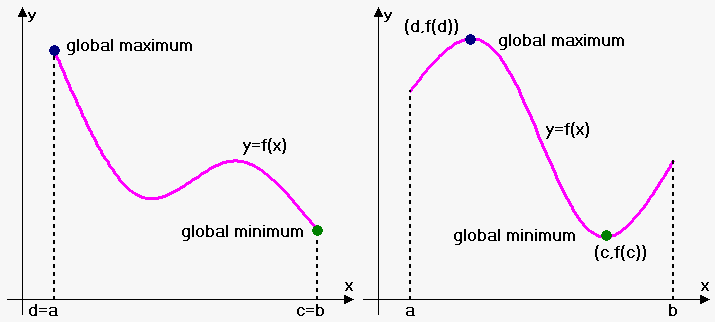
Extreme Value Theorem (EVT)
if f is continous on a closed interval [a,b] then f has an absolute maximum and an absolute minimum on [a,b]
It does not say where, so end point values play no role in determining if it is true
Condition for a Local Maximum or Minimum
if f has a local max or local min at c then f’(c) does not exist or f'(c) = 0 at that point.
The converse is false: ex. x³ has f’(0)=0 but no extremum at 0 does make it a candidate though (critical number)

Fermat’s Theorem
f is differentiable and has a local max or min at c, then f’(c)=0

Locating Absolute Extreme Values (Candidates Test)
If f is continuous on a closed interval [a, b], then the absolute max and min are the largest and smallest of f at the critical numbers in (a, b) and at a and b
Evaluate f at EVERY candidate and write the table not a sign chart

Critical Number
A number c in the domain of f where f’(c) = 0 or f’(c) does not exist.
A local extremum can not occur at an end point because it needs an open interval around c

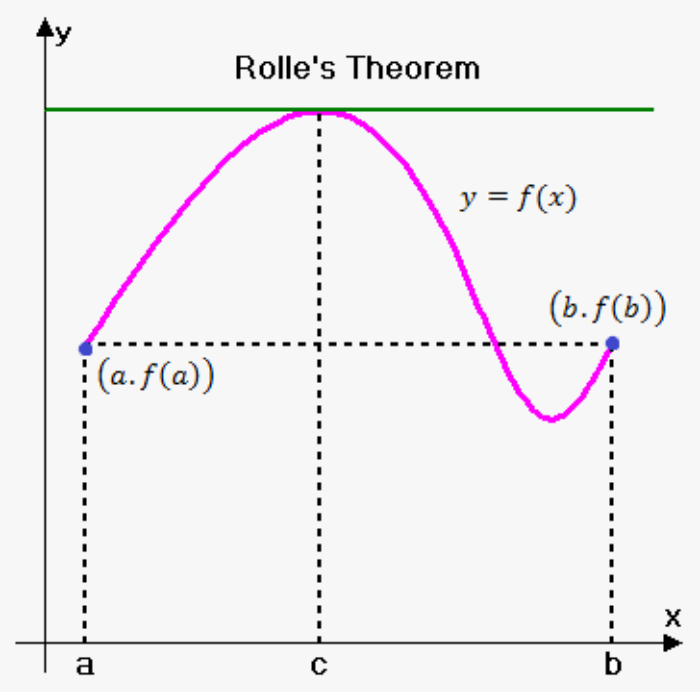
Rolle’s Theorem
if f is continuous on [a,b], differentiable on (a,b), and f(a)=f(b), then there must be at least one c in (a,b) such that f’(c) = 0
All three conditions are required
Mean Value Theorem
if f is continuous on [a,b] and differentiable on (a,b), then there is at least on c in (a,b) with f’(c) = slope of the secant line between a and b
Remember: c is the x value not the slope

Corollary: Zero Derivative
if f is continuous on [a, b],differentiable on (a, b), and f'(x) =0 for all x in (a, b), then f is constant on (a, b)
this one is really just common sense

Corollary: Equal Derivatives
if f and g are differentiable on (a.b) and f’(x) = g’(x) for all x in (a,b), then f(x)=g(x) + C on (a,b)
this one is really just common sense

Increasing and Decreasing Function Test
if f is differentiable on (a,b), with f’(x)>0 (or f’(x) < 0) on (a,b), then f is increasing (or decreasing). If f is also continous on [a,b] then this extends to [a.b]

First Derivative Test
if f is continuous on an interval I, c is a critical number, and f is differentiable on an open interval (a,b) around c (except possibly at c)
then f’ changes + to - at c: local max. f' changes - to + at c: local min. Same sign on both sides: neither

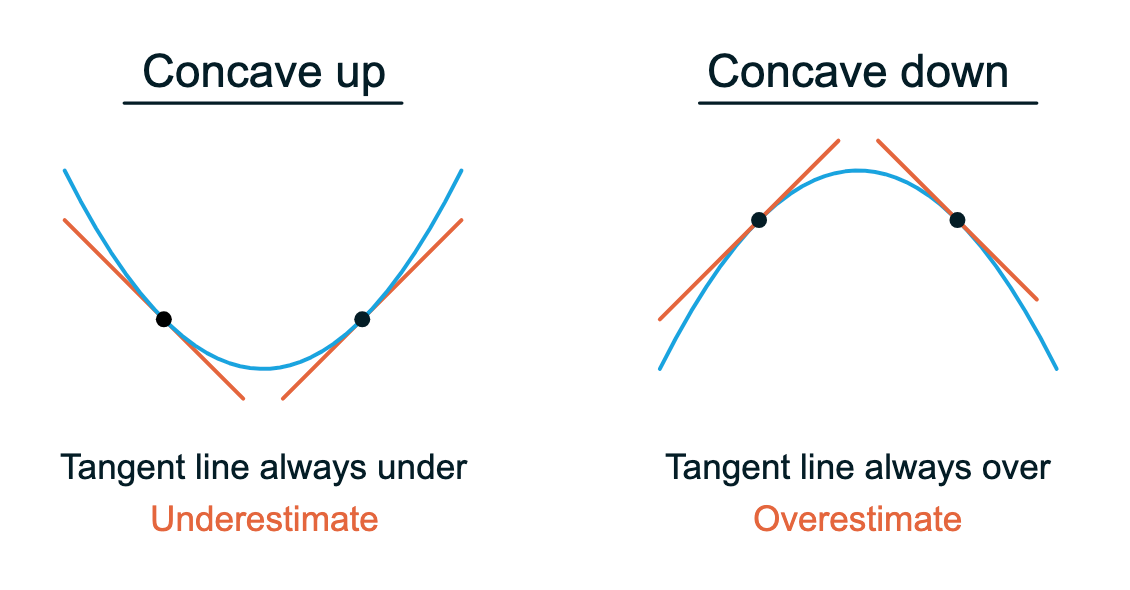
Test for Concavity
if f is continuous on [a,b], and f’ and f’’ exist on (a,b), then f’’ (x) > 0 on (a, b): concave up. f’’ (x) < 0 on (a, b): concave down
from the sign of f’’
Condition for an Inflection Point
f is differentiable on an open interval containing c, and (c, f(c)) is an inflection point
f’’ (c) = 0 or f’’ (c) does not exist
Basically the critical point of the f’ graph

Second Derivative Test
if f’ and f’’ exist on an open interval (a,b) containing c, and f’(c) = 0
f’’(c) < 0: local max
f”” (c) > 0: local min
If f’’ (c)= 0 or does not exist, the test gives no information. Use the First Derivative Test instead
