CT Response to Load
 Call Kai
 Learn
 Practice Test
 Spaced Repetition
 Match
 Flashcards
 Knowt Play
1/143

There's no tags or description
Looks like no tags are added yet.
144 Terms
epithelial, nervous, muscle, connective
what are the types of CT?
Cells and ECM
what are the components of CT
resident and non-resident
what are the types of cells in CT?
ECM
what defines the type of CT
fibers, proteoglycans, glycoproteins, water
what are the components of the ECM
GAGs
what part of proteoglycans attracts water and attaches to the proteins?
collagen molecule, fibril, fiber, primary fiber bundle, secondary/fascicle, tertiary, tendon
what is the progression of collagen structure that builds to make CT?
enthesis
what is the name for the bone-tendon junction?
1- end of the tendon
2- unmineralized fibrocartilage
3- mineralized fibrocartilage
4- bone
what are the zones of the enthesis?
mid-tendon
this part of the tendon has less frequent injuries, but if there is one it is usually due to overuse
Musculotendonus Junction
which area is the most common site of injury?
parallel
tendons and ligaments have dense regular CT, meaning their fibers are...
bone, ligament, tendon, and capsule
what types of tissues are composed primarily of type 1 collagen?
cartilage
what type of CT is composed of type 2 collagen?
elastin, allows for support through ROM
the joint capsule has more of what type of fiber? why?
ligament
when comparing tendon to ligament, which fibers are more irregular?
tensile
what types of forces do ligaments resist
stabilize a joint, prevent excessive motion, guide motion, proprioception
what is the function of a ligament
from proximal and distal attachments
where do ligaments receive their blood supply?
fiber that allows deformation to return back to original state
what is elastin?
mass*acceleration
force=
stress
force on an area during movement results in
force/area
stress=
toe region, elastic zone, plastic zone, failure
in a stress/strain curve, what are the regions?
the slope of the elastic zone
what part of the stress/strain curve is used to calculate stiffness
yield pt
what point marks the change from the elastic zone to the plastic zone?
stiffer
tissues with a higher slope in the elastic zone are...
it has sold and semisolid components
how is biological tissue an example of heterogenous material
extensibility is the ability to stretch, elasticity is the ability to return to original length
what is the difference between extensibility and elasticity
adaptations
how does CT respond to stresses (both internal and external) placed on it?
structural tension, joint compression, joint shear forces
what are examples of internal forces, loads, and forces?
gravity, GRF, contact force (weights/manual)
what are examples of external forces, loads, and forces?
magnitude, duration, and frequency of the force
response to stress is different based on what characteristics about the force?
tension, compression, shear, torsion, bending, combined
what are the types of loading?
tension
this load is directed away from the center

sprains, strains, tears
what are mechanisms of injury related to tension
compression
this load is directed inward toward the center
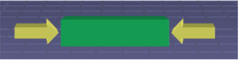
falls, trauma
what are mechanisms of injury related to compression
shear
2 forces applied parallel to each other but at different levels and opposite sides

torsion
this load is applied and results in twisting along the longitudinal axis

bending

tension
due to bending load, what force is created on the opposite side of the bend? (the bulging side)
compression
due to bending load, what force is created on the opposite side of the bend? (the indented side side)
stress/load
this is the term used to describe the force applied to a structure, it is directly related to the magnitude and inverse to the area (F/a)
strain/deformation
this is the product of applied force that presents as a change in shape or length due to that force
load/deformation curve
what can be made from the stress/strain results?
proteoglycan concentration
what part of the ECM is responsible for the mechanical properties of the tissue?
length change
if load is applied in a linear direction, what is the resulting deformation?
angular change
if load is applied in a shearing direction, what is the resulting deformation?
strength, elasticity, plasticity, stiffness, strength
what type of information can a load/deformation curve tell us
load sustainability, deformation sustainability, energy storage before failure
the strength of a structure is determined by...
stress vs strain
stiffness is a ratio of...
measurement of elasticity/definition of rigidity
modulus of elasticity/Young's modulus is...
toe region
this part of the stress/strain curve is the initial curve when the crimp is removed from CT
elastic region
this part of the stress/strain curve has a linear relationship with stress/strain, if stress is removed the structure will return to its original length
plastic region
in this region of the stress strain curve, there is tearing which results in permanent deformation. this deformation can recover over time depending on synthesis and reorganization of new tissue
fluid and solid (viscoelastic)
what behaviors does all CT exhibit
rate of loading
what influences the properties (fluid/solid) of CT
results in a steeper slope, meaning it is more stiff and a greater load is needed for failure
how does increased loading effect the slope of the elastic range, what does this mean for stiffness and failure pt
ECM is able to disperse, resulting in lower load needed for failure, but it will occur at an increased point of displacement
what happens in CT with slow loading rates
Creep and Load/stress relaxation
what are the two characteristics of viscoelastic properties?
creep
this viscoelastic property is time dependent (>15min) using a constant load resulting in deformation over time
stress relaxation
this viscoelastic property is when tissue is deformed and fixed over time resulting in decreased force over time due to relaxation
hysteresis
loss of energy during plastic deformation as the result of broken bonds in CT due to the application of stress/load
greater stiffness and strength
the result of increased cross sectional area in the fibers of ligaments and tendons results in..
the same
elongation to achieve failure is ______________ with increased cross sectional area
increased length until failure and decreased stiffness
if the length of fibers increases, how does it effect the length till failure? what does this mean about stiffness
magnitude
a longer fiber would have the same _________________ of force required to cause failure
aging, exercise, immobilization
what factors affect the joint capsule, tendon, and ligament tissue properties?
20
increases strength, diameter, and cross sectional area
number of cross links between fibers increases until what age? what does this result in?
20-60
from what ages does the diameter of fibrils in CT decrease?
increases vascularity, strength and diameter
how does exercise effect the properties of jt capsule, tendons, and ligaments?
it decreases stregnth
how does immobilization effect the properties of jt capsule, tendons and ligaments
no
if a pt is 12 months reconditioned post immobilization, are they 100% back to pre-immobilization levels?
bone
which type of CT is the most stiff/rigid and ductile
self-repair, aging, immobilization
in what ways does bone change throughout life?
osteoblasts
osteoclasts
osteocytes
what is the name of the bone cells that build bone? break it down? maintain?
osteon
structural unit of cortical bone that is in a haversian system
haversian canal
the center of the osteon containing blood vessels and nerves
lamellae
a series of concentric rings around each haversian canal
lacunae
cavity type area that houses the osteocytes
canuliculi
small channels that connect lacunae, but doesn't cross cement lines
volkman canal
canals from haversian canals to canuliculi, does cross cement lines
cement line
periphery of the osteon that is the weakest area of bone strucutre
80%
what % of bone mass is cortical bone?
cortical bone
this type of bone is dense and surrounds trabecular bone, it has a haversian system
cancellous bone (trabculae)
this type of bone has thin plates in a mesh like structure, spaces between the plates is filled with red marrow. there is no hversian system
woven bone
immature bone at a growth plate or fracture that is made up of cells and collagen in random arrangement
lamellar bone
mature bone that organized and replaces wocen bone
heterogenous
bone is composed of collagen and hydroxyapatite, making it...
it resists many forces, but responds differently to each
because bone is anisotropic and not isotropic, how does it respond to different forces
in the direction that the force is applied
when bone responds to stresses, its strength and stiffness is greatest...
compression and tension
what forces is bone the strongest in?
shear
what force is bone the weakest in?
less dense
less stiff
way more ductile
how does trabecular bone compare to cortical bone in regards of density, stiffness, and ductility
at the cement line, resulting in fracture
how does bone failure occur with tension
within the structure
where is the stress and strain occurring with compression in bone occurring inward
shorten and widen
forces in the same line on opposite sides of the structures causes the structure to...
vertebrae
where in bone are compression injuries most likely to occur
bone deformation at an angular manner
shear forces on bone usually result in...