Anatomy and Physiology I final exam
 Call Kai
 Learn
 Practice Test
 Spaced Repetition
 Match
 Flashcards
 Knowt Play
1/160

There's no tags or description
Looks like no tags are added yet.
161 Terms
What is leprosy?
A chronic yet curable infectious disease causing lesions on the skin and damage the eyes, nose, and peripheral nerves
what causes leprosy?
Caused by a bacterial infection, Mycobacterium leprae
what are the symptoms of leprosy?
Light colored or red skin patches or bumps that can have reduced sensation, numbness and weakness in hands and feet
Can leprosy be cured?
Yes, with 6-12 months of multi-drug therapy. Early treatment avoids loss of parts and disability.
Define anatomy?
The study of the structure of living organisms
What are different types of anatomy(give the groups and sub groups)
Gross/ Macroscopic
– Regional
– Systemic
– Surface
• Microscopic
– Cytology
– Histology
• Developmental
– Embryology
define physiology?
The study of the function of living organisms
what are the different types of physiology
Renal physiology
Neurophysiology
Cardiovascular Physiology
what is the principle of complementary of structure and function
“what a structure can do depends on its specific form”
Levels of structural organization in order
Chemical level
Cellular level
Tissue level
Organ level
Organ system level
Organismal level
what are the characteristics of life functions
Maintaining Boundaries
• Movement
• Responsiveness
• Digestion
• Metabolism
• Excretion
• Reproduction
• Growth
What is homeostasis?
The ability to maintain a constant and stable internal environment while the external environment is changing.
Define negative vs positive feedback
Negative Feedback- The output shuts off the initial stimulus or reduces the intensity
• Positive Feedback - the result or response enhances the original stimulus so that the activity is accelerated
Explain the different types of body sections
sagittal vs midsagittal section
frontal section
transverse section
oblique section
sagittal—>left and right section(uneven)
midsagittal—> left and right section split equally
frontal—> front and back section
transverse—> cuts into superior and inferior section(upper and lower)
oblique—> not like the other sections
Explain the relative positions
Superior Vs Inferior
Anterior Vs Posterior
Cranial Vs Caudal
Dorsal Vs Ventral
Proximal Vs Distal
Medial Vs Lateral
Superficial Vs Deep
superior vs inferior—> above the head vs below the head
anterior vs posterior—> toward the front of the body vs toward the back of the body
cranial vs caudal—> toward the head vs toward the tail
dorsal vs ventral—> toward the backside of the body vs toward the belly/front side of the body
proximal vs distal—> closer to the origin/point of attachment vs farther from the point of attachment/origin
medial vs lateral—> closer to the midline vs farther from the midline
superficial vs deep—> closer to the surface of the body vs farther from the surface/ inside the body
what abdominal division are the gallbladder, liver, stomach, appendix, bladder/prostate, kidneys, pancreas, Lrg. and/or sml. intestines
Gallbladder—> Rt. Hypochondriac
Liver —> Rt. Hypochondriac and epigastric
Stomach—> Epigastric(mostly) and Lft. Hypochondriac
Appendix—> Rt.Iliac(mostly) and hypogastric
Bladder/prostate—> hypogastric
Kidneys—> Rt and Lft. Lumbar
Pancreas—> umbilical
Lrg. and/or Sml. Intestines—> All
What cavities are apart of the dorsal cavity
cranial cavity
spinal cavity
what cavities/membranes are apart of the ventral cavity
Thoracic cavity
Diaphragm
Abdominopelvic cavity
what cavities are apart of the thoracic cavity
mediastinum
pleural cavities
pericardial cavity
what cavities are apart of the abdominopelvic cavity
abdominal cavity
pelvic cavity
what membranes are apart of the thoracic cavity and where are they located in the body
parietal pleurae—> lines lung cavity wall
visceral pleurae—>covers the lung surface
parietal pericardium—> forms the outer sac surrounding the heart
visceral pericardium—> directly adheres to the outer surface of the heart muscle
what are the membranes of the abdominal cavity and where are they located?
mesenteries—> double-layered folds of peritoneum that anchor the inestines to the posterior abdominal wall
parietal peritoneum—> lines the inner wall of the abdominopelvic cavity
visceral peritoneum—> covers the external surfaces of most abdominal organs
greater omentum—> attaches to the stomach and the transverse colon
lesser omentum—> attaches to the stomach and liver
what is a collapsed lung?
occurs when the lung looses it’s ability to maintain it’s shape and thus collapses on itself, usually resultant in the loss of negative pressure in the pleural cavity
what is penumothorax?
A medial condition where air or gas is present in the pleural cavity.
The most common cause occurs after physical trauma to the chest, such as stabbing or gun shots which penetrate the pleural cavity, or from blast injury.
Can also occur spontaneously in people
What percent of all patients are not given all of there options? What is the third leading cause of death? what percent of all patient end up with some medical mistake? And how many medical errors every day? what percent of all employees at a hospital do not want to be cared for at their own hospital?
10-20%
medical errors
30%
40,000 medical errors occur every day
40%
what are the stats of drug mistakes(how many people out of how many people)? how many times a week are the wrong parts in a surgery are taken out? How many unnecessary procedures are wrong?
1 in 4 have drug mistakes
40 times a week
1 in 5 wrong
where is the gall bladder located(abdominal division)?
Rt. hypochondriac
where is the Liver located(abdominal division)?
Rt. Hypochondriac and epigastric
where is the stomach located(abdominal division)?
Epigastric(mostly) and Lft. Hypochondriac
where is the appendix located(abdominal division)?
Rt. Iliac(mostly) and hypogastric
where is the bladder/prostate located(abdominal division)?
Hypogastric
where is the kidneys located(abdominal division)?
Rt. and Lft. Lumbar
where is the pancreas located(abdominal division)?
Umbilical
where is the Lrg. and/or Sml Intestines located(abdominal division)?
All
what is matter?
Something that takes up space and has mass
What is mass?
The amount of matter in an object
what is energy?
the ability to do work or put matter into motion
what is chemical energy?
energy stored in the bonds of chemical substances(Adenosine Triphosphate, ATP)
what is electrical energy?
energy created via the movement of charged particles(nerve impulses)
what is mechanical energy?
energy directly used in moving matter(bike riding)
what is radiant/electromagnetic energy?
energy that travels in waves(electromagnetic spectrum, light)
what are elements?
Elements are the simplest form of a substance that can not be broken down any further
96% of the body is made up of what elements?
C,H,O,N
what are the atomic weights of C,H,O,N
C—>12.011
H—>1.008
O—>15.999
N—>14.007
What are molecules?
Two or more elements bonded together
What are compounds?
Molecules of two or more different elements
What is molecular weight?
Atomic weight of the elements which comprise a compound determine the compound’s weight
What are mixtures composed of?
They are substances composed of two or more compounds
What are colloids/emulsions?
Heterogeneous mixtures- formed when larger particles are suspended in solvent and do not fall out solution
Can appear to be translucent or milky
what are suspensions?
Heterogenous mixture- similar to colloids except often times particles are visible and can fall out of solution
what are covalent bonds? and give example
Bonds that form when electrons are shared between two or more elements
CH4 or Methane
what are ionic bonds? and give example
Bonds that form when electrons are transferred from one element to another resulting in negative(anion) and positive(cation) net charges
NaCl or salt
what are nonpolar molecules?
Formed when electrons are distributed evenly amongst the elements in a compound
What are polar molecules?
Formed when electrons are not evenly shared in covalent bonds(hydrogen)
what are macromolecules?
are large molecules made from smaller molecules linked in a long chain
what does organic mean?
all hydrogen and carbon containing compounds
what does organic chemistry mean?
the study of structures and reactions of carbon and hydrogen compounds
what does biochemistry mean?
the study of the chemistry of living organisms
what are hydrocarbbons?
long chains of carbon and hydrogen
what does aromatic mean? and what are the configurations?
when a chain of carbon, using alternating single and double bonds, configures to form a ring.
Chair configuration and boat configuration

boat vs chair configuaration, which is which?
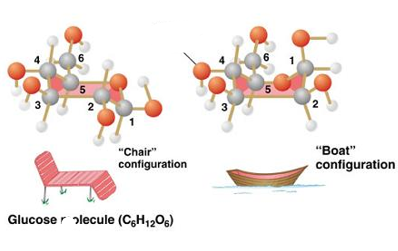
what is dehydration synthesis?
a chemical reaction that joins two smaller molecules into a larger molecule by forming a covalent bond and releasing a water molecule
what is hydrolysis?
a chemical reaction in which a molecule of water breaks one or more chemical bonds in a compound
what are monosaccharides? and give examples
“One sugar”
Glucose, Fructose, Ribose, and Deoxyribose
what are disaccharides? and give examples
“two sugars”
Sucrose, Lactose
what are polysaccharides? and give examples?
“many sugars”
Polymers
what are lipids?(give examples)
lipids
phospholipids
cholestrol
what are proteins?(give examples)
amino acids
peptide bonds
enzymes
Describe structure of fats(triglycerides)
Glyceride(1) (simple sugar alcohol)
Fatty Acid(3) (long hydrocarbon chain with an acid group)
describe structure of phospholipids
fatty acids(2) (long hydrocarbon chain with an acid group)
Glyceride (1) (simple sugar alcohol)
Phosphorus containing group
what are saturated fats?
solid at room temp
single bonds only
what are unsaturated fats?
liquid at room temp
one or more double bonds
the more double bonds the lower the temperature required to make it a solid
what are unsaturated cis fats?
liquid
unsaturated and polyunsaturated form kinks which prevent layering
what are unsaturated trans fat?
liquid
unsaturated and polyunsaturated place the double bond in a trans position thus preventing kinking and allowing layering
what is rancidification?
the decomposition of fats and other lipids by hydrolysis and/or oxidation
what are antioxidants? and what are some natural anti-oxidants
they are often added to fat-containing foods in order to slow the development of rancidity due to oxidation.
natural anti-oxidants include flavonoids, polyphenols, ascorbic acid,(vitamin C), and tocopherols(vitamin E)
what are cholestrols made up of?
made up of four interlocking hydrocarbon rings and a side chain
what is intersex?
intersex is the modern scientific phrase used to define individuals who suffer with hermaphroditism.
what are pseudo-hermaphroditism?
Pseudo-hermaphroditism is a rare genetic disorder that effects the production of dihydrotestosterone (a hormone produced by the conversion of estrogen into testosterone)
describe male pseudo-hermaphrodites
genetically male but during development have a deficiency in dihydrotestosterone and as a result end up developing a clitoris and labia majora.
appear female but internally have testes and a vas deferens.
Upon puberty their body produces an increasing testosterone as a result the labia majora tires to change into a scrotum, the clitoris tries to extend into a penis, and the testes descend.
describe female pseudo-hermaphrodites
genetically female but an early burst of dihydrotestosterone causes the formation of a penis and scrotum but they may still have ovaries, fallopian tubes, and sometimes a partial uterus.
however, these individuals upon puberty may develop breasts and take on female body morphism
describe true hermaphrodite
These individuals have an abnormality of cell division are genetically may have both cells with 46XY chromosomes and cells with 46 XX chromosomes. As a result both male and female structures develop within the uterus
what is the external and internal structure of a true hermaphrodite
externally these individuals may form a penis and scrotum. however, the penis tends to not be completely formed/virilized. also one or both testes may not be palpable or may be undescended.
Internally these individuals may develop female structures such as a uterus, oviducts, and a vagina may develop
describe proteins?
contain an amine and acid group
20 amino acid types
these amino acids are linked together by peptide bonds
the cells creates proteins via the process translation using RNA(m,r, & t)
describe enzymes
enzymes are biological catalysts
Describe substrates, active sites, activation energy, and coenzyme
substrates—> substances that an enzyme acts upon
Active site—> the site where the substrate binds to the enzyme
activation energy—> energy required for a reaction to occur
coenzyme—> a cofactor that is needed in order for the enzyme to act
describe nucleic acids
DNA and RNA are comprised of:
- (1) Nucleotide(Adenine, Guanine, Cytosine, Thymine, or Uracil
- (1) Sugar(ribose or deoxyribose)
- (1) phosphate group
describe ADP and ATP
Often used as energy exchange units
describe AMP
primarily used as the building block for DNA
Describe translation and transcription
transcription—> DNA to RNA
translation—> RNA to Protein
mRNA vs tRNA vs rRNA
mRNA—> messenger RNA
tRNA—> transfer RNA
rRNA—> ribosomal RNA