AP Music Theory Unit 1
 Call Kai
 Learn
 Practice Test
 Spaced Repetition
 Match
 Flashcards
 Knowt Play
1/92

There's no tags or description
Looks like no tags are added yet.
93 Terms
1st scale degree
Tonic
2nd scale degree
Supertonic
3rd scale degree
Mediant
4th scale degree
Subdominant
5th scale degree
dominant
6th scale degree
Submediant
7th scale degree # (half step from tonic)
leading tone
7th scale degree b (whole step from tonic)
subtonic
unison (0 half steps)
perfect unison
unison (1 half steps)
augmented unison
second (0 half steps)
diminished second
second (1 half steps)
m2 (minor second)
second (2 half steps)
M2 (Major second)
second (3 half steps)
2+ (augmented second)
third (2 half steps)
3° (diminished third)
third (3 half steps)
m3 (minor third)
third (4 half steps)
M3 (major third)
third (5 half steps)
3+ (augmented third)
fourth (4 half steps)
4° (diminished fourth)
fourth (5 half steps)
P4 (perfect fourth)
fourth (6 half steps)
4+ (augmented fourth)
fifth (6 half steps)
5° (diminished fifth)
fifth (7 half steps)
P5 (perfect fifth)
fifth (8 half steps)
5+ (augmented fifth)
generic interval
number of interval only
specific interval
quality and number combined
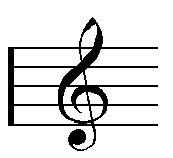
treble clef
Every Good Boy Does Fine on the line, FACE in the space
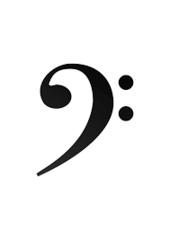
base clef
F clef
Soprano, Alto, Tenor Clefs
C clefs

whole note
4 beats

quarter note
1 beat

sixteenth note
1/4 beat

half note
2 beats

eighth note
1/2 beat

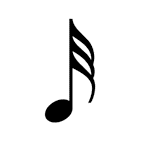
thirty-second note
1/8 beat
whole rest
4 beats of silence
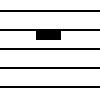
half rest
2 beats of silence

quarter rest
1 beat of silence

eighth rest
1/2 beat of silence
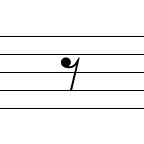
sixteenth rest
1/4 beat of silence
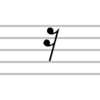
thirty-second rest
1/8 beat of silence

interval inversions
M-m, m-M, d-A, A-d, P-P and = 9
Parallel scales
Major and minor scales that share the same tonic
Relative scales
Major and minor scales that share the same key signature, for major go up m3 for minor go down M3
Major Scale
WWhWWWh

Minor Scale
WhWWhWW
Harmonic Minor Scale
a natural minor scale with a raised 7th scale degree both ascending and descending
Melodic Minor Scale
Raised seventh and sixth ascending, natural minor descending
Key Signatures
Set of flats and sharps placed on the staff to indicate which notes should be performed at higher or lower pitches than their natural pitches on the staff. Use BEADGCF
No Sharps of Flats key signature (Major key)
C Major
No Sharps of Flats key signature (Minor key)
A Minor
1 flat key signature (Major key)
F Major
1 flat key signature (Minor key)
D Minor
2 flat key signature (Major key)
Bb Major
2 flat key signature (Minor key)
G Minor
3 flat key signature (Major key)
Eb major
3 flat key signature (Minor key)
C minor
4 flat key signature (Major key)
Ab major
4 flat key signature (Minor key)
F minor
5 flat key signature (Major key)
Db Major
5 flat key signature (Minor key)
Bb minor
6 flat key signature (Major key)
Gb major
6 flat key signature (Minor key)
Eb minor
7 flat key signature (Major key)
Cb major
7 flat key signature (Minor key)
Ab minor
1 sharp key signature (Major key)
G major
1 sharp key signature (Minor key)
E minor
2 sharp key signature (Major key)
D major
2 sharp key signature (Minor key)
B minor
3 sharp key signature (Major key)
A major
3 sharp key signature (Minor key)
F# Minor
4 sharp key signature (Major key)
E major
4 sharp key signature (Minor key)
C# minor
5 sharp key signature (Major key)
B major
5 sharp key signature (Minor key)
G# minor
6 sharp key signature (Major key)
F# major
6 sharp key signature (Minor key)
D# minor
7 sharp key signature (Major key)
C# major
7 sharp key signature (Minor key)
A# minor
Chord
2+ notes sounding simultaneously (technically a harmic interval)
Triad
a three-note chord consisting of a root, a third, and a fifth.

Major Triad
M3, m3, P5 (from bottom up 1,3,5)
Minor Triad
m3, M3, P5 (from bottom up 1,3,5)
Augmented Triad
M3, M3, +5 (from bottom up 1,3,5)
Diminished Triad
m3, m3, °5 (from bottom up 1,3,5)
Cross relation
The chromatic alteration of a pitch in one voice part, immediately after the diatonic version has sounded in another voice.
Ionian Mode
Major type mode, Same as major scale, starts on scale degree one
Dorian Mode
Minor type mode, raised 6th scale degree
Phyrgian mode
Minor type mode, lowered 2nd scale degree
Lydian Mode
Major type mode, raised 4th scale degree
Mixolydian Mode
Major type mode, lowered 7th scale degree
Aeolian Mode
Same as natural minor scale
Locrian Mode
Minor scale with a lowered 2nd and 5th (tonic triad is a diminished triad, tri-tone)