Midterm review questions
 Call Kai
 Learn
Learn Practice Test
 Spaced Repetition
 Match
Match Flashcards
 Knowt Play
1/74

There's no tags or description
Looks like no tags are added yet.
Name | Mastery | Learn | Test | Matching | Spaced | Call with Kai | Chat |
|---|
No analytics yet
Send a link to your students to track their progress
75 Terms
if two triangular ridges join, what is the entire ridge called
transverse ridge
in a facial view of a maxillary central incisor, vertical lines may divide the crown into thirds called 1. Mesial, 2. middle and 3. ______
distal
on incisors, the number of lobes on the facial surface is
3
the borders of the lingual fossa of the maxillary lateral incisor are the cingulum, the distal marginal ridge, the incised edge or ridge, and the
Mesial marginal ridge
the spaces formed around the point of contact between proximal surface of adjacent teeth are called
embrasures
true or false? the CEJ curves more Mesial of the tooth than on the distal
true
true or false? the facial height of contour of tooth #8 is located in the middle third of the crown
false
what is the correct order of anatomic landmarks of a tooth with two roots beginning at the CEJ and moving toward the root tip
cervix, trunk, furcation, apex
when referring to mandibular anterior tooth surfaces, what is another term for facial surfaces
labial
when referring to maxillary tooth surfaces, what term is the same as lingual
palatal
which tissue makes up the majority of the bulk of the tooth
dentin
which tooth crowns have the lingual crest of the curvature located in the middle third
all posterior teeth only
which tooth structure is hardest
enamel
____ are rounded incisor extensions of the labial lobes found on newly erupted or unworn permanent incisor teeth
mamelons
compared to permanent maxillary lateral incisors, maxillary central incisors are more likely to exhibit
a root that is almost the same length as the crown
the marginal ridges and cingulum of the permanent maxillary central incisor are ____ than those of the permanent maxillary lateral incisor
less prominent
when viewed from the facial aspect, the mandibular central incisor is ____ mandibular lateral incisor
narrower
which of the following incisors is symmetrical
mandibular central incisor
which incisor is the smaller tooth in the mouth
mandibular central incisor
which incisor is normally the widest mesiodistally
maxillary central incisor
which of the following characteristics is normally seen on ALL types of permanent incisors
the labial height of contour is in the cervical 3rd
which statement is true regarding all lateral incisors
the mesioincisal angles are more square than the distoincisal angles
which tooth has the shortest root relative to its crown
maxillary central incisor
the crown of the permanent maxillary canine is ____ the crown of the permanent mandibular canine
shorter than
true or false? a distinguishing characteristic of mandibular canines is the relatively straight line of the Mesial outline, compared to the distal outline
true
which tooth has a distinct Mesial and distal fossae with a pit that can have "snake eye" fillings
#28
true or false? on the permanent maxillary canine, the Mesial cusp ridge is longer than the distal cusp ridge
false
a Y-shaped occlusal groove pattern is characteristic of a
mandibula second premolar
if a mandibular second premolar has three cusps, what are they called
mesiolingual, distolingual and buccal
which premolar has a pronounced concavity on the Mesial side of the crown
maxillary first premolar
the cusp ridges form the buccal and lingual sides of the occlusal table, and the ____ make up the Mesial and distal boundaries of the occlusal table
marginal ridges
the only single rooted tooth to have three cusps is the______
mandibular second premolar
true or false? multiple supplementary grooves often are found on a maxillary second premolar
true
when compared to other premolars, which of the following characteristics is unique to a Mandibular First Premolar
there is likely to be a mesiolingual groove crossing onto the mesiolingual surface
which of the following characteristics is NOT true about a maxillary first premolar
the short lingual cusp is non functional is NOT true
which premolar has a deep Mesial root depression
maxillary first premolar (because it is bifurcated)
which premolar has a non functional lingual cusp
Mandibular First Premolar
which premolars are most likely to have three cusps and a lingual groove
mandibular second
due to the four cusps being almost equal in size, the "+" groove pattern on the occlusal surface of this molar identified the tooth as the
mandibular second permanent molar
from which view is only one root visible on a mandibular first molar
Mesial
if a permanent maxillary second molar has only three cusps, what are the three cusps called
mesiobuccal, distobuccal and lingual
name the two grooves found on the buccal surface of the mandibular first molars, mesibuccal and
distobuccal
of the following, which cusp is the smallest cusp on permanent maxillary molars
distolingual

the ____ cusp of the maxillary first molar is the largest cusp
mesiolingual cusp

the furcation of the mandibular molars may be seen from either a _____ or lingual
buccal
true or false? a prominent ridge crossing the occlusal surface of the permanent maxillary first molar is called the oblique ridge
true
during most of their eighth year, children have how many teeth in their mouth
24
during what age span are primary teeth in the process of erupting into the mouth
6 months to 2 years
how many non succadaneous are in the complete dentition
12
primary molars differ from permanent molars in that primary molars have
greater divergence of roots
the permanent mandibular central incisor erupts at age
6-7 years
how many roots does a primary maxillary first molar have
three

tooth #19 forms within the mandible at which location
distal to the tooth "K"
using the universal number or letter, which tooth erupts in place of primary tooth "E"
tooth #8
what permanent tooth erupts into the space previously held by any of the primary second molars
second premolars
chose the best description for anterior crossbite
the maxillary anterior teeth are lingual to the mandibular anterior teeth

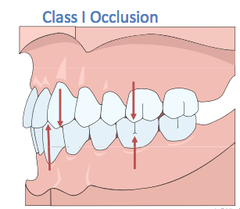
when the mesiobuccal cusp of the maxillary first molar sits even with the buccal groove of the mandibular first it is
class 1 occlusion
when the mandibular posterior teeth sit more to the buccal than the maxillary posterior teeth, it is termed
posterior cross bite

true or false? in class II malocclusion, the profile retrognathic, means the lower jaw sits back further than in class 1 occlusion
true

loss of tooth structure due to mechanic forces is termed
abrasion
when examining a large group of people, what is the most frequent location where extra (supernumerary) permanent teeth may be found where
maxillary incisor area

which two teeth are most likely to be congenitally missing
#7 or #10
tooth wear caused by tooth to tooth contact is what
attrition

how many teeth should be visible in the mouth of a 3 year old
20
a cone shaped mass found on the occlusal surface of posterior teeth and that is made of ridges called a
cusp
a transverse ridge is made up of which two ridges
two triangular ridges
how many molars are there in one quadrant of a normal adult human dentition
3
which primary tooth is most unique in shape and resembles no other tooth
#S (primary mandibular first molars)
how many total premolars are there in the complete adult dentition
8
how many teeth are in a complete adult dentition
32
using the universal numbering system, what tooth is #13
maxillary left second premolar
using the universal numbering system, what tooth is the permanent mandibular left lateral incisor
#23
using the universal numbering system, what teeth are the maxillary central incisors
#8 and #9
using the universal numbering system for primary dentition, which teeth are the maxillary central incisors
E and F
using the universal numbering system, what teeth numbers are the 3rd molars
1, 16, 17, 32