haloalkanes/halogenoalkanes
 Call Kai
 Learn
 Practice Test
 Spaced Repetition
 Match
 Flashcards
 Knowt Play
1/22

There's no tags or description
Looks like no tags are added yet.
23 Terms
primary halogenoalkane
contains a halogen atom attached to a carbon with 1 alkyl group
secondary halogenoalkane
contains a halogen atom attached to a carbon with 2 alkyl groups
tertiary halogenoalkane
contains a halogen atom attached to a carbon with 3 alkyl group
physical properties
carbon-halogen bond is polar, haloalkanes can form PD-D attractions
boiling points higher than alkanes and alkenes but lower than alcohols (similar molar masses)
cannot form hydrogen bonds with water so therefore are insoluble in water
chemical properties
haloalkane contains a δ+ carbon atom and so is attacked by nucleophiles in a nucleophilic substitution reaction
nucleophile
species that can donate a pair of electrons to a reactant in the formation of a coordination covalent bond (with the electrophile)
can be neutral of negatively charges, must have lone pair of electrons
nucleophilic substitution reaction
a nucleophile donates an electron pair to form a new bond as another bond breaks, producing a leaving group
halogen atom is the leaving group for haloalkanes and is substituted, a new product is formed depending on the nucleophile
mechanism for nucleophilic substitution of haloalkane

mechanism undergone by 1° and some 2° haloalkanes
Sn2
mechanism gone by 3° and some 2° haloalkanes
Sn1
Sn2 mechanism
nucleophilic substitution (S) involving an attacking nucleophile (n) and there are two species in the slowest step (2)
therefore the molecularity for the slow step is 2
Sn1 mechanism
only one species involved in the slow step, therefore the molecularity of the slow step is 1
steps of Sn2 mechanism
first step involves the nucleophile attacking the haloalkane to form a species called a ‘transition state’
the first step is the slow step, and it involves 2 species so the slow is bimolecular
in the second step, the transition state breakdown to form the alcohol and halide ion (nucleophile is OH-)
1-chloropropane + aqueous sodium hydroxide

stereospecificity of Sn2 mechanism
Sn2 mechanism is stereospecfic, meaning that the 3 dimensional arrangement of the reactants determines the 3 dimensional arrangement of the products
in the first step, the attakcing nucleophile attacks from the opposite side of the leaving group
this results in the alcohol product being an inversion of the configuration at the carbon
Sn2 optical activity
if the carbon atom is chiral and the haloalkane is 100% one optical isomer, SN2 forms 100% one optical isomer of the product.
product is optically active
steps of Sn1 mechanism
first step: the C–X bond breaks heterolytically, forming a carbocation and a halide ion
the first step is the slow step and involves only 1 species, the haloalkane, so it is unimolecular
second step: the nucleophile, OH-, attacks the carbocation forming alcohol and X-
2-chloro 2-methylpropane w/ hydroxide nucleophile (tertiary)

carbocation intermediate
the carbocation intermediate in Sn1 is planar, meaning the nucleophile can attack from either above or below the plane (50:50 chance)
two sides to attack from therefore Sn1 is not stereospecific
a 50:50 mixture is known as a racemic/racemate mixture, and there is no optical activity
2-bromo propane w/ hydroxide nucleophile (secondary Sn1)
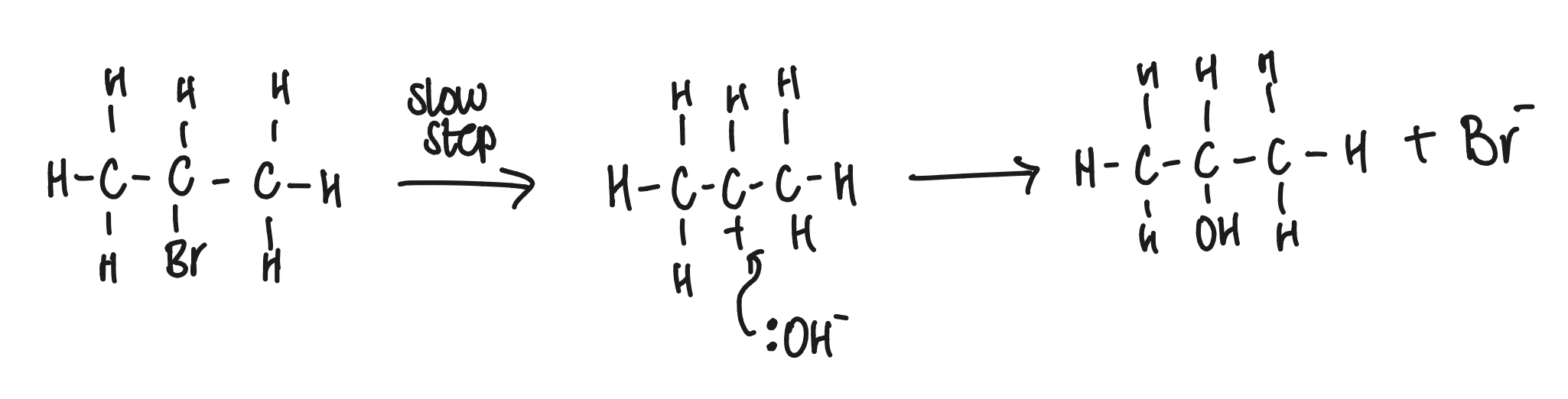
why 3° haloalkanes follow Sn1 mechanism
3° carbocations are relatively stable as they have 3 alkyl groups acting on them
Sn2 is difficult because of steric hindrance - backside attack needed in Sn2 but tertiary haloalkane is surrounded by the three bulky alkyl groups so blocks the nucleophile
why 1° haloalkanes follow Sn2 mechanism
if they followed Sn1, carbocation intermediate would not be stable enough (only 1 positive inductive effect)
there is no steric hindrance to stop the nucleophile attacking the delta positive carbon
2° haloalkanes Sn2 vs. Sn1
optically active mixture: Sn1
not optically active: Sn2
optically active but not 100%: mixture of Sn1 and Sn2