L5 - Erythrocyte structure & function pt. 1
 Call Kai
 Learn
 Practice Test
 Spaced Repetition
 Match
 Flashcards
 Knowt Play
1/54

There's no tags or description
Looks like no tags are added yet.
55 Terms
What is the Primary Function of Erythrocytes?
Transport and protect hemoglobin, which carries oxygen to tissues for aerobic metabolism
Why do RBCs enclose Hemoglobin?
To concentrate hemoglobin
Protect it from degradation and oxidation
Prevent free hemoglobin from damaging tissues
What Factors are required for Adequate Oxygen Delivery?
Functional RBCs and hemoglobin
Adequate RBC mass
Sufficient blood pressure
Appropriate vascular tone
What is the Difference between Anemia and Erythrocytosis?
Anemia: decreased RBC mass
Erythrocytosis: increased RBC mass
What gives Blood Its Red Color?
Iron-containing hemoglobin
Oxygenated blood is bright red
Deoxygenated blood is darker red

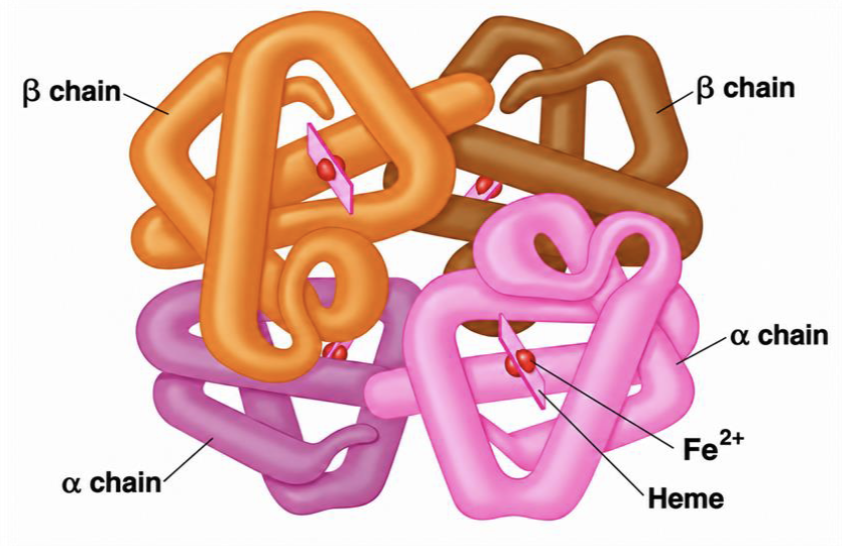
What is the General Structure of Adult Mammalian Hemoglobin?
Four globin chains (2α, 2β), each containing one heme group
Each heme binds one O₂ molecule
How does Hemoglobin Composition change during Development?
Embryonic and fetal globins support oxygen acquisition before birth
Adult globins predominate afterward
What is the Difference between Ferrous and Ferric Iron?
Ferrous (Fe²⁺) binds oxygen
Ferric (Fe³⁺) cannot bind oxygen and forms methemoglobin

Where do Oxygen Loading and Unloading occur?
Loading occurs in the lungs
Unloading occurs in Peripheral tissues
What is the Bohr Effect?
Changes in local pH and CO₂ alter hemoglobin's oxygen affinity → promoting unloading in active tissues
How do Low pH and High CO₂ affect Hemoglobin–Oxygen Affinity?
They decrease affinity → promoting oxygen unloading to metabolically active tissues
How do High pH and Low CO₂ affect Hemoglobin–Oxygen Affinity?
They increase affinity → promoting oxygen loading in the lungs
What is 2,3-DPG, and What is its Function?
An RBC metabolite that decreases hemoglobin's oxygen affinity → facilitating oxygen unloading
What does the Oxygen–Hemoglobin Dissociation Curve represent?
The relationship between oxygen partial pressure (PO₂) and the percentage of hemoglobin saturated with oxygen

What Conditions cause a Right Shift of the Oxygen Dissociation Curve?
Decreased pH
Increased CO₂
Increased temperature
Increased 2,3-DPG

What is the Effect of a Right Shift?
Decreased oxygen affinity
Increased oxygen unloading to tissues
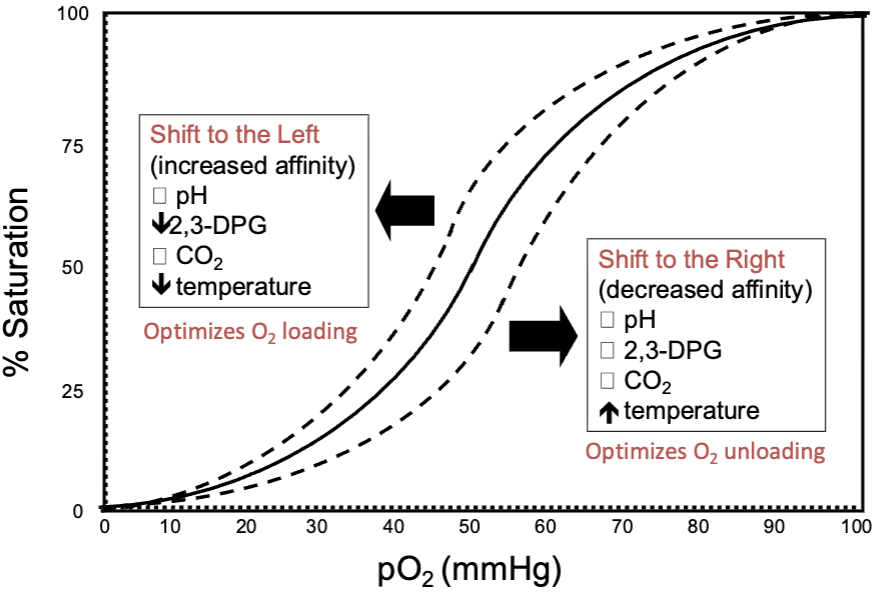
What Conditions cause a Left Shift of the Oxygen Dissociation Curve?
Increased pH
Decreased CO₂
Decreased temperature
Decreased 2,3-DPG

What is the Effect of a Left Shift?
Increased oxygen affinity
Reduced oxygen unloading to tissues

What are the Immediate Adaptations to High Altitude?
Hyperventilation causes respiratory alkalosis and a LEFT shift → splenic contraction can temporarily increase RBC mass
What are the Long-Term Adaptations to High Altitude?
Increased 2,3-DPG causes a RIGHT shift
Increased EPO stimulates RBC production and raises RBC mass
QUESTION: For the following conditions, in which direction would you expect the oxygen-Hgb dissociation curve to shift (↑ O2 affinity)
A horse finishing a 24-hr endurance ride
ANSWER → RIGHT
Endurance exercise increases metabolic activity, CO₂ production, and temperature, promoting oxygen unloading
QUESTION: For the following conditions, in which direction would you expect the oxygen-Hgb dissociation curve to shift (↑ O2 affinity)
Stored RBCs in the blood bank, with depletion of 2,3-DPG
ANSWER → LEFT
2,3-DPG decreases during storage, causing hemoglobin to retain oxygen more tightly
QUESTION: For the following conditions, in which direction would you expect the oxygen-Hgb dissociation curve to shift (↑ O2 affinity)
A cow with metabolic alkalosis due to abomasal displacement
ANSWER → LEFT
Increased blood pH increases hemoglobin's oxygen affinity
QUESTION: For the following conditions, in which direction would you expect the oxygen-Hgb dissociation curve to shift (↑ O2 affinity)
An intrepid Poodle, climbing Mt. Everest
ANSWER → RIGHT
Long-term acclimation increases 2,3-DPG, promoting oxygen unloading to tissues
Why do Mature RBCs rely on Anaerobic Glycolysis?
They lack mitochondria and therefore → generate ATP through anaerobic glycolysis
What are the Functions of the Embden–Meyerhof Pathway?
Produces ATP for membrane ion transport and osmotic balance
Plus NADH for methemoglobin reduction
What is the Function of the Pentose Phosphate Pathway?
Produces NADPH to support the glutathione antioxidant system
Protect RBCs from oxidative damage
What is the Function of the Methemoglobin Reductase Pathway?
Uses NADH to reduce Fe³⁺ to functional Fe²⁺ → maintaining hemoglobin's oxygen-binding ability
What is Methemoglobinemia, and What are Its Clinical Signs?
Excess oxidized hemoglobin (Fe³⁺), causing impaired oxygen transport, cyanosis, and muddy-brown blood

How can Methemoglobinemia occur despite Normal RBC Mass?
RBC numbers may be adequate, but oxidized hemoglobin cannot bind oxygen effectively
What is the Function of the Rapoport–Luebering Pathway?
Produces 2,3-DPG from glycolytic intermediates to regulate oxygen unloading
How does Hemoglobin Synthesis change during RBC Maturation?
Hemoglobin progressively accumulates while other cellular components decrease
Synthesis ends with maturation

What are the Major Steps of Heme Synthesis?
Succinyl-CoA and glycine initiate synthesis
Reactions occur in mitochondria and cytosol
Iron is inserted into the porphyrin ring
What is the Function of Ferrochelatase (Heme Synthetase)?
Inserts iron into the porphyrin ring during the final step of heme synthesis
How are Globin Chains Synthesized, and What determines Hemoglobin Type?
Globin genes direct protein synthesis
Amino acid sequences determine embryonic, fetal, adult, and species variants

Why is Feline Hemoglobin particularly Sensitive to Oxidative Injury?
It contains eight oxidation-sensitive sulfhydryl groups, MORE than most other mammals.
What are Porphyrias, and What Clinical Signs can occur?
Heme synthesis disorders causing porphyrin accumulation, tooth/bone discoloration or fluorescence, and photosensitivity

How does Lead Toxicosis interfere with Hemoglobin Synthesis?
Inhibits ALA dehydratase and ferrochelatase → reducing heme synthesis and disrupting RBC maturation

What RBC Abnormalities can occur with Lead Toxicosis?
Increased circulating nucleated RBCs
Basophilic stippling from retained ribosomal material

Why are Adequate Iron Stores essential for Hemoglobin Synthesis?
Iron forms the oxygen-binding center of heme
Deficiency limits hemoglobin synthesis and can cause anemia
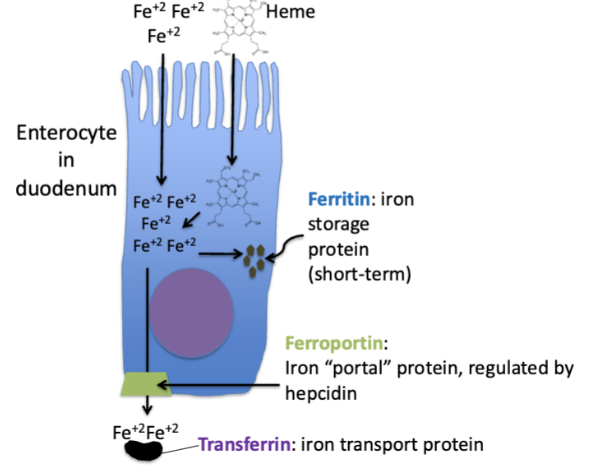
What are the Functions of Transferrin, Ferritin, and Hemosiderin?
Transferrin transports plasma iron
Ferritin stores readily available iron
Hemosiderin provides longer-term storage

How is Dietary Iron absorbed and transported?
Enterocytes absorb iron, store it or export it through ferroportin
Plasma transferrin transports exported iron.
How do Bone Marrow Macrophages support Erythropoiesis?
Nurse macrophages acquire, store, and release iron to developing erythroid cells for hemoglobin synthesis

How is Iron recycled from Senescent RBCs?
Macrophages remove old RBCs, recover hemoglobin iron, and store or export it for reuse in erythropoiesis

What is Hepcidin, and How does It regulate Iron Availability?
A liver-produced hormone that binds and degrades ferroportin, decreasing intestinal iron absorption and macrophage iron release

How do Blood Loss, Iron Deficiency, and Excess Iron affect Hepcidin?
Blood loss and iron deficiency decrease hepcidin
Abundant iron stores increase hepcidin
How does Inflammation affect Hepcidin and Erythropoiesis?
Inflammation increases hepcidin —> restricting iron availability and potentially causing anemia of inflammation
What is RBC Mass, and Which Measurements assess It?
The physical volume of circulating RBCs → assessed using HCT/PCV, RBC count, and hemoglobin concentration
How are Hematocrit and Packed Cell Volume determined?
Both reflect RBC mass.
HCT is calculated from RBC count × MCV
PCV is physically measured after centrifugation
What do MCV, MCH, and MCHC measure?
MCV: average RBC volume
MCH: hemoglobin amount per RBC
MCHC: average hemoglobin concentration within RBCs

Table 1. Oxygen–Hemoglobin Dissociation Curve
Feature | Right Shift | Left Shift |
O₂ affinity | Decreased | Increased |
O₂ unloading | Increased | Decreased |
pH | ↓ | ↑ |
CO₂ | ↑ | ↓ |
Temperature | ↑ | ↓ |
2,3-DPG | ↑ | ↓ |
Primary effect | Delivers O₂ to tissues | Retains O₂ more tightly |
Example | Exercise | Metabolic alkalosis |
Remember:
Right = Release O₂
Left = Hold O₂
Table 2. Major RBC Metabolic Pathways
Pathway | Main Product | Primary Function |
Embden–Meyerhof | ATP, NADH | Energy for ion transport and osmotic balance; NADH production |
Pentose phosphate | NADPH | Antioxidant protection via glutathione |
Methemoglobin reductase | Fe²⁺ | Maintains functional iron for O₂ binding |
Rapoport–Luebering | 2,3-DPG | Promotes O₂ unloading |
Remember: Mature RBCs lack mitochondria and rely on anaerobic glycolysis for ATP.
Table 3. Hemoglobin Synthesis Disorders
Disorder | Mechanism | Key Findings |
Porphyria | Defective heme synthesis enzymes → porphyrin accumulation | Teeth/bone discoloration or fluorescence; photosensitivity |
Lead toxicosis | Inhibits ALA dehydratase and ferrochelatase | Basophilic stippling; increased nucleated RBCs |
Iron deficiency | Insufficient iron for heme synthesis | Decreased hemoglobin production; anemia |
Table 4. Key Molecules in Iron Metabolism
Molecule | Primary Function |
Transferrin | Transports iron in plasma |
Ferritin | Readily available intracellular iron storage |
Hemosiderin | Long-term intracellular iron storage |
Ferroportin | Exports iron from enterocytes and macrophages |
Hepcidin | Degrades ferroportin, decreasing iron availability |
Key relationship: ↑ Hepcidin → ↓ Ferroportin → ↓ Iron availability
Table 5. Hepcidin Regulation in Clinical Conditions
Condition | Hepcidin | Iron Availability | Erythropoiesis |
Hemorrhage | ↓ | ↑ | ↑ |
Large iron stores | ↑ | ↓ | ↓ |
Iron deficiency | ↓ | ↑* | ↑* |
Inflammation | ↑ | ↓ | ↓ |
*In iron deficiency, decreased hepcidin promotes iron availability and erythropoietic drive, but actual RBC production may remain limited by insufficient iron stores.