Diamonds
 Call Kai
 Learn
 Practice Test
 Spaced Repetition
 Match
 Flashcards
 Knowt Play
1/226

There's no tags or description
Looks like no tags are added yet.
227 Terms
Macle
A flat, triangular contact-twinned diamond crystal

prism images of inclusions
Can be seen multiple times when viewed from adjacent facets

mirror reflections of inclusions
Can be seen twice when viewed from the opposite facet

spherical aberration
Optical flaw where light rays passing through the side of a curved lens focus at a different point than rays passing through the middle of the lens. Straight lines appear to bend.
chromatic aberration
Optical defect where a lens fails to focus all colours of light to the same point resulting in a rainbow effect around the viewing field.
The GIA clarity grading system is based on which 5 factors?
number
size
location
relief (contrast)
nature (type)
…of the inclusions.
The 10x triplet loupe has which 3 components?
Magnifying lense
Color correcting (achromatic) lens
Linear correcting (aplanatic) lens
Xtl
Crystal (incorrect: “bubble”)

Ndl
Needle

PP
Pinpoint

Cld
Cloud

TW
Twinning Wisp

Ftr
Feather (sometimes: “gletz”)

IG
Internal Graining

GC
Grain Center
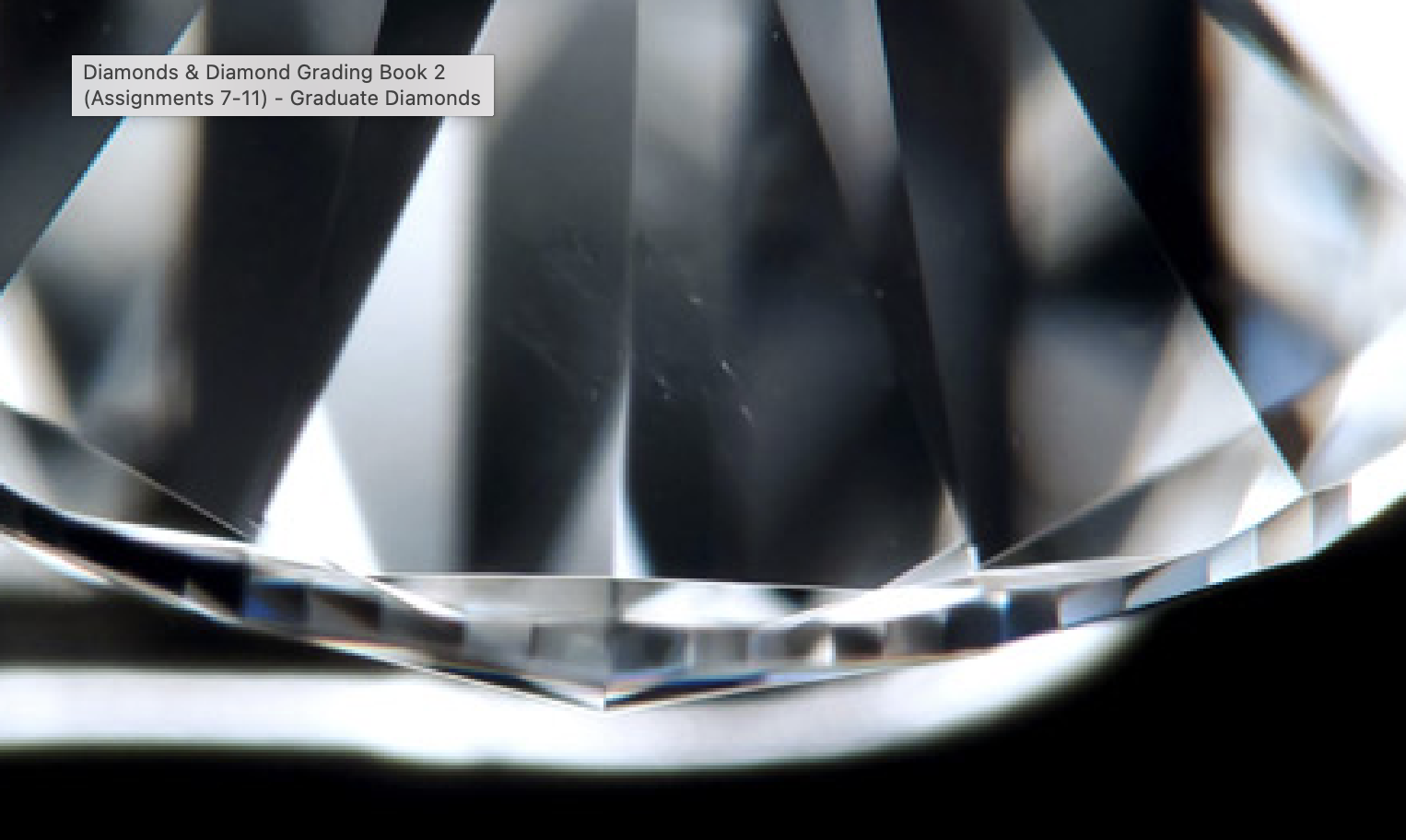
EC
Etch Channel
BG
Bearded Girdle

Br
Bruise (sometimes: “percussion mark”)

K
Knot

Patch
Patch of Color

Ch
Chip

Cav
Cavity
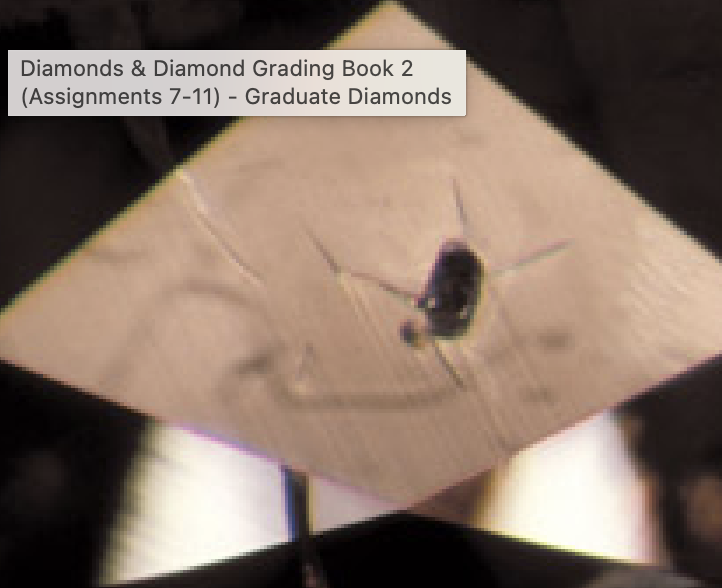
IN
Indented Natural

LDH
Laser drill hole

ILD
Internal laser drilling

Fracture filling
Treatment that involves injecting a molten glass substance into a diamond’s surface reaching feathers or drill holes to make the characteristic less apparent. GIA does not grade fracture filled diamonds because the treatment is not permanent. Tell-tale sign?

Flash effect
A flash of colour which changes to a second colour when you tilt the stone.

Nck
Nick (blemish)
Abr
Abrasion (blemish)

Scr
Scratch (blemish)

EF
Extra facet (blemish)

LS
Lizard skin (blemish)
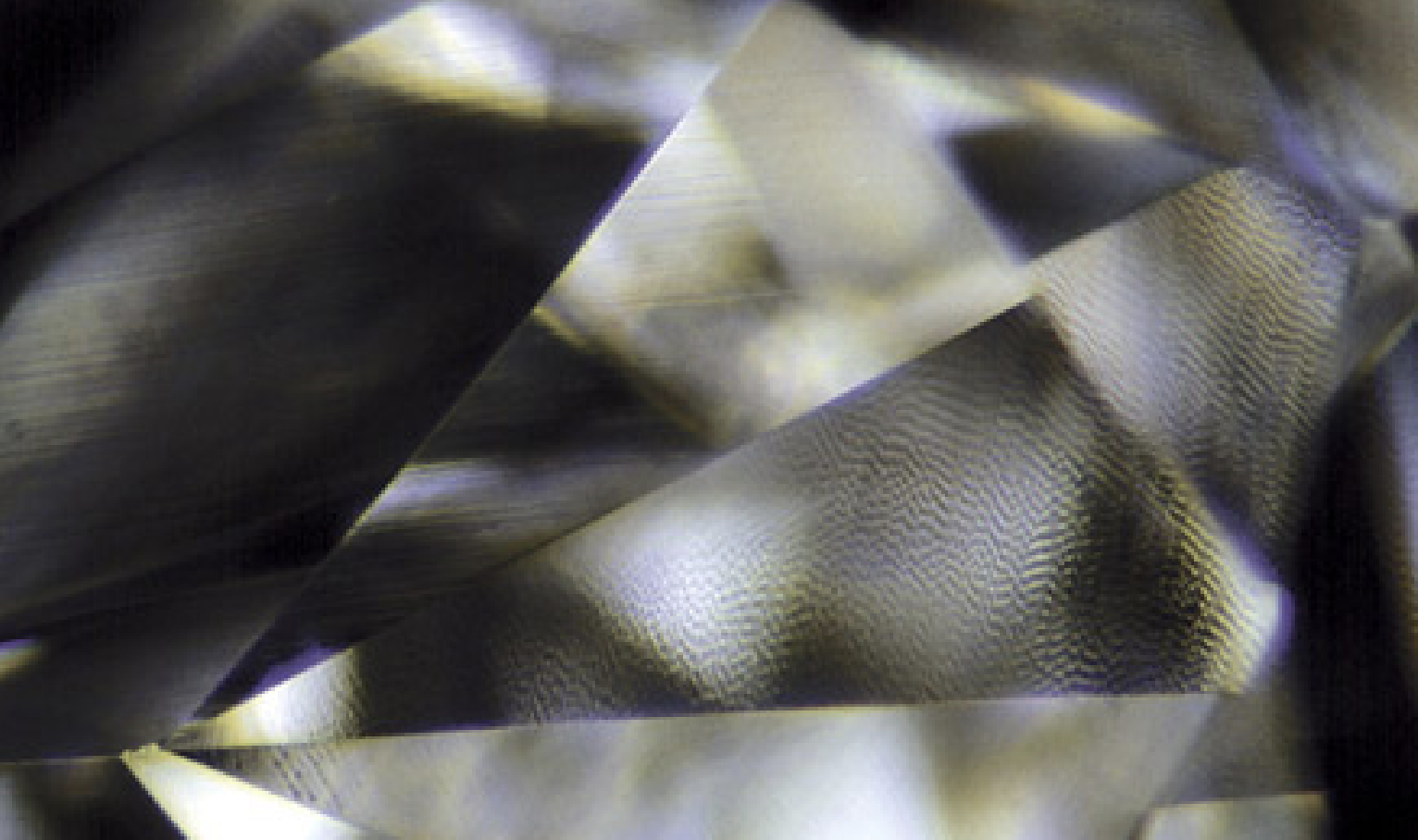
PL
Polishing lines (blemish)

Brn
Burn (blemish)

RG
Rough girdle (blemish)

Pit (blemish)
Small opening often accompanied by drag lines. Result of PP inclusion removed during polishing.

LMR
Laser manufacturing remnant. Can be blemish (surface groove) or inclusion (surface reaching fracture).

N
Natural (blemish)

SG
Surface graining (blemish)

Callable inclusion
Affects the clarity of the diamond and can be seen at 10x magnification
Non-callable inclusion
Does not affect the clarity and can therefore also exist on a flawless diamond
FL
Flawless
no inclusions or blemishes at 10x EXCEPT:
— extra facets not visible face up at 10x
— Naturals (N) confined to the girdle as long as they don’t thicken the girdle or distorted its outline
— internal graining (IG) if not it’s reflective, white, coloured and doesn’t affect transparency
— inscriptions that are not internal and do not penetrate at 10x
— mounting features
IF
Internally Flawless
only insignificant blemishes and no inclusions at 10x
— same features allowed as FL
— Normally, the blemishes on an IF diamond can be removed by very minor repolishing except for surface graining because this cannot be polished away
VVS
Very very slightly included
contain minute inclusions very difficult to see at 10x
— inclusions in VVS1 are extremely difficult to see face up, might only be visible through pavilion
— very difficult to see in VVS2
— A typical VVS1 stone might show a pinpoint or two, or reflective internal grinding that’s visible only through the pavilion or very faint through the crown
— if these characteristics show of more clearly through the crown, the stone would get a VVS2 grade
VS
Very slightly included
minor inclusions that range from difficult (VS1) to somewhat easy (VS2) to see under 10x
— All types of clarity characteristics possible
— Grade depend depends on overall visibility when considering all five grading factors
— typical inclusions are small crystals, knots, distinct clouds, or minor surface-reaching inclusions such as feathers, cavities, or indented naturals.
SI
Slightly included
noticeable inclusions that are easy (SI1) or very easy (SI2) to see at 10x
— All types of clarity characteristics possible
— Grade depends on overall visibility and considering all five grading factors
— most of the time the characteristics in an SI1 diamond are not visible face up without magnification
— Eye-visible inclusions are more often seen in an SI2 diamond
— typical inclusions include crystals, feathers, clouds and twinning wisps
I
Included
obvious conclusions at 10x
— Can be seen face up without magnification
— Seriously affect the stone’s durability
— Numerous or large enough to affect the transparency and brightness
— Often rough at this clarity level is used for industrial purposes
Proportions of a diamond
Proportions are the angles and relative measurements of a polished gem and the relationship between them.
→ Play a key role in the diamond’s light performance and appearance.
Polish
The overall condition of the facet surfaces of a finished diamond.
Symmetry
The exactness of a finished gem’s shape and the placement of its facets.
How can a diamond’s cut grade be estimated?
By visually evaluating its brightness, pattern and fire.
Scintillation
The dynamic sparkle, twinkle, and pattern of light-and-dark flashes you see when the diamond, the light source, or your eyes move.
Fire
A diamond’s display of dispersion.
Refractive Index
A measure of the change in speed and direction of light as it travels from the air to a certain material.
Average Girdle Diameter
(minimum girdle diameter + maximum girdle diameter) ÷ 2
Total Depth Percentage
(depth ÷ Average Girdle Diameter) x 100
Table-to-Culet depth. Expressed as % of average girdle diameter.
Well proportioned diamonds typically have total depth percentages around …?
60%
Diamonds with total depth percentages below … % are generally underweight?
55%
Diamonds with total depth percentages of …% or more are generally overweight?
65%
Table percentage
The size of a diamonds table is expressed as a percentage in relation to its average girdle diameter.
Most between 55 - 65%
The crown angle on a diamond is ideally between … and … degrees?
25 - 35°
A crown height percentage of …% and above is considered deep?
18.5%
ETN girdle
Extremely thin girdle
Knife-edge at 10x

VTN girdle
Very thin girdle
Very thin line at 10x

THN girdle
Thin girdle
Thin line at 10x

MED girdle
Medium girdle
Distinct line at 10x

STK girdle
Slightly thick girdle
Obvious at 10x

THK girdle
Thick girdle
Very obvious at 10x

VTK girdle
Very thick girdle
Distracting at 10x

ETK girdle
Extremely thick girdle
Very distracting at 10x

Design
A diamond’s physical shape, including its proportions and durability.
Finish
The quality of the polish and precision of the cut of a fashioned gemstone.
OR
Out-of-Round
The girdle outline doesn’t look perfectly round.
T/oc
Table off-center.
The table is not centered in the crown
C/oc
Culet off-center.
The culet is not centered in the pavilion.
T/C
Table/Culet alignment.
Table and culet are displaced in opposite directions.
GTV
Girdle thickness variation.
Variations in the girdle thickness
CV
Crown angle variation.
Variation in measurements of all eight crown angles. Typically related to T/oc
CHV
Crown height variation.
Variation in the diamond’s eight crown height measurements
SV
Star angle variation.
Unequal star facet angles
PV
Pavilion angle variation.
Variation in measurements of all eight pavilion angles. Typically related to C/oc
SPV
Star percentage variation.
Variation in the diamond’s eight measured star facet length percentages
UHP
Upper half variation.
Unequal upper half facet angles
LPV
Lower half percentage variation.
Variation in the diamond’s eight measured lower half facet length percentages
LHV
Lower half variation.
Unequal lower half facet angles
MF
Missing facet.
A facet that should be in a given location is absent
EF
Extra facets
Facets not required by the cutting style are placed without regard for the diamond’s symmetry
T/oct
Non-octagonal table.
The table doesn’t have eight sides of equal length and parallel opposing sides. This results in star and bezel facets that are also misshapen.
Fac
Misshapen facets.
Facets are not properly shaped or they’re not the same size and shape as others of the same type
Ptg
Non-pointing.
Facets failed to meet at precise points or a fully formed facet doesn’t reach its prescribed location
Aln
Misalignment.
Crown and pavilion facets not aligned with each other
Beneficiaton
A commitment to reserve a portion of the resources derived from a country for its economic development.
Central Selling Organisation (CSO) , later Diamond Trading Company (DTC)
The marketing and sales arm of De Beers
Downstream
The retail portion of the diamond value chain.
Upstream
The mining and rough distribution part of the diamond value chain.
Bort
Industrial grade diamond, heavily included, yellow, gray, brown
Sight
Rough diamond sales event where long-term customers buy from producers based on contracts.
Vertical Integration
A business strategy of operating in more than one segment of the value chain to make more profit.
Carbonado
An aggregate of many randomly oriented interlocking tiny diamond crystals that is the toughest form of diamond. Used for industrial purposes. Usually opaque, dark, and porous, with a glassy appearance and an irregular surface. Sourced only in Brazil and Central Republic of Africa.
CLIPPIR diamonds
Cullinan-like
Large
Inclusion-Poor
Pure
Irregular
Resorbed
Superdeep diamonds from the transition zone. The carbon comes from an oceanic plate that has been subducted. The growth medium for these diamonds are metallic melts that dissolve the carbon from the oceanic plate.