Unit 5 AP Euro
 Call Kai
 Learn
 Practice Test
 Spaced Repetition
 Match
 Flashcards
 Knowt Play
1/72

There's no tags or description
Looks like no tags are added yet.
73 Terms
The political idea that power comes from the people, not God, and that it remains with the people.
popular sovereignty
The political concept, advocated by Montesquieu, where government’s powers are divided into different branches, such as executive and legislative.
separation of powers
The first successful revolt by a colony against rule by a European mother country. The 13 British colonies revolted against foreign rule. It ended in an American victory and the establishment of the first federal Republic in history.
American Revolution (1775 - 1783)
This was the North American theater (region) of the European conflict called the Seven Years’ War. It was fought between Britain and its American colonies against France and its French colonies in North America. Most Native Americans fought for the French side in the conflict. It ended in a major British victory.
French and Indian War (1754 - 1763)
One of the most important political documents ever written, it was inspired by the social contract theory of Locke and was written by Thomas Jefferson. It lays out the reasons for the American rejection of British rule.
Declaration of Independence
Pre-Revolutionary term for the Catholic clergy of France.
First Estate
Pre-Revolutionary term for the Catholic clergy of France.
Second Estate
Pre-Revolutionary term for the masses of French society prior to the Revolution. It included peasants, bourgeoisie, and the urban poor.
Third Estate
One of the lower classes. They are rural, agricultural free laborers.
peasants
This was a slang term that referred to the urban working poor.
sans-culottes
Term referring to the urban, educated middle and upper classes.
bourgeoisie
A hated tax paid only to the common people of France, not by the clergy or the nobility.
taille
The historic parliament of France, it was a body that the French king could consult at will. It lacked the same type of powers that the British Parliament possessed.
Estates-General
These were lists of grievances drawn up by each of the three estates; they were reform suggestions and included demands such as fair taxation and equal voting rights.
cahiers de doleances
The delegates of the Third Estate declared the end of the Estates-General and the formation of the National Assembly as the new parliament of France. It was dominated by the bourgeoisie.
National Assembly
On June 20, 1789, the King ordered that the National Assembly be locked out of their meeting room. The delegates regrouped on a tennis court at Versailles and swore not to disband until they had written a constitution for France.
Tennis Court Oath
A military force that is made up of civilians rather than soldiers, usually put together in times of emergency.
militias
A large fortress in the heart of Paris that served as a hated prison. On July 14, 1789, a Paris mob stormed it in search of weapons. They mob killed several soldiers. This is a major event of the Revolution.
Bastille
In the summer of 1789, a panic swept across France that the nobility was going to crush the new Revolution. Angry peasant mobs attacked the estates of the nobles and burned many to the ground.
Great Fear
These were the ancient requirements that peasants needed to work several days each month on the lands of the nobility.
manorial obligations
Written by the delegates of the National Assembly during the summer of 1789, this is the first constitution of France. It promised equal rights for all French men.
Declaration of the Rights of Man and Citizen
This is considered to be one of the first mistakes of the Revolution. This law required all French Catholic clergy to swear an oath of loyalty to the nation over the Church. It turned the Church into an enemy of the Revolution.
Civil Constitution of the Clergy
The most common system of measurement used in the world. It uses the meter, liter, and gram as units of measure. It was first adopted by France during the Revolution.
metric system
This became the famous three-word motto of the Revolution; it sums up the ideals of the Revolution.
“Liberty, Equality, Fraternity”
On October 5, 1789 thousands of Parisian poor women marched to Versailles to demand that King Louis XVI do something to lower the price of bread. It grew violent. The women forced the King and his family to leave Versailles and return to Paris.
Women’s March
This was the first successful slave revolt against European rule to occur. It began in 1791 when Black slaves overwhelmed the French planters in the Caribbean colony of Saint-Domingue. The slave rebels established the first Black ruled republic in world history and successfully defended their independence against Napoleon’s attempt to reestablish French control.
Haitian Revolution
A general increase in prices and a decline in the purchasing power of the money.
inflation
French term for those French nobles who fled from revolutionary France and went to other European nations. Many helped the foreign powers against France.
emigres
A 1792 agreement between Austria and Prussia pledging to work together to crush the Revolution and to restore the old order in France.
Declaration of Pillnitz
This was a new French parliament that replaced the National Assembly in October 1791. It was dominated by younger bourgeoisie who favored more radical reforms.
Legislative Assembly
The most important political group to appear in the early Revolution. They were the most radical and violent faction in the National Convention. They ran the nation during the Reign of Terror.
Jacobins
They were a moderate faction of the Jacobins who supported the Revolution but opposed extremism, such as the execution of the king.
Girondin
Mountain
The were the most radical faction of the Jacobins. They dominated France during the Reign of Terror. They supported the execution of the King and declared war on Austria and Prussia.
This was the most extreme and violent phase of the Revolution. Thousands of people were arrested and executed on the guillotine as enemies of the Revolution. It ended with the execution of Robespierre in July 1794.
Reign of Terror
A new French parliament that was elected in the fall of 1792. It governed the nation during both the Terror and the Directory.
National Convention
A group of 12 delegates, selected by the National Convention, given dictatorial power over France during the Reign of Terror. Robespierre emerged as the leader of this group.
Committee of Public Safety
A brief, violent period during the summer of 1794 when several thousand leaders of the Terror were arrested and executed. Robespierre’s execution in July 1794 began this.
Thermidorean Reaction
A new government formed after the end of the Terror It was made up of 5 delegates selected by the Convention. It lasted from 1794 until Napoleon seized power in November 1799.
Directory
A term for the overthrow of a legitimate government by military force.
coup d’etat
The study of human history and prehistory through the excavation of artifacts.
archeology
An archeological wonder, this is a massive stone tablet from the second century BCE, discovered by Napoleonic troops in Egypt in 1798. It contained the same message written in three different languages (hieroglyphics, Demotic, and ancient Greek).
Rosetta Stone
The first government of Napoleon, it lasted from November 1799 until he proclaimed the Empire in May 1804. Napoleon gradually emerged as the single ruler of the nation.
Consulate
An 1801 agreement between Napoleon and the Pope that ended the hostility between the Church and France. The Church recognized Napoleon as the rightful ruler of France and Napoleon restored much of the Church’s rights (but not lands).
Concordat with the Church
Indifferent or hostile to religion, or holding no religious beliefs at all.
irreligious
Authorized by Napoleon, a panel of judges wrote a national legal code for France in 1804 that replaced old regional feudal codes. It created a rational system of modern laws that was adopted by nations all over the world.
Code Napoleon (AKA Napoleonic Code)
A direct vote by the common people on a significant issue in which the choice is between “yes” and “no.”
plebiscite
It began when Napoleon proclaimed himself Emperor in May 1804 and ended with his forced abdication in April 1814. It was briefly restored during the Hundred Days of 1815.
First (Grand) Empire
The European diplomatic goal of preventing any single nation from dominating the entire continent. Britain was especially dedicated to it.
balance-of-power
A nation that is officially independent, but is in fact controlled by a different nation.
puppet-state
A Napoleonic puppet-state that lasted from 1807 - 1814. It restored a measure of Polish independence that Poland had lost after the partitions of the 1790’s.
Grand Duchy of Warsaw
A Napoleonic puppet-state that created the first unified German state since the Treaty of Westphalia in 1648. It lasted from 1806 - 1813.
Confederation of the Rhine
Term for Napoleon’s plan to ban all European trade with Britain in hopes of bringing that nation to economic ruin. It banned the sale of goods to Britain and the import of British goods to the continent.
Continental System
The strategy of using economic tactics, such as tariffs and embargos, against rivals in hopes of causing financial collapse.
economic warfare
A brutal conflict that began when Napoleon’s forces occupied Spain. The Spanish, with British support, began a long, guerilla war that drained French strength during the conflict.
Peninsular War (1807 - 1814)
A defensive military tactic where an inferior force utilizes tactics that defy the conventional rules of warfare such as the wearing of uniforms and the taking of prisoners.
guerilla warfare
The disastrous June 1812 military invasion of Russia by Napoleon’s Grand Armee. The Russians retreated all summer, drawing the French deep into Russia. When the winter began, the French began an epic retreat.
Invasion of Russia
A military defensive tactic where a retreating army burns all resources that an advancing enemy could possibly use, including structures, towns, and fields of crops.
scorched earth
One of the most important diplomatic events in European history, the Congress went from November 1814 to June 1815. The goal of the diplomats was to restore European order after the defeat of Napoleon.
Congress of Vienna
He served as the Austrian Foreign Minister and later the Chancellor (Prime Minister) during most of the first half of the 1800’s. His conservative views dominated European international politics for decades after the Congress of Vienna.
Prince Metternich
The act of returning a monarch to their throne, a government to power, or the control of a previous regime.
restoration
Something that is legal, rightful, or appropriate.
legitimacy
The period from March to July 1815 when Napoleon escaped from Elba and attempted to restore his control over France. It ended with his defeat at Waterloo and his capture and exile to St. Helena.
Hundred Days
Decisive June 1815 battle, the last in Napoleon’s career. He was defeated by Prussian and British forces led by the Duke of Wellington. Napoleon was later taken prisoner and sent to his final exile.
Battle of Waterloo
A pamphlet written by a French clergyman who had sympathies with the common people. He argued that the common people were the real France, not the nobility or even the Church. It inspired many people.
“What is the Third Estate?” by Abbe Sleyes (1789)
This is the first constitution of France. It was written by a group of delegates from the National Assembly. It promised basic human rights like free speech, free press, and freedom of religion.
“Declaration of the Rights of Man and Citizen” by National Assembly (1789)
The female author was angry that the Declaration of the Rights of Men seemed to leave the women of France out. She argued that since women paid the same taxes, obeyed the same laws, and were punished the same way, they should have the same privileges.
“Declaration of the Rights of Women” by Olympe de Gouges (1791)
This British work is the foundation of conservatism. He argued that the Revolution was too extreme and that no single generation had the right to destroy the work done by all previous generations.
“Reflections on the Revolution in France” by Burke (1790)
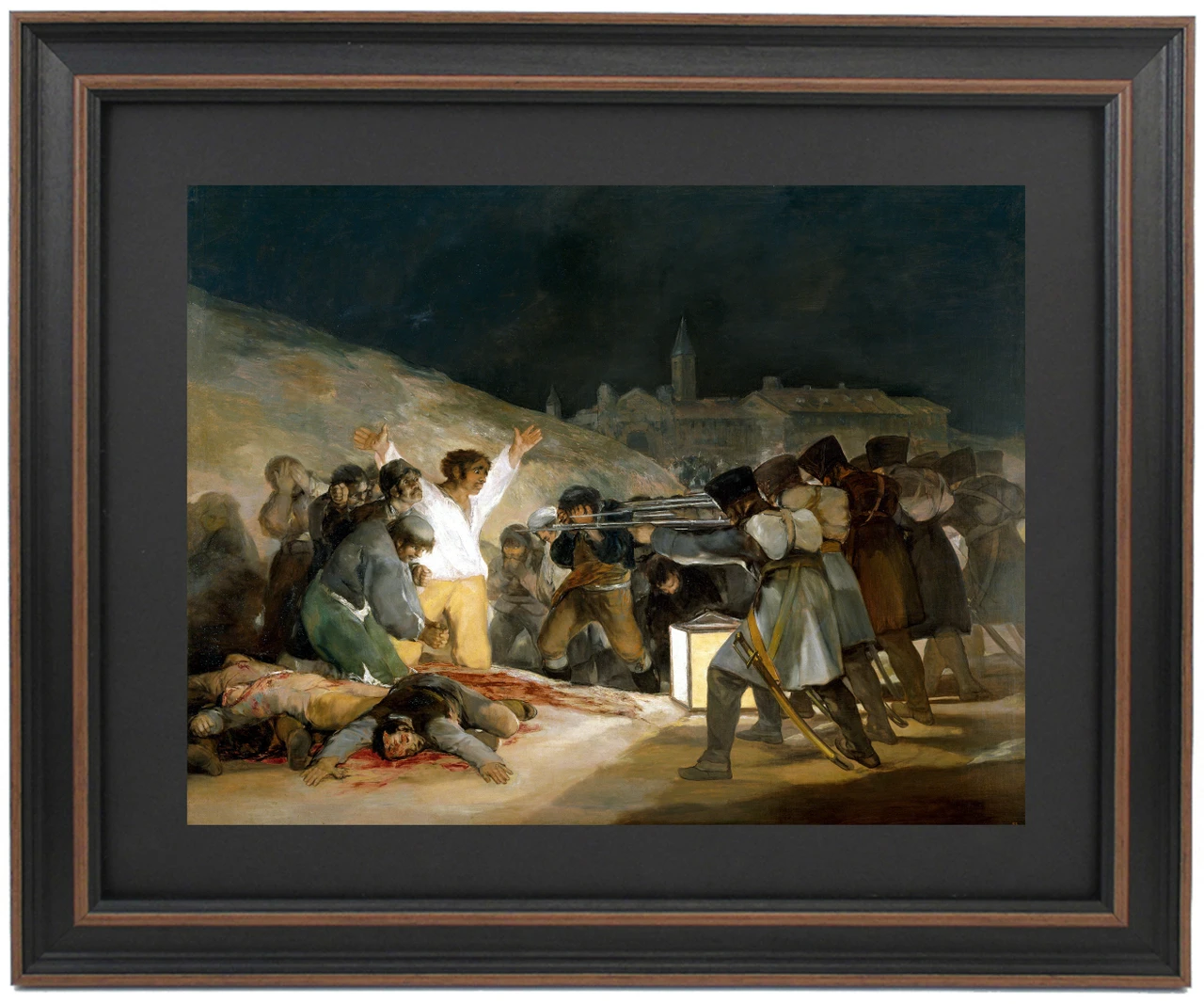
“Third of May” by Francisco Goya

“Death of Marat” by Jacques-Louis David

“Marie Antoinette With a Rose” by Elizabeth Vigee Lebrun

“The Tennis Court Oath” by Jacques-Louis David

“Coronation of Napoleon” by Jacques-Louis David

“Emperor Napoleon I Sitting on his Throne” by Ingres