UE Limb Loss
 Call Kai
 Learn
 Practice Test
 Spaced Repetition
 Match
 Flashcards
 Knowt Play
1/53

There's no tags or description
Looks like no tags are added yet.
54 Terms
3 most common reasons =
- trauma
- tumor
- vascular compromise (PVT)
3 less common reasons =
- infection
- congenital
- disease progression
3 different names for hand, partial hand and digits amputations =
- trans-phalangeal
- trans-metacarpal
- trans-carpal
**most common!
6 other types of UE amputations =
- wrist disarticulation
- trans-radial (next most common)
- elbow disarticulation
- trans-humeral
- shoulder disarticulation
- fore quarter amputation

the "golden period" of fitting for UE prosthesis is __ _____
30 days
success rate of patients fit within 30 days is ____%
93
success rate of patients fit after 30 days is ___%
42
5 types of UE prosthetics =
- no prosthesis
- passive functional / cosmetic
- body-powered / conventional
- myoelectric / external power
- hybrid
why do some individuals choose not to use a prosthetic?
- experiences: poor initial fitting
- function: limited benefit
- training: insufficient education and training
- financial: cost and maintenance
- appearance: cosmetic concerns
cost, functionality, durability and user effort of passive functional / cosmetic =
- COST: low
- FUNCTIONALITY: low
- DURABILITY: moderate
- USER EFFORT: low
cost, functionality, durability and user effort of body-powered / conventional =
- COST: low
- FUNCTIONALITY: high
- DURABILITY: high
- USER EFFORT: high
cost, functionality, durability and user effort of myoelectric / external power =
- COST: high
- FUNCTIONALITY: high
- DURABILITY: moderate
- USER EFFORT: low
cost, functionality, durability and user effort of hybrid =
- COST: high
- FUNCTIONALITY: high
- DURABILITY: moderate
- USER EFFORT: low
4 advantages of a passive functional/cosmetic =
- lightweight, simple
- little maintenance
- inexpensive
- improved appearance
3 disadvantages of a passive functional/cosmetic =
- limited grasp function
- decreased durability
- unreal expectations for cosmesis
goal of amputation =
Preserve length of residual limb
6 important things when trying to achieve the goal of amputation =
- Skin integrity (decreasing scar formation)
- ROM and contracture prevention (Positioning, stretch)
- Strengthening and endurance
- Future Function
- prosthetic readiness
- participation and QOL
what is myodesis?
Muscle sutured to bone
what is myoplasty?
Suturing muscle to muscle
- less ideal
7 complications of UE limb loss =
- Residual limb pain: contractures, prosthetic acceptance
- Phantoms sensation : body asymmetry, PTSD (85% of people)
- Phantom pain: overuse syndromes, body image concerns (85% of people)
- neuroma: pain
- HO: ROM
- Skin breakdown: cannot use it
- Edema: fluctuating size
4 levels of partial hand amputation =
- transphalangeal (THUMB SPARED)
- thenar partial or complete
- transmetacarpal, distal (THUMB SPARED OR INVOLVED)
- transmetacarpal, proximal (THUMB SPARED OR INVOLVED)
in a partial hand amputation, preservation of 2 sensate digits allow for the ability to do what?
ability to oppose each other, some prehension-the ability to approach, grasp, and release os
in a partial hand amputation, salvage of a third digit allows for what?
a more stable terminal pinch, improving precision motions
in a partial hand amputation, a ___ ____ will reduce hand width, leading to decreased grip strength, but improving the appearance of finger loss
ray resection
what are the 2 distal surgeries?
digits and partial hand
what are the 2 mid-level surgeries?
wrist disarticulation and transradial
what are the 3 proximal surgeries?
elbow disarticulation, transhumeral, shoulder disarticulation
what surgery happens a lot more in the UE than it does in the LE?
osteointegration
terminal devices: what is a voluntary opening?
- Opens when user exerts tension on the cable
- When tension is released, spring / rubber band closes the hand
- Pinch force can be adjusted by spring / rubber band
terminal devices: what is a voluntary closing?
- Closes when user exerts tension on the cable
- Pinch force is determined by wearer (strong/light)
- variable grip force but greater training needed
what does a manipulator help you do?
basic things
- open a door
3 different types of hands =
functional, mechanical, electric
what are the differences between a prosthetic hand vs a split hook?
prosthetic hand
- heavier in weight
- more difficult to see objects being grasped
- more complex mechanically
- cannot get into pockets
- less versatile as a tool
- more cosmetic in appearance
split hook
- lighter in weight
- easier to see objects being grasped
- simpler mechanically
- will fit into pockets
- versatile as a tool
- not cosmetic
what is a bebionic v3 hand?
an advanced bebionic hand myoelectric prosthetic hand controlled by electrical signals from muscle movements in the residual limb
what is a michealangelo hand by otto block?
an advanced electronic myoelectric prosthetic hand that uses muscle signals from your residual limb to perform natural movement
what is a body powered / conventional prosthetic?
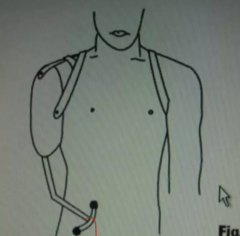
- Components on the prosthesis are operated by a harness system (Elbow, Terminal device (hand), Either VO/voluntary opening or VC/voluntary closure)
- the harness system is controlled by gross body movement (scap abduction, chest expansion, shoulder depression)
- limited cosmetic features compared to myoeletric
what does a single control harness when it comes to body powered / conventional control?
operates the terminal device (hand)
what is a double control harness when it comes to body powered / conventional?
- 2 control cables are used
- Activation of term device and elbow/forearm flexion
- Elbow joint lock/release
body powered / conventional shoulder disarticulation: elbow flexion, terminal device, elbow lock =
- ELBOW FLEXION: biscapular abduction and lats activation
- TERMINAL DEVICE: biscapular abduction and lats activation
- ELBOW LOCK: scapular elevation
body powered / conventional transhumeral: elbow flexion, terminal device, elbow lock =
- ELBOW FLEXION: biscapular abduction and humeral flexion
- TERMINAL DEVICE: biscapular abduction and humeral flexion
- ELBOW LOCK: shoulder depression and humeral abduction and extension
body powered / conventional transradial: elbow flexion, terminal device, elbow lock =
- ELBOW FLEXION: intact
- TERMINAL DEVICE: biscapular abduction humeral flexion
- ELBOW LOCK: intact
cost, grip force, and harness for a body powered / conventional =
- less expensive
- reduced grip force
- harness can be cumbersome
- possible overuse/nerve entrapment
cost, grip force, and harness for a myoelectric / external power =
- higher cost
- greater grip force
- reduced need for harness
- increased weight
cost, grip force, and harness for a hybrid =
- increased post
- greater grip force
- reduced need for harness
- reduced weight
what is targeted muscle reinnervation (TMR)?
spare muscles in chest or limb are denervated and reinnervated with residuals nerves of amputated limb
problem with TMR =
severed nerves can cause pain and poor control
solution for TMR =
reroute nerve -> viable muscle
outcomes of TMR =
reduced neuroma pain, reduced phantom pain, better prosthetic control, more natural movement
what is targeted sensory reinnervation (TSR)/regenerative peripheral nerve interface (RPNI)?
advanced neuro-prosthetic and reconstructive surgical techniques designed to manage post-amputation nerve pain and improve the control of advanced prosthetic limbs
problem with TSR =
severed nerves can cause pain and poor control and poor body image
solution for TSR =
- Skin is touched - the amputee feels as if the missing limb is being touched - the brain has new sensory signals
- When combined with a special prosthetic device, the amputee can receive sensory feedback from the prosthesis, which can improve balance and gait
UE amputation is the final result when what is not possible?
surgical salvage
preserving what 2 things help improve the successful use of a prosthesis by a client and can be accomplished with a multitude of techniques?
bony length and shoulder/elbow function
what is the ultimate goal of amputation surgery?
to provide a sensate residual limb that can best interact with the client's environment with and without a prosthesis