Vet Phys - Resp. 7
 Call Kai
 Learn
Learn Practice Test
 Spaced Repetition
 Match
Match Flashcards
 Knowt Play
1/56

There's no tags or description
Looks like no tags are added yet.
Name | Mastery | Learn | Test | Matching | Spaced | Call with Kai | Chat |
|---|
No analytics yet
Send a link to your students to track their progress
57 Terms
How does intracellular PO₂ affect the rate of oxygen usage by cells?
Cells only need about 1 mmHg of intracellular O₂ to function normally.
When intracellular PO₂ > 1 mmHg, O₂ usage remains constant for a given intracellular ADP concentration.
What is the rate limiting factor?
ADP
What happens when intracellular PO2 is > 1 mmHg?
O2 usage rate becomes constant for any given concentration of ADP in the cell.
What happens when the ADP concentration is altered?
the rate of O2 usage changes in proportion to the change in ADP concentration.
What controls the rate of O2 usage by the cell during normal operating conditions?
it’s controlled ultimately by the rate of energy expenditure within the cells—that is, by the rate at which ADP is formed from ATP
Therefore, as long as the intracellular PO2 remains > 1 mmHg, the controlling factor for the rate of oxygen usage is the intracellular concentration of ADP.
What happens when tissue cells are oxygen limited and PO2 falls below the required amount?
O2 usage is no longer determined by ADP concentration. Neither of the two states below can continue for long before cell death occurs
Diffusion limited
Blood-flow limited
What happens if diffusion is limited?
cells are rarely more than 50 um from a capillary to avoid this condition, usually occurs in pathological states
What happens if blood flow is limited?
if blood flow rate falls to zero, available O2 also falls to zero
How does oxygen bind hemoglobin?
loosely and reversibly
How does CO bind to hemoglobin?
It binds at the same place on hemoglobin as oxygen does → displacement of oxygen
What is the binding affinity of CO?
250x
How does the dissociation curve of CO binding compare to O2?
The dissociation curve is very similar to oxygen but CO only needs 0.4 mmHg (versus 100 mmHg for oxygen) to compete with oxygen for binding
A partial pressure of 0.6 mmHg can quickly be lethal
What is the allosteric affect of CO?
CO binding also causes oxygen to bind more tightly to hemoglobin, shifting oxygen dissociation curve to the left
O2 and Hb are no longer bound loosely and reversibly, Hb unable to deliver oxygen
What is the clinical relevance of COHb?
pulse ox can often misread COHb as oxyhemoglobin, thus showing normal oxygen levels.
What happens when Hb binds O2 more tightly?
O2 content in blood is reduced but PO2 is not reduced (unbound oxygen remains the same) → Respiratory centers of the brain aren’t stimulated, worsening oxygen delivery
What is the amount that CO2 can be transported compared to O2?
CO2 can typically be transported in far greater quantities than O2
How much CO2 is transported per 100 mL blood?
Under normal resting conditions, an average of 4 ml of CO2 are transported from the tissues to the lungs in each 100 ml of blood.
CO2 removal step 1
Dissolves easily in molecular form from cells
CO2 removal step 2
Upon entering capillaries, most of CO2 undergoes instantaneous physical and chemical reactions
Carbonic anhydrase enzyme in RBC’s
CO2 + H2O → H2CO3 (carbonic acid)
Catalyzes reaction 5000x
Almost instantaneous
CO2 removal step 3
Carbonic acid dissociates
H2CO3 → H+ + HCO3- (bicarb)
H+ binds with hemoglobin, bicarb diffuses out of RBC and is replaced by Cl-
CO2 removal step 4
Special bicarbonate-chloride carrier protein in the red blood cell membrane that shuttles these two ions (H+ and HCO3-) in opposite directions at rapid velocities.
What is the chloride shift?
The chloride content of venous red blood cells is greater than that of arterial red blood cells
from Cl- binding in place of bicarb
What is some clinical context for carbonic anhydrase in dogs?
Acetazolamide (brand name: Diamox®) is a diuretic and antiglaucoma agent
It is also a carbonic anhydrase inhibitor
Blocking carbonic anhydrase action in RBC’s can cause CO2 transport from the tissues to become so poor that the tissue PCO2 may rise to 80 mm Hg instead of the normal 45 mm Hg
Can lead to hyperchloremic metabolic acidosis and potential acidemia in dogs
How else is CO2 moved?
In addition to reacting with water, CO2 reacts directly with amine radicals of the hemoglobin molecule → Forms carbaminohemoglobin (CO2Hgb).
This combination of CO2 and hemoglobin is a reversible reaction that occurs with a loose bond
How does CO₂ react directly with hemoglobin?
CO₂ reacts with the amine radicals of hemoglobin to form carbaminohemoglobin (CO₂Hgb).
Is the binding of CO₂ to hemoglobin reversible?
Yes. CO₂ binds to hemoglobin through a loose, reversible bond, allowing CO₂ to be released when needed.
Does CO₂ also bind to plasma proteins?
Yes. A small amount of CO₂ reacts with plasma proteins in the tissue capillaries in a similar way.
The quantity of plasma proteins is only about ¼ the quantity of hemoglobin in the blood.
What percentage of CO₂ transport is associated with carbonic anhydrase and hemoglobin?
With most CO2 transport being done by RBCs
70% of CO₂ transport involves the carbonic anhydrase pathway
23% is transported directly bound to hemoglobin as carbaminohemoglobin
7% being CO2 itself
What does the carbon dioxide dissociation curve demonstrate?
It demonstrates the dependence of total blood CO2 in all its forms on PCO2
What are the normal arterial and venous PCO₂ values?
Arterial PCO₂: ~40 mmHg
Venous PCO₂: ~45 mmHg
The normal blood PCO₂ is maintained within a narrow range.
What is the normal concentration of total CO₂ in the blood?
The blood contains about 50 volume% CO₂ in all its different forms.
How much of the blood's CO₂ content is actually exchanged during normal transport from tissues to lungs?
Only about 4 volume% of the total blood CO₂ is exchanged during normal CO₂ transport.
How does blood CO₂ concentration change as blood travels through the tissues and lungs?
the concentration rises to about 52 volume % as the blood passes through the tissues and falls to about 48 volume % as it passes through the lungs.
What is the Bohr effect?
Increasing CO2 in blood displaces O2 from hemoglobin
increases O2 transport
occurs systemically
What is the Haldane effect?
The reverse of the Bohr effect - binding of O2 w/ Hb tends to displace CO2 from the blood
occurs in the lungs
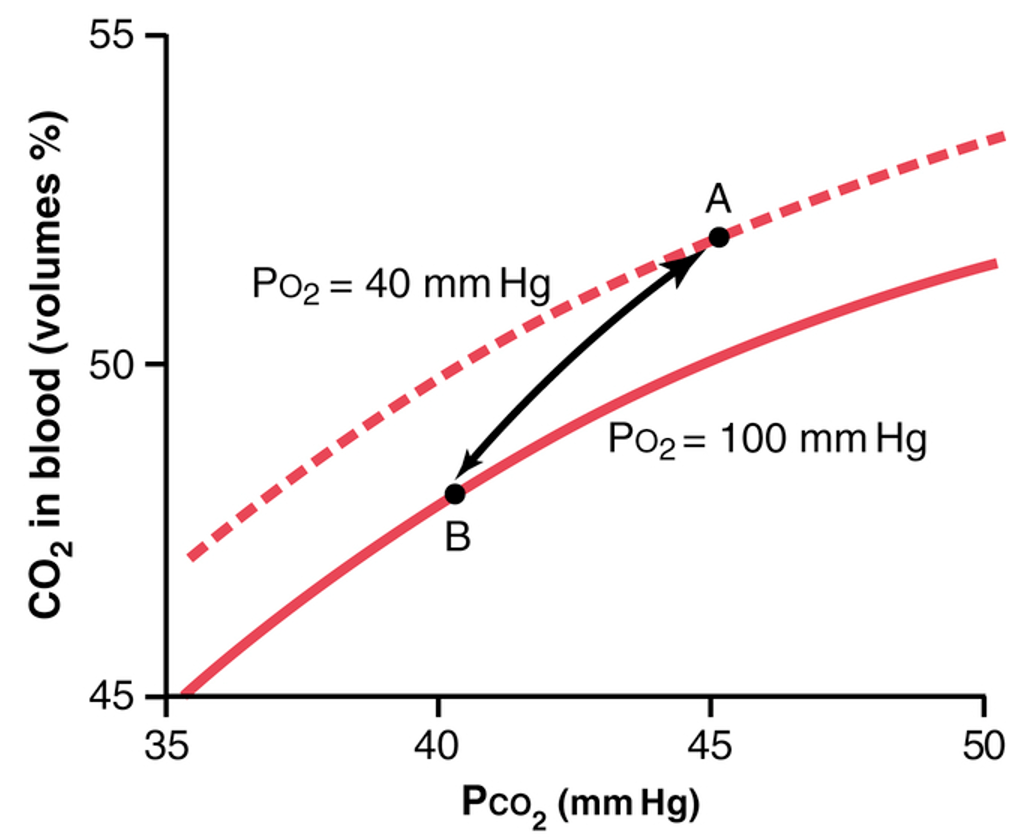
What does Point A represent on the CO₂ dissociation curve?
At the tissues:
PCO₂ = 45 mmHg
Blood CO₂ content rises to ~52 volume%
This represents CO₂ being picked up by the blood from the tissues.
What happens to PCO₂ and PO₂ when blood enters the lungs?
PCO₂ falls: 45 → 40 mmHg
PO₂ rises: → 100 mmHg
The increase in PO₂ is important because of the Haldane effect.
Without the Haldane effect, how much CO₂ would be released in the lungs?
Without the Haldane effect, the CO₂ dissociation curve would not shift.
Blood CO₂ content would fall from 52 → 50 volume%, releasing only 2 volume% CO₂.
What does the Haldane effect do to the CO₂ dissociation curve in the lungs?
The increase in PO₂ causes the CO₂ dissociation curve to shift downward.
This decreases the amount of CO₂ that can remain in the blood.
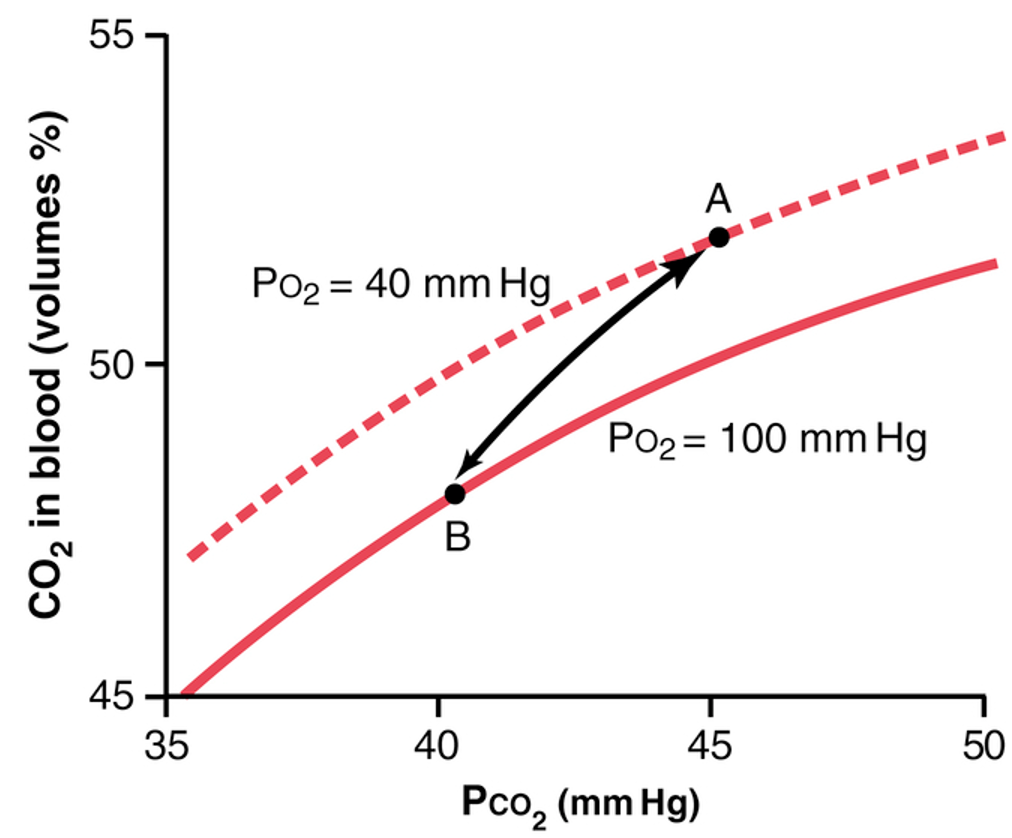
What does Point B represent on the CO₂ dissociation curve?
At the lungs:
PCO₂ = 40 mmHg
PO₂ = 100 mmHg
Blood CO₂ content falls to ~48 volume%
So 4 volume% CO₂ is released from the blood.
How does the Haldane effect increase CO₂ unloading in the lungs?
The increase in PO₂ in the lungs lowers the CO₂ dissociation curve, causing blood CO₂ content to fall an additional 2 volume%.
Without Haldane effect: 52 → 50% = 2% CO₂ released
With Haldane effect: 52 → 48% = 4% CO₂ released
What is the overall significance of the Haldane effect?
The Haldane effect approximately doubles:
The amount of CO₂ released from blood in the lungs
The amount of CO₂ picked up by blood in the tissues
How much O₂ is normally transported from the lungs to the tissues by each 100 mL of blood?
About 5 mL of O₂ per 100 mL of blood.
How much CO₂ is normally transported from the tissues to the lungs by each 100 mL of blood?
About 4 mL of CO₂ per 100 mL of blood.
Under normal resting conditions, how does CO₂ output compare with O₂ uptake?
About 82% as much CO₂ is expired as O₂ is taken up by the lungs.
What is the respiratory exchange ratio (R or RER)?
The ratio of CO₂ output to O₂ uptake.
R = Rate of carbon dioxide output / rate of oxygen uptake
What happens to RER when an animal exclusively uses carbohydrates for energy?
RER approaches 1.0.
With carbohydrate metabolism, approximately 1 molecule of CO₂ is produced for every 1 molecule of O₂ consumed.
Why does carbohydrate metabolism produce an RER close to 1?
When O₂ is metabolized with carbohydrates, approximately one molecule of CO₂ is formed for each molecule of O₂ consumed.
Which animals tend to have higher RERs, and why?
Herbivores tend to have higher RERs because their diets are generally higher in carbohydrates.
High carbohydrate use → RER approaches 1.0
What happens to RER when an animal primarily uses fat for energy?
RER approaches 0.7.
High fat use → RER approaches 0.7
Why is RER lower during fat metabolism?
When O₂ reacts with fats, a larger portion of the O₂ combines with hydrogen atoms from the fats to form water rather than being used to produce CO₂.
Therefore, less CO₂ is produced relative to O₂ consumed → lower RER.
Which animals tend to have lower RERs, and why?
Carnivores tend to have lower RERs because their diets are generally higher in protein and fat.
What is the rate limiting step in healthy animals for rate of oxygen usage?
a. ATP
b. ADP
c. AMP
d. Carbonic anhydrase
b. ADP
What is the primary mechanism whereby carbon dioxide is transported?
a. Dissolved in molecular form
b. Converted by carbonic anhydrase
c. Bound to hemoglobin
d. None of the above
b. Converted by carbonic anhydrase
Why does carbon monoxide displace oxygen from hemoglobin?
a. Higher affinity
b. Loosens oxygen bonds to hemoglobin
c. Binds to a different binding site than oxygen
d. All of the above
a. Higher affinity
What is the term used to describe that binding of O2 with hemoglobin tends to displace CO2 from the blood?
a. Bohr Effect
b. Boring effect
c. Haldane Effect
d. Shunt effect
c. Haldane Effect
what is PO2 based on?
the amount of oxygen gas dissolved directly in the blood plasma