APBio unit 1
 Call Kai
 Learn
 Practice Test
 Spaced Repetition
 Match
 Flashcards
 Knowt Play
1/173

There's no tags or description
Looks like no tags are added yet.
Name | Mastery | Learn | Test | Matching | Spaced | Call with Kai | Chat |
|---|
No analytics yet
Send a link to your students to track their progress
174 Terms
Nucleic Acids function
stores genetic material like genes and blueprint for building proteins, transfers information like blueprint for new cells
RNA (ribonucleic acid)
nucleic acid with a single strand that preforms a lot of functions including protein synthesis and regulation of gene expression

DNA (deoxyribonucleic acid)
nucleic acid with a double helix that stores info for its own replication and the sequence of amino acids in proteins
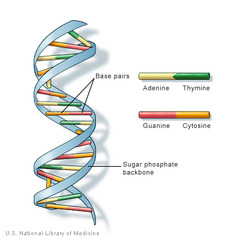
monomers of nucleic acids
nucleotides (ACGTU)
Types of bases found in nucleotides
purines and pyrimidines
purines
double ring N base, Adenine (A), and Guanine (G)

pyrimidines
single ring N base, cytosine (c), thymine (t), and Uracil (u)

What is a nucleotide composed of?
A phosphate group and a pentose sugar as the backbone, and a nitrogen-containing (nitrogenous) base (AGTCU)

How are nucleotides joined together?
a series dehydration synthesis reactions to form a linear molecule (strand), or a sequence of nucleotides
RNA is predominately a
single strand molecule
DNA is
a double strand molecule
the 2 strands in DNA are held together by
hydrogen bonds
Adenine (purine) makes hydrogen bonds with...
Thymine (pyrimidine)
Cytosine (pyrimidine) make hydrogen bonds with...
guanine (purine)
complementary base pairing
bonding between nitrogenous bases in DNA
How many hydrogen bonds are between Adenine and Thymine
2 bonds

How many hydrogen bonds are between Guanine and Cytosine
3 bonds, meanings its stronger
Replication
Copying process by which a cell duplicates its DNA
mitosis
cell replication
meiosis
gamete production
Protein monomer
amino acids
how are amino acids linked together in proteins
peptide bonds (a covalent bond between amino acids)
peptides
two or more amino acids joined together
polypeptides
long chains of amino acids joined together
protein
a polypeptide that has folded into a particular shape that determines its functioning
ending in -ase means...
its an enzyme
Functions of proteins
involved in almost everything, including metabolism, support, transport, defense, regulation, motion

polymer of protein
polypeptide
Amino acid structure
central carbon, amino group, carboxyl (acid), R group (side chain)
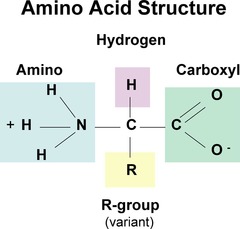
variable that changes amino acids is the...
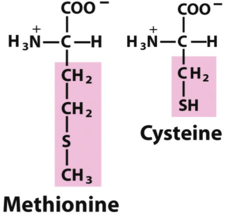
R group, which is different for each amino acid and provides each with different chemical properties and functions

Sulfur containing amino acids form...
disulfide bridges, which stabilizes a 3-d structure
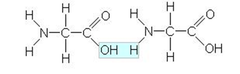
peptide bonds
covalent bond between NH2 (amine) of one amino acid and COOH (carboxyl) of another. C-N bond
N-terminus and C-terminus are...
ends of amino acids
N-terminus
NH2 end

C-terminus
COOH end

What happens when a protein loses its proper shape?
it is denatured (change in structure = can't function the same)
Levels of protein structure
primary, secondary, teritary, quaternary
primary structure
sequence of amino acids in a protein, determined by gene and can altar a proteins function

secondary structure
the patterns of coils or folds of a polypeptide chain (protein), created by inteactions between adjacent amino acids like H bonds (weak bonds between R groups)

tertiary structure
The overall, three-dimensional shape of a polypeptide due to interactions between distant amino acids R groups, such as disulfide bonds, hydrophobic interactions, H bonds, or ionic bonds

quaternary structure
more than one polypeptide chain bonded together, finally it becomes a functional protein

Unfolding a protein
conditions like temp, pH, or salinity (salt) can disrupt H bonds, ionic bonds, or disulfide bridges, altering secondary or tertiaty structure and 3-D shape, destorying a proteins functionality
Can proteins reserve being denaturalized
some can return to their functional shape but many cannot
Chaperone proteins
assist in folding other proteins correctly
Matter
anything that has mass and takes up space (solid, liquid, gas, plasma)
Matter is composed of basic substances called...
elements
Element
composed of one atom, a subtance that cant be broken down into substances with different properties,

The 6 elements that make up 95% of the body weight of organisms
(acronym CHNOPS) Carbon, Hydrogen, Nitrogen, Oxygen, Phosphorus, Sulfur
The 3 elements all macromolecules have
Carbon, Hydrogen, and Oxygen
Phosphorus is found where?
DNA, RNA, Nucleic Acids
Sulfur is found where?
Occasionally proteins
Atom
smallest part of an element

proton
positive charge, in central nucleus

Neutrons
no charge, in central nucleus

Electrons
Negative charge, very low mass, in electron shells

electron shells
orbiting clouds around nucleus

Atomic number
equal to the number of protons in each atom of an element
mass number/atomic mass
the sum (+) of the number of protons and neutrons in the nucleus of an atom
Periods (periodic table)
Horizontal rows, elements in the same row have the same number of shells

Groups
Vertical columns on the periodic table, elements in the same group have the same valence and similar chemical properties
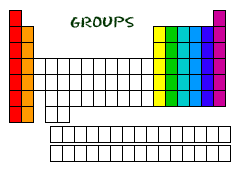
Atoms in the periodic table being electrically neutral means..
the atomic number tells you the number of electrons and protons
Isotopes
atoms that are the same (same element) but have different atomic masses

Radioactive Isotopes
give off energy in the form of rays and subatomic particles, ex Carbon 14 (used to examine photosynthesis reactions)
Four elements that make up 96% of living matter
carbon, hydrogen, oxygen, nitrogen
Four elements that make up remaining 4% of living matter
phosphorus, calcium, sulfur, potassium
Valence shell
outermost energy shell of an atom, determines many of an atoms chemical properties
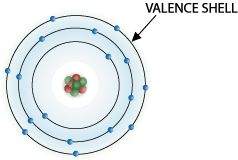
octet rule
states that the outermost shell is most stable when it has 8 electrons
excpetion to the octet rule
if an atom only has one shell, the outermost valence shell us complete when it had two electrons, (Hydrogen, only has 1 shell)
atoms that have their valence shells filled with electrons tend to be...
chemically stable
atoms that do not have their valence shells filled with electrons tend to be...
chemically reactive
Effect of electrons on atom
they determine its chemical behaviors using the number of electrons in the atoms outermost shell (valence shell), like if it will share electrons with another atom
What tendency drives chemical reactions and creates bonds?
Atoms tendency to either complete a partially filled valence shell or empty a partially filled valence shell
Hydrogen bond
weak, attraction between + and -

Hydrophobic bonds
weak, no charge (non polar), repels/doesnt mix with water
Hydrophilic bonds
weak, polar (- or + charge), reacts/mixes with water
Covalent bonds
Strong, very stavke bonds formed by sharing electron pairs so there are 8 between them, forms molecules. ex. hydrogen gas

The more electrons shared in a covalent bond...
the stronger it gets
Nonpolar covalent bond
pair of electrons shared equally by 2 atoms (ex methane)

Polar covalent bond
electrons are shared unequally, ex water

electronegativity
the ability of an atom ot attract electrons towards itself in a chemical bond

Why are the bonds in water polar?
because the oxygen atom is more electronegative than the hydrogen atoms
Is water polar or non polar?
polar
Hydrogen bond
weak attraction between a slightly positive hydrogen atom and a slightly negative atom, weak on its own, strong with multiple
What makes hydrogen bonding possible in water?
the shape of the molecule and its polarity
Why does DNA have hydrogen bonds?
So it is weaker and able to break to replicate
OH stands for
Hydroxl
What kind of bonds do H2O molecules form with eachother?
H-bonds, where +H is attracted to -O and it creates a sticky molecule
Cohesion
ability of water molecules to cling to each other due to hydrogen bonding, surface tension
Adhesion
The ability of water molecules to cling to other polar substances, capillary action (water goes up tree)
Cohesion and adhesion example
Water getting to the tops of trees
What makes H2O a good solvent?
polarily
Solvents
dissolve (water)
Solutes
getting dissolved (salt)
Solution
mixture of solvent and solute (salt water)
Hydrophilic
mixes with water, POLAR
Hydrophobic
DOESNT mix with water, NON-polar
Special thing about ice
Water is LESS dense as a solid (rare) so ice floats
WHY is water less dense as a solid?
Water is made up of hydrogen bonds, and at temps below 4C, hydrogen bonds between water molecules become more rigid but also more open
Why is ice floating important?
oceans and lakes don't freeze solid over winter because the surface ice can insulate the water below
water having a high specific heat capacity means what?
allowed by hydrogen bonds, water is able to absorb large amounts of thermal energy, which allows it to it resist big changes in temperature