311 Session 4 Ascending and Descending Pathways
 Call Kai
 Learn
Learn Practice Test
 Spaced Repetition
 Match
Match Flashcards
 Knowt Play
1/30

There's no tags or description
Looks like no tags are added yet.
Name | Mastery | Learn | Test | Matching | Spaced | Call with Kai | Chat |
|---|
No analytics yet
Send a link to your students to track their progress
31 Terms
What is the main function of DCML
Ascending tract that provides informaiton on touch, vibtraion, pressure, proprioception, and two point discrimination
Mechanoreceptors / proprioceptiors →
dorsal root ganglion (first order neuron) →
dorsal root → spinal cord →
fasciculus gracilis / cunueates →
medulla (either nucleus gracislis / cuneatus [2nd order neuron]) →
DECCUSATE forming the Medial Lemniscus pathway →
VPL thalamus (third order neuron)
First order neuron in the DCML might be in the DRG but where does the fist synapse occure
Medulla oblangata (nucleus gracilis / cuneatus
What are the two divisions of the dorsal column
Fasciculus Gracilis (sensations from lower part of body [T7 and below])
Fasciculus Cuneatus (sensations form upper parts of the body)
What are the 1st, 2nd, and 3rd order neurons for the DCML
1st = DRG
2nd = medulla (nucleus gracilis / cuneatus)
3rd = VPL Thalamus
Where do the descending somatic pathways originate
Cerebral cortex
Brainstem
Where is the upper motor neurons vs the lower motor nueron for descending somatic pathways
Upper: motor cortex
Lower: ventral horn of spinal cord (efferent region)
What spinal tract is responsible for volunatry movements
Corticospinal tract
Trace the Corticospinal tract
Upper motor neuron: primary motor cortex →
Corona radiata →
internal capsule →
cerebral peduncle of midbrain →
medulla and decussates → forms the lateral corticospinal fibre →
if it doesnt cross = anterior corticospinal tract
descend contralaterally →
synapse with contralateral ventral horn (lower motor neuron) →
ventral root →
distal movements
Where does axons that control motor innervation of the lower vs upper limbs terminate
Upper limbs: terminate in cervical region (more medially)
Lower limb: Lumbar region (more lateral)
Majority of the fibres deccusate in the corticospinal tract, but where do the undecussated fibers go
Travel downwards IPSILATERALLY and reach the anteriror column only decussating at the desired spinal cord level
Reticulospinal tract; origin
Reticular formation in pons and medulla

Does the pontine reticulospinal tract deccusate
No
Where does tectospinal or “colliculospinal” tract originate
Originate in superior colliculi of midbrain →
descend and enter the spinal cord →
synapse on interneurons in ventral horn of spinal cord

What is the function of the tectospinal tract
Turns / orients head and neck towards auditory stimuli
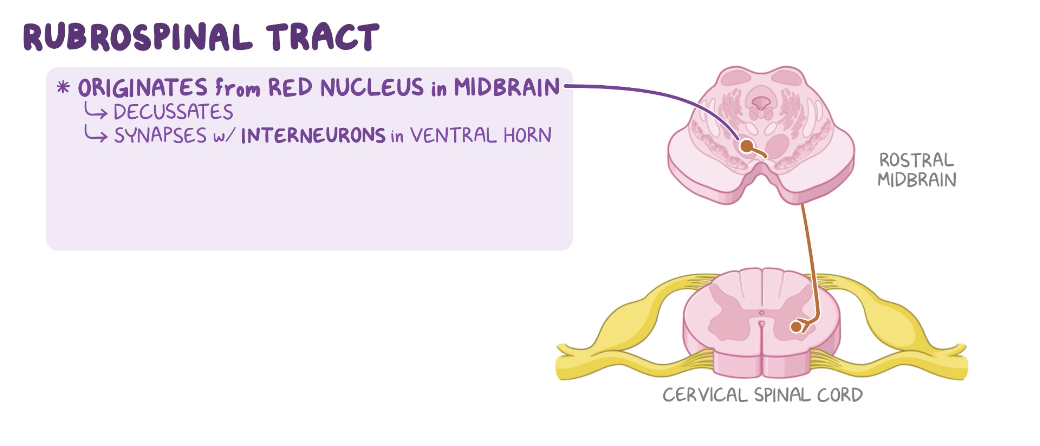
Where does the rubrospinal tract originate
Red nucleus of the midbrain → decussates → descends to spinal cords lateral white matter →
synapse w interneurons in ventral horn → terminates in cervical regions
Rubrospinal tract function
Regulates flexor and extensor muscle activity in upper limb
Vestibulospinal tract; origin and trace
Originates in vestibular nuclei → DOESNT DECCUSATE
→ synapses on interneurons in ventral horn of spinal cord

Vestibulospinal tract function
maintains balance and posture by regulating postural/extensor muscles
What are the five descending tracts
Corticospinal
Reticulospinal
Rubrospinal
Vestibulospinal
Tectospinal
How do crossed and uncrossed connections explain bilateral influence on trunk muscles
The anterior corticospinal tract can influence motor neurons on both sides of the spinal cord!!!!! So it has bilateral control over axial / trunk muscles
Compare and Contrast lateral vs anterior corticospinal tract IN TERMS of;
crossing
spinal location
main control
side

Trace the paterllar/knee-jerk stretch reflex
Quad stretches
Muscle spindle detects stretch
Sensory neuron enters spinal cord
activates lower motor neuron
Quads contract
leg extends
What is the basic somatic motor pathway
CNS → lower motor neuron → skeletal muslce

Where is the cell body of a somatic lower motor neuron?
In the CNS; its axon travels directly to skeletal muscle
Autonomic motor pathway;
trace
targets
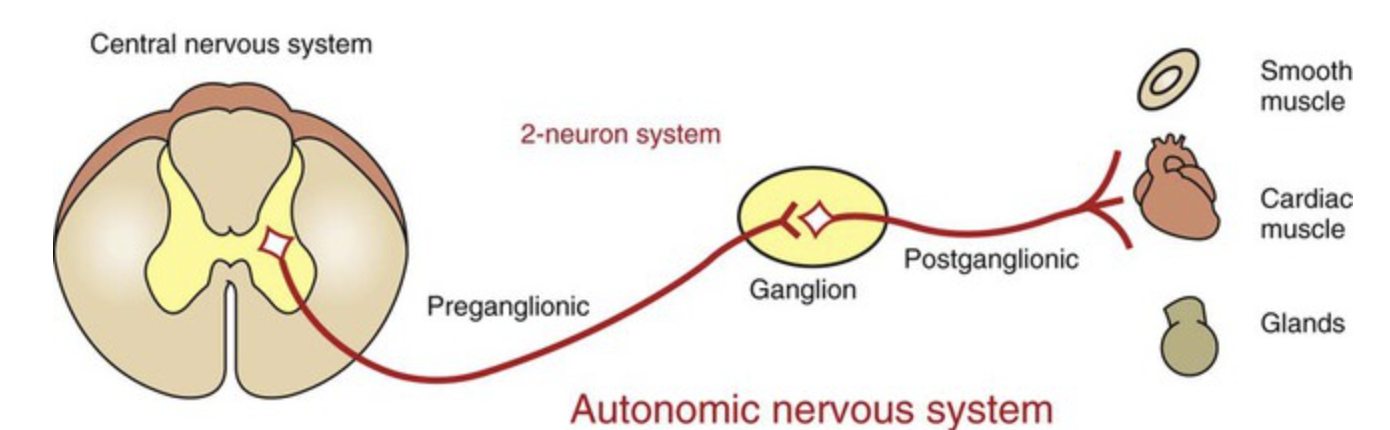
CNS → preganglionic neuron → autonomic ganglion → postganglionic neuron → target
Smooth muscle, cardiac, glands
Where are the cell bodies and synapse in the autonomic motor pathway
Preganglionic cell body = CNS → synapse in peripheral autonomic ganglion → postganglionic neuron → target
What is the general organization of the sympathetic nervous system
Thoracolumbar origin → ganglia generally closer to the CNS → short pre + long post
What is the general organization of parasympathetic nervous system
Cranisacral origin → ganglia near/in target organs → long post + short pre
What is the broad role of the enteric nervous system
Neural networks in the gut wall organize local GI activity and receive autonomic influence
What CNS regions broadly contorl autonomic function?
Mainy the hypothalamus and brainstem