Geomorphology hydrology
 Call Kai
 Learn
 Practice Test
 Spaced Repetition
 Match
 Flashcards
 Knowt Play
1/88

There's no tags or description
Looks like no tags are added yet.
89 Terms
-When two continents collide:
-Both are buoyant, neither can sink under the other
-Crust is thickened as it is compressed
-Rocks are folded and deformed causing massive uplift, mountain belts, orangery
-Continues to push together and mountain range keeps growing
-One side mountains, one side flat beach land
Archimedes principle
-The buoyant force is equal to the weight of the displaced water
-Gravity pushing down, fluid pushing up
-Depends on the mass in the crust, will move down if heavier into the mantle, move up if lighter
Isostatic rebound-
Mountain bed increases in hight, due to erosion of mountain belt moving eroded mass into the lowland/deposited elsewhere, decreasing the mass
-Where the mass has been added that land will move down
-Also occurs from glaciation as ice pushes surface down into the mantle, when ice melts deglaciation eustatic sea level rise as ice becomes water carrying away water and sediment
Eustatic rise
When glaciation occurs water and sediments move into the sea causing sea level to rise
-Sea becomes further inland
-Sediment begins to accumulate and forms a delta
Sea level
-When glaciers are present on earth, they retain part of the water normally involved in the hydrologic cycle
-This decreases sea level and thus increases the distance necessary for rivers to travel
-Once the glaciers melt they yield enough water to increase sea levels, eustatic rise
-Uplift is generally measured against sea level so establishing certainty of eustasy as a base level reference is fundamental to understanding tectonics
Intertropical convergence zone-
-Is a belt of low pressure girdling earth at the equator, where trade winds meet
-Produces monsoons by following the suns overhead position moving North in boreal summer and south in boreal Winter
-It is formed by the vertical ascent of warm, moist air from the latitudes north and south of the equator
-The air is drawn into the ITCZ by the action of the Hadley cell, a macroscale atmospheric feature which is part of earths heat and moisture distribution system
-Moisture is transported upwards by the convective activity of thunderstorms
-Regions in the ITCZ receive precipitation over 200 days in a year
orography
Moist ocean air being lifted upwards by mountains also causes rainfall, loses its energy as it moves up and drops moisture on the mountain range only on one side as creates a rain shadow as moisture runs out
why does air heat up faster over land than oceans
due to the radiation that is reflecting back from the land to the atmosphere E.G urban heat
-Hot air over the land tents to rise, creating an area of low pressure
-This creates a steady wind blowing towards land, bringing the moist near surface air over the oceans with it
Tectonic Aneurysim
-Link between highest rainfall and highest uplift point
-Heavy rainfall/river at the mountain belt, erosion from landslides and mass leaving causing isostatic rebound
-More prone to deformation
-accelerates uplift, steepness relief, increases precipitation and drives more erosion
-Positive feedback loop
Landslides
-Displacement of sediment from one location to another due to a failure along a failure plan
-Mass in that location gets moved to somewhere else
-Build up more power and force as gain fluids and sediment
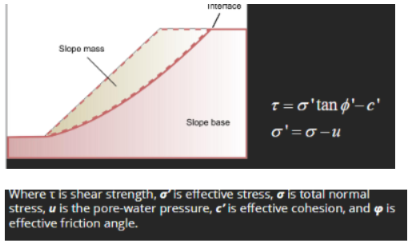
Mohr-Coulomb failure criterion
-Suggests that the shear strength of the ground is proportional to the normal effective stress as
-Mass keeps itself stable by pushing down onto the failure plane through that normal force
-The grains lock edges together to remain stable in friction
-If they are weakened protentional of the material to slide
-Pore water pressure reduces effective stress, therefore material strength
Mohr-Coulomb failure criterion equation
-C is natural properties that stick together like clay
Regolith-
a blanket of loose, unconsolidated dust, broken rocks, and soil that covers solid bedrock
Infinite slope stability model equation

Infinite slope stability model results meaning
H- Normal direction down from surface
F- Safety if above 1, Failure if below 0
Infinite slope stability model equaution meaning

Threshold slope
- Where river incision responds to uplift and hillslopes adjust accordingly by landsliding
-Discharge
volume of water per unit time passing through a cross section of a stream where
Q
discharge equation

General form of a hydrograph
-The prediction of the timing of flow in a river will have the general form of a right skewed graph of discharge that we call a hydrography
-Interested in flood peak
Flood frequency analysis
-Analysis of empirical records of a flood at a place on a river network
-The hydro climatology and watershed conditions upstream of a point are constant
probability distribution of floods to be expected at the point can be estimated from the frequency distribution of past floods recorded are
can be used to estimate the probabilities of other hypothetical expected discharges
-Through interpolation or extrapolation of the recorded range of flows
Grain sizes smallest to biggest
0.04mm Clay
0.04-0.06mm Silt
0.063-2mm Sand
2mm Gravel
Bed material
Present in bed
Bedload
Transport along bed
Suspended load
Transport in water, no contact with bed
Wash load
Transport in water, but not present in bed
Dissolved load
Transport in water, dissolved
Average annual transport distances
-Gravel 50-500 m/yr
-Sand 100-10,000 m/yr
-Silt clay many km or into floodplain where it stays for a long time
Suspended load measurement
-Since fine sediment travels in suspension, its concentration in water is usually computed as a power function of Q
-Measured in a controlled volume
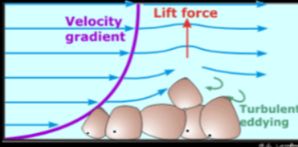
-Suspended load is held up in the flow by eddies, which counteract the tendency for the particle to settle under gravity

Hysteresis
Describes the nonlinear relationship between discharge and sediment concentration
-Sediment supply changes during and between storms, landslides and where they entire the system
a system where the state, structure, or behavior depends not only on current environmental conditions, but also on its historical path
Measurement of suspended load by sampling sediment concentration
-Depth integrating sampler, water with sediment inside passed through a bottle
-Passed up and down through flow at constant speed
-Designed to average the flow correctly over the velocity and concentration variations
-Drain water out, dry sediment to show how much sediment goes through at the designed flow rate
-Can be used to estimate sediment transport rate
Velocity
-Not only varies cross stream but with depth
-Moving away from the banks and beds causes an increase in velocity
-Sets up a stress field on the river bound, puts a shear force on the bed
shear stress and velocity equation
-Shear stress is equal to the change in velocity with depth, its proportional to the velocity of the fluid (water has a consistent viscosity)
-Z is depth
-U is velocity

how does shear stress deform water
due to the weight of water and its downstream movement
-Due to down slope component and normal force
-Top flow moves faster than bottom flow
-Shear stress highest at the bed as most weight and downslope
turbulent flow
-Similar but the resistance is not about viscosity but about the ability for the turbulent to transfer that force upwards
-Due to flow speed and depth
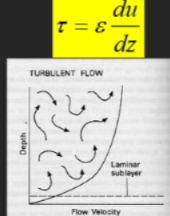
laminar flow
motion of liquid moves in smooth parallel lines that do not mix

reynolds number
-Shows if water is laminar or turbulent

shear stress in turbulent flow
-Shear is able to pick up bedding and rotate and move it
shear stress on the bed equation
-Give us an estimate of the stress being exerted on the bed
-Tells us what sediment is being picked up and moved

bedload entrainment
Depends on river depth and size
-Uses no units to compare large and small rivers, dimensionless, the star
-When does the sediment on the river start moving
-Shear stress needed to initiate motion depends on bulk flow properties and grain size
shields number, bedload entrainment
R- Hydraulic Radius, tells us about the efficacy in the flow
S- Gradient of the water surface
G- Gravity
P- Density of water

critical shear stress
-Able to recognise a critical shear stress where particles on a river bed started to move
-0.06 t* is a constant (shear stress)
-Larger sediment is moving
-Smaller the shear stress is not enough is move sediment
equation for flow that is required to move the particles
-Hc critical flow depth when particles would move under conditions of grain size and water surface load
-When a channel is wide enough the hydraulic radius is the same as the flow depth

suspended load units in questions
-Write out as fractions
-Use Equilevant equations to cancel out units
-Till you get units you need
-Then times all number on top together
-Time all numbers on bottom
-Then divide

law of the wall
-At the boundary flow equals velocity of zero
-No movement
-Velocity profile assumes the flow at the wall is zero
-It assumes there is a boundary layer near the bed where eddies cannot trach to distribute momentum
-These areas behave like laminar flow
law of the wall equation
for turbulent flow.
U* is shear velocity is a measure of the intensity of turbulent fluctuations
K is Von Karmans constant is a measure of eddy mixing length
Z is height above the bed
Z0 is arbitrary small height above the bed where velocity goes to zero

Settling velocity
-Stokes law for settling of spheres
-Sediment is settling out of the flow under gravity, sand sinking to bottle
-Settles takes into consideration,
-Depends on temperature and viscosity of liquid
settling velocity equation
D- Grain size
U- Dynamic viscosity
Ps-p- Sediment density , water density
-In m/s

Criterion for suspensibility
-Balance settling rate against rate of upfit by eddies
-Resisting the sand being dropped to bottom is turbulent flow of eddies
-Competition of sediment settling and eddies keeping it in suspension
-Important to understand the sediment load and find out where the sediment is in a stream, if it's in suspension or on the bed
criterion for suspensibility equation
-K is a constant 0.41, tells us length scale of an Eddie proportional to flow depth
-U is shear velocity flow

criterion for suspensibility results
High value of pie indicates bedload, settling load is higher than turbulent flow bigger than 2.5
-0.8-1.2 is shear velocity is dominating
-Wash load is less than 0.8, sediment load that is not present in the bed at all

Process view of sediment in channels
-Sediment originates somewhere
-Therefore it has certain exogenous characteristics, size, sorting, chemistry
-It is transported in a number of ways
-It comes to rest somewhere for short periods, affecting river and floodplain form and behaviour as habitat or as substate for human activities, navigation and flood control levees
Sediment supply
-The controls on rate of sediment production, transport and accumulation are subject to
Temporal variability
Natural variability
Management controls
Human impacts
eddy
a circular, swirling current of water that forms when the main, fast-moving current flows past an obstruction (like a large boulder or bridge pillar) or curves around a riverbank
-Aggradation
the geological process in which the elevation of a land surface, streambed, or river valley increases due to the deposition of sediment and other materials.
degradation
the deterioration of the natural environment through the depletion of resources (such as air, water, and soil), the destruction of ecosystems, and the loss of wildlife
Hungary water effect
-Humans can impact water flow
-Adding in dams
-Bigger dams trap all the sediment from up stream
-Meaning sediment supply is cut off
-Degradation downstream, getting cut down
-Effect habitats and fish
Indus Basin
-1.1x10⁶ km2 in area spanning Afghanistan, China, India and most of Pakistan
-12th largest in the world containing 260 million residents
-Has both humid (mountainous north) and arid (south) areas
-Economy dominated by irrigated agriculture, winter wheat and summer rice/cotton
-Agriculture relied on meltwaters from upper Indus basin (glacier) 37% Indus area
-Increasingly on groundwater pumped in lower Indus basin 63%
-Lower basin is arid and upper is humid
Indus basin flooding proposed explanations
Proposed explanations
-More intense precipitation with warming, climate change, warmer and dryer can hold more moisture, rains more intensely (Clausius Clapeyron)
-Warming atmosphere leads to rapid glacial mass loss
-Anthropogenic causes (dam operations mismanagement)
runoff trend
-Runoff over whole area has increased
-More water running off than infiltrating
-First half showed mostly negative
-By end whole covered

why is Clausuis clapeyton hypotheisis not likely
because the region is actually experiencing one of the only global reductions in atmospheric evaporative demand, how much water the atmosphere can hold
-Most of the globe has atmospheric demand increasing whereas south Asia has the demand decreasing, a place where global warming is not happening
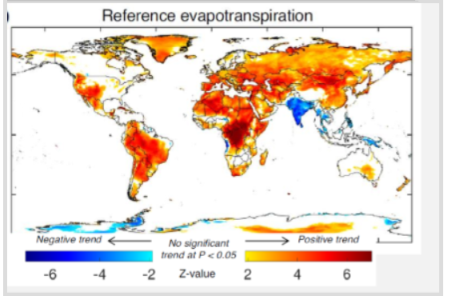
atmospheric evaporative demand
the rate at which the atmosphere pulls water from land surfaces, rivers, plants, and soils
What actually evaporates and transpires based on how much moisture is truly available in the soil.
-Made up of Air temp, Wind speed, Net solar radiation and Humidity
Glacial melting hypothesis not likely because
the region is experiencing one of the lowest global glacial mass loss rates
Water management hypothesis not likely because
there is limited capacity to capture water during extreme flooding and large dams are mostly in the uplands, which comprise only 37% of the Indus basin area
Bad management during events should not lead to systematic increase in flood frequency
standardised precipitation and evapotranspiration index SPEL 12
-Can look at trends and compare to landscape responses
-Balance between incoming precipitation and potential losses back to the atmosphere provides information about how much water will be left in the landscape (average) in advance of heavy rainfall
-Wetting/drying index
-Positive wetting, negative drying
-When incoming rainfall exceeded infiltration runoff occurs
a multi-scalar drought index that measures drought conditions by comparing the difference between precipitation and potential evapotranspiration (PET
SPEL 12 equation

PET- Potential evapotranspiration
What could evaporate and transpire if the soil and plants never ran out of water.
-Is the atmosphere able to draw up more or less water over time
-Made up of Air temp, Wind speed, Net solar radiation and Humidity
Summary of trends
-Monsoon season is becoming wetting especially in the lower basin
-Positive trends in SPEI, P, SM, AL, AET and NDVI
-Negative trends in PET, positive RH, negative WS no significant change in T
-Seasonal trends suggest strengthening, year round wet soils, and year round greening, even in the dry season
-Air temp has no strong temp that could be used to expand flooding
NDVI Normalized Difference Vegetation Index
Values represent the proportion of a pixel that is vegetated, which can change through time due to the expansion of irrigated agriculture
Greenest of vegetation
Irrigation in Indus basin
Bringing water from a cannel to crop land for them to grow when the land would be dry
-Causing farmland to grow patches of green from irrigation
-Increase in NDVI
-From increase in agriculture
water balance model
-Generate outputs on soil, evapotranspiration and stimulates net irrigation
-To understand what conditions can we generate the trend of soil increasing precipitation increasing and greenness going up

irrigation flooding results
-Show that water added by irrigating large areas during historically dry periods is exacerbating atmospheric climate change and trends, P + and PET -
-Driving even arid areas of the LIB toward energy limited conditions and intro a flood prone state of elevated SM all year round
-Bring dry areas into a flood plain place all year round, more efficient than calculating how much water you need per plant
-Causes GW SM and NDVI to increase
Himalayas water born diease
-Effects children due to weaker immune system
-E coil
-Leads to dehydration and diarehha
-Invisible problem which is microscopic
-Caused from not having sanitation e.g. toilets
-People often end up urinating near rivers, which are meant to be clean
water borne disease solutions
-Using pit toilets (charpi) , whole in the ground, with a water source to clean after
-Try to protect water sources at the supply, using tap stands with concrete area where water is protected, mostly used by women who carry and transport water
-Effort to build spring boxes, where water comes to the surface which is fresh, protect by box, can then be back filled with rocks for further protection
-Can instal water tanks, pipe water from a spring into a tank, for larger villages
-In lowlands less talk on springs water and able to drill straight down for water
Tube Well issue
-In the well become positive for arsenic, poison
-In wells that were less than 50 ft of depth, in deeper depth arsenic levels decrease
-Correspond to a sedimentation during a Holocene era, change from larger sediment to fine grains from the Himalayan that built the delta, correlation to where arsenic levels where
-Depth and distance from channel issue
Arsenic levels due to
-Weathering of As bearing mica
-Close to surface contain oxygen zone, unsaturated zone, contains aerobic bacteria
-Increasing depth oxygen supply reduces, contain anaerobic bacteria
-Break down iron hydroxy particles to gain energy and produce free arsenic and iron ions into the water
-Some arsenic is able to be back absorbed but most in released
-Therefore arsenic can be pulled up in the tube well
-Holocene mica and anaerobic bacteria cause arsenic releases together
μ
dynamic viscoscity
R
hydraluic radius
u
mean flow velocity
p
density of water
τ
sheer stress
D
grain size
g
acceleration due to gravity (9.81 m s⁻²)
s
channel slope