SCH4U - Introduction to Thermochemistry
 Call Kai
 Learn
 Practice Test
 Spaced Repetition
 Match
 Flashcards
 Knowt Play
1/44

There's no tags or description
Looks like no tags are added yet.
45 Terms
What is the definition of Energy, and what is it measured in (2)?
ENERGY: the ability to do work
JOULES
What is the definition of Work, and what is it measured in (2)?
WORK: the amount of energy transferred by a force over a distance
JOULES
Define Potential Energy (1)
The energy of a body or system due to its position or composition
Define Kinetic Energy (1)
The energy of an object due to its motion
Define Thermochemistry (1)
The study of thermal energy (heat) changes that accompany physical or chemical changes in matter
Define Thermal Energy:
The total quantity of kinetic and potential energy in a substance
Define Heat (1)
The transfer of thermal energy from a warm object to a cooler object
Define Temperature
A measure of the average kinetic energy of entities in a substance
What does the Law of Conservation of Energy state?
ENERGY CANNOT BE CREATED OR DESTROYED (main idea)
Energy is always CONSERVED
Energy can only be CONVERTED from one form to another

Define a Chemical System (1)
A group of reactants and products being studied
Define “Surroundings” in regards to chemical systems
All matter that is not part of the system
Define an “Open System” in regards to chemical systems and provide an example
Matter AND Energy are free to enter and leave the system
A chemical reaction in an unsealed beaker
Define a “Closed” system in regards to chemical systems and provide an example
Energy can enter and leave the system, but NOT matter
A glow stick
Define an “Isolated system” in regards to chemical systems
an ideal system in which BOTH matter and energy cannot enter or leave the system
Define an Exothermic Reaction
A chemical reaction that RELEASES energy into the surroundings
EXAMPLE: The combustion of methane
CH4 (g) + 2 O2 (g) → CO2 (g) + 2 H2O (l) + energy

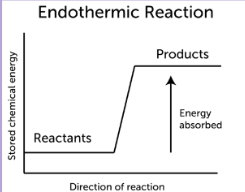
Define an Endothermic Reaction
A reaction that ABSORBS thermal energy from the surroundings
EXAMPLE: The synthesis of nitric oxide from its elements
N2 (g) + O2 (g) + energy → 2 NO (g)
Define Calorimetry
The experimental process of measuring the thermal energy change in a chemical or physical change
What is a calorimeter?
A device used to measure thermal energy changes in a chemical or physical change
Define the “Specific Heat Capacity” of a substance
The quantity of thermal energy required to raise the temperature of 1 g of a substance by 1oC
Recall the specific heat capacity chart

What are some calorimetry assumptions we must make?
Any thermal energy transferred from the calorimeter to the outside environment is negligible
Any thermal energy absorbed by the calorimeter itself is negligible
All dilute aqueous solutions have the same density (1.0 g/mL) and heat capacity (4.18 J/(g.oC) as water
In regards to the formula q = mcΔT, what does q represent?
q: the total amount of thermal energy absorbed or released by a chemical system
In regards to the formula q = mcΔT, what does m represent?
m: the mass of the substance
In regards to the formula q = mcΔT, what does c represent?
c: the specific heat capacity of the substance
In regards to the formula q = mcΔT, what does ΔT represent? (1)
ΔT: the change in temperature (ΔT = Tfinal - Tinitial)
If q has a negative value, what does that mean?
it means that the system transfers thermal energy to its surroundings
The change is EXOTHERMIC
The temperature of the water in the calorimeter INCREASES
If q has a POSITIVE value, what does it mean?
it means that the system absorbs thermal energy from its surroundings
The change is ENDOTHERMIC
The temperature of the water in the calorimeter DECREASES
qsystem = -q? (1)
qsystem = -qsurroundings
What is the definition of enthalpy and what letter do we represent it with? (2)
The total amount of thermal energy in a substance
H
Define Enthalpy Change, state its symbol and units (3)
the energy released to or absorbed from the surroundings during a chemical or physical change
(ΔH)
kJ (kilojoules)
ΔHsystem = q? (1)
ΔHsystem = qsystem
If ΔH is LESS than zero, the reaction is:
EXOTHERMIC
If ΔH is GREATER than zero, the reaction is:
ENDOTHERMIC
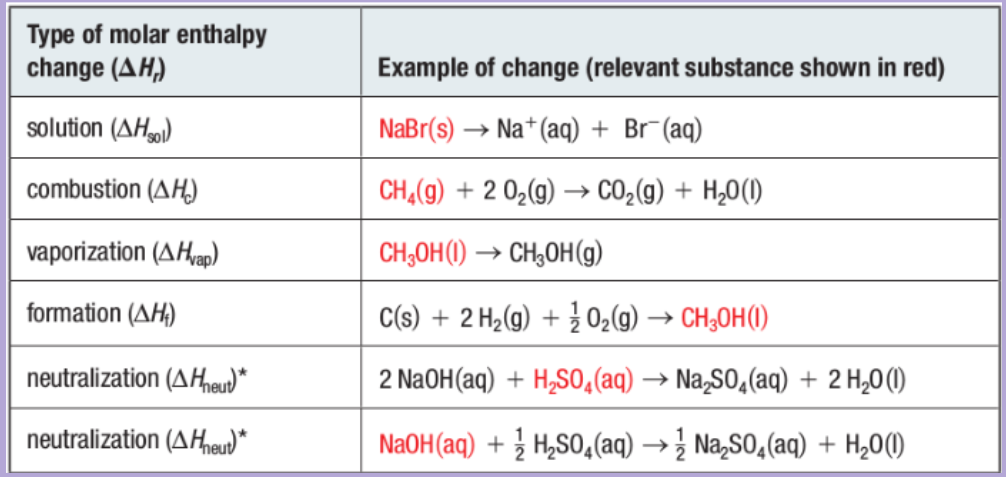
Define Molar Enthalpy, state its symbol and main units (3)
The enthalpy change associated with a physical, chemical or nuclear change involving 1 mol of a substance (kJ/mol)
(ΔHr)
kJ/mol
Can molar enthalpy be measured in kJ/mol as well?
Yes
Recall the table of the 6 different types of molar enthalpy (ΔHr) change:
What is a thermochemical equation?
A chemical equation that describes the thermal energy change (change in heat) of a reaction

What are the 2 ways thermal energy change can be expressed in thermochemical equations?
Within the equation as a distinct term
At the end of the equation with a positive or negative sign describing the scenario

What is a Potential Energy Diagrams?
A graphical representation of the energy transferred during a physical or a chemical change

How do we draw a Potential Energy Diagram for an Exothermic Reaction?
the reactants have MORE potential energy than the products

How do we draw a Potential Energy Diagram for an Endothermic Reaction?
the reactants have LESS potential energy than the products

When we get an answer for q, do we change its’ sign in verbal form?
No
You only do it if the question specifically asks for the opposite of what happened (ex. asking for the amount of energy ABSORBED but the sign was negative originally, , indicating an exothermic reaction)
Recall Qasid’s Rule
Exothermic, temp increases, -q (-kJ/kJ/mol)
Endothermic, temp decreases, +q (+kJ/kJ/mol)
What is the first thing you should do when you see a thermochem question?
Always work backwards/reverse - engineer. Understand what you are looking for first, ont build up.
Do we add masses if given 2 or more?
If given a solid and a water, do not. Treat them separately. Water for q = mcdeltaT, solid for n = m/M
If given 2 waters, YES.