Unit 1: Motivation
 Call Kai
 Learn
Learn Practice Test
 Spaced Repetition
 Match
Match Flashcards
 Knowt Play
1/20

Earn XP
Description and Tags
Motivation, performance, arousal
Name | Mastery | Learn | Test | Matching | Spaced | Call with Kai | Chat |
|---|
No analytics yet
Send a link to your students to track their progress
21 Terms
Homeostatic model of motivation/Drive reduction
deficit occurs, aversive arousal, drive to reduce arousal, return to equilibrium
Cognitive dissonance theory
mismatch between action and belief, dissonance arousal, change of belief or action, return to equilibrium

Biological, learned, cognitive basis of cognitive dissonance as state arousal
counter attitudinal essays cause sweating
if attitude is shifted discomfort reduces
no cognitive dissonance for doing boring tasks if you get paid
Two types of arousal
cortical and autonomic
Autonomic arousal
sympathetic nervous system causes fight or flight from endocrine and adrenal activity
linked to RAS, stress, emotion
Cortical arousal
RAS processes sensation and directs attention
ascending pathway activates cortex and descending activates motor system
stimulating monkey RAS improves discrimination task performance
Theories of arousal and peak performance
task difficulty (yerkes-dodson)
optimal stimulation (hebb)
reversal (apter)
personality (eysenck)
Task difficulty theory of peak performance
best performance on difficult tasks with low arousal and on easy tasks with high arousal

Optimal stimulation theory
hedonic tone
a point of arousal between increasing positive emotion and emotional disturbance
sensory deprivation experiments showed a lack of stimulation is aversive


Reversal theory
arousal avoidance system (telic) and excitement seeking system (paratelic)
telic: low arousal=relaxation, high arousal=anxiety
paratelic: low arousal=boredom, high arousal=excitement
Personality theory of arousal and performance
positive hedonic tone of introverts is optimized at lower stimulation levels than average, extraverts higher
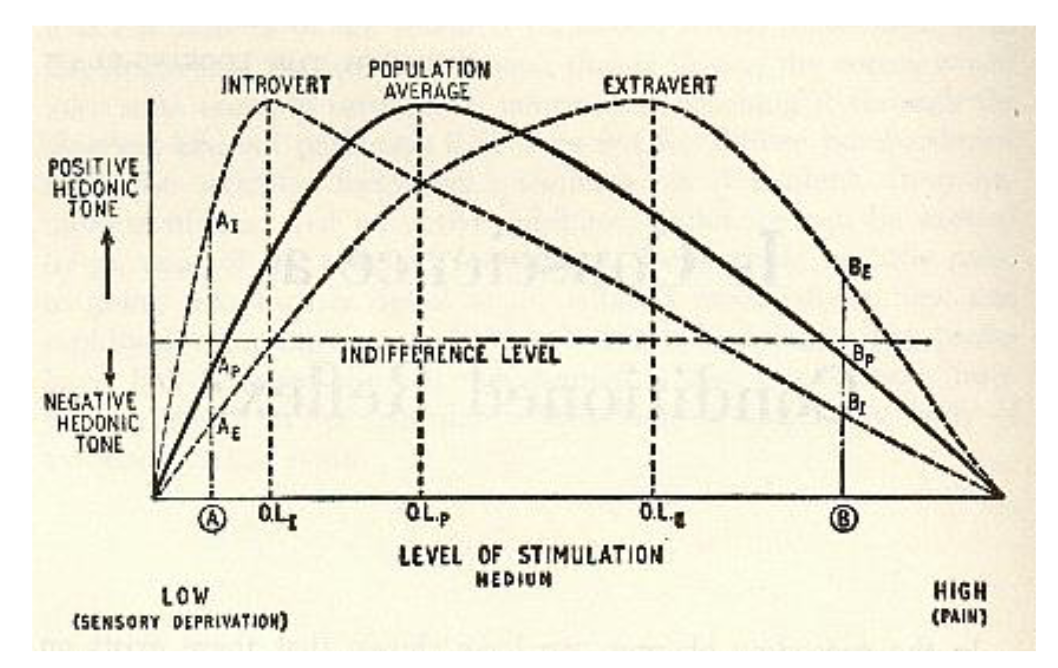
Trait vs state arousal
Trait arousal is dispositional, state arousal is context based (sensory overload, cognitive dissonance, evaluation arousal)
Biological component of trait arousal
extraversion regulation by cortical arousal levels (introverts have higher baseline), neuroticism regulation by limbic system reactivity (neurotics have higher baseline)
high BAS have more activity in regions linked to executive function and approach in response to arousal
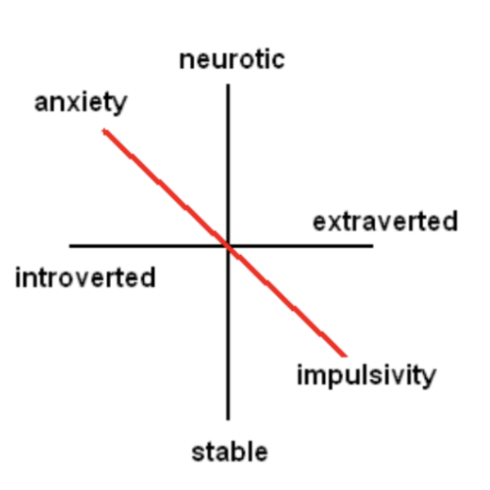
Personality (learned/cognitive) component of trait arousal
learned negative associations with arousal
state of preparedness: fears are highly prepared learning that is difficult to break and easy to acquire
depressed people have excess focus on threat, CBT helps rethink threats
Biological component of state arousal
physiological response (glucose, lactic acid, NE, immunoglobin decline)
Learned/cognitive component of state arousal
self preoccupying intrusive thinking: anxiety is interference of intrusive thoughts with task focused thinking
two stage coping: anticipatory (affective, approach or avoid), appraisal of adequacy (did it work)
Arousal and anxiety
arousal leads to selective attention
selective attention leads to focus on threat cues, more arousal, and more attentional narrowing
Studies for arousal (social, cultural, cognitive)
alone but feeling no pain
aggression and honor culture
mind over matter

Alone but feeling no pain (DeWall and Baumeister)
pain tolerance and social exclusion
forecast for lonely future increases pain tolerance and exclusion lowers emotional sensitivity and empathy
arousal leads to sympathetic activation which dulls pain perception

Aggression and culture of honor (Cohen and Nisbett, 1980)
southern males insulted and measured on physical, emotional, behavioral response
more threat to masculinity, cortisol, physical and cognitive aggression priming, aggression response
norms of honor cultures lead to negative associations to social threat and an increased sympathetic response

Mind over matter, reappraising arousal outcomes (Jamieson, 2011)
asked to think about their physical arousal as adaptive during a stressful task
increased cardiovascular adaptation and efficiency, decreased attentional bias
reappraisal in two stage coping with arousal