chp. 10: intro to metabolism
 Call Kai
 Learn
 Practice Test
 Spaced Repetition
 Match
 Flashcards
 Knowt Play
1/131

There's no tags or description
Looks like no tags are added yet.
132 Terms
elements
a pure substance made of only one type of atom that combines to form molecules and compounds essential for life.
cannot be broken down into simpler substances by chemical means.
essential: CHONPS
P → component of DNA and in ATP
N → precursor to a.a and nucleic acids
C → backbone of organic molecules
protons
a positively charged particle found in the nucleus of an atom. It has a charge of +1
pH is a measure of hydrogen ion (H⁺) concentration. Acidic environments have high proton concentration and basic environments have low proton concentration.
Microbes have specific pH ranges they grow in: acidophiles (low pH, high H⁺),
neutron
a neutral or uncharged subatomic particle found in the nucleus of an atom.
helps stabilize nucleus
Atoms of the same element can have different numbers of neutrons, these are called isotopes.
isotopes used for radiolabeling molecules to track metabolic pathways and nutrient uptake
reactivity
how easily an atom forms chemical bonds. determined by how close its valence shell is to being full or empty.
Atoms with almost full or almost empty valence shells are highly reactive. Atoms with a full valence shell (like noble gases) are nonreactive.
dehydration synthesis
“building” ANABOLISM aka condensation rxn
links monomers together
The Mechanism: The term "dehydration" refers to the removal of water. During this reaction, one monomer provides a hydroxyl group (-OH) and the adjacent monomer provides a hydrogen atom (-H).
The Result: These combine to form a molecule of water (H2O), which is released as a byproduct. Simultaneously, a new covalent bond forms between the two monomers.
ex: building peptidoglycan linking NAM-NAG

hydrolysis rxn
“breaking” CATABOLISM. (polymer → monomer)
The Mechanism: This reaction uses water to break covalent bonds. An enzyme adds a water molecule to the bond, splitting it into -H and -OH, which attach to the newly separated ends of the monomers.
The Result: A large polymer is broken down into smaller, usable monomers.
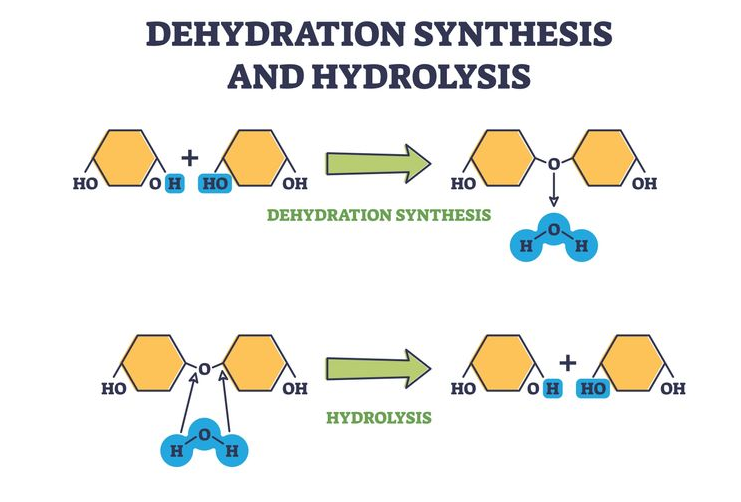
anabolism vs catabolism
Anabolism uses energy to build complex molecules for growth and repair (monomer → polymer)
condensation rxn
catabolism breaks complex molecules down to release energy for body functions. (polymer → monomer)
hydrolysis

oxidation-reduction rxns
chemical reactions where electrons are transferred between molecules.
Oxidation = a molecule loses electrons
Reduction = a molecule gains electrons
They always happen together: when one molecule loses electrons, another gains them. COUPLED

oxidation
removal/loss of an electron (CATABOLIC) → loses energy
occurs through the addition of an oxygen, or removal of an H
energetically FAVORABLE! = releases energy
always coupled w/ reduction!

reduction
gaining of electrons (ANABOLIC) → gains potential energy
can occur through the addition of an H or the removal of an Oxygen
energetically UNFAVORABLE = requires energy
always coupled w/ oxidation!

OIL RIG
Oxidation Is Loss
Reduction Is Gain
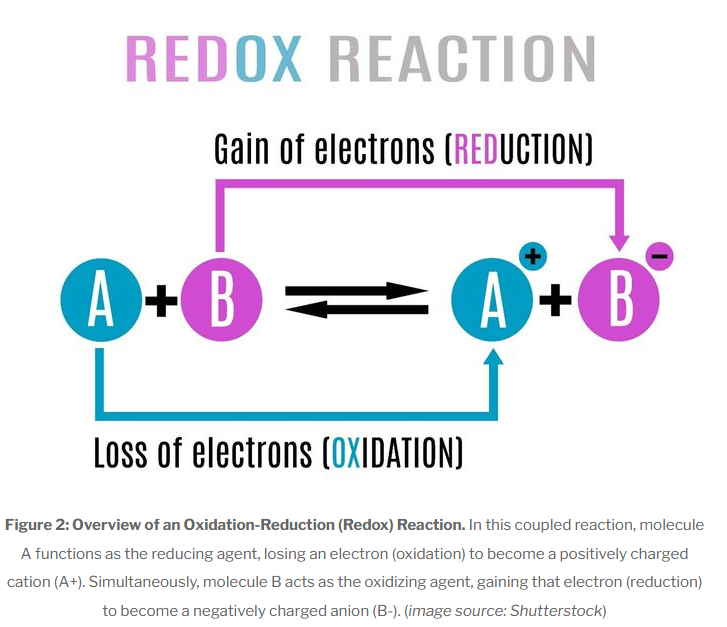
electron carriers
electrons are carefully shuttled from energy-rich food molecules (like glucose) to a final/terminal electron acceptor. This shuttling is performed by mobile electron carriers, such as NAD+ and FAD.
When NAD+ picks up electrons (and a proton), it is reduced to NADH.
The NADH now holds that energy and transports it to the Electron Transport Chain (ETC), where it will be oxidized back to NAD+, releasing the energy to help generate ATP.
acid
a substance that acts as a proton donor. When it dissolves in water, it dissociates to release hydrogen ions (H+) and anions.
Strong Acids: dissociate almost completely
hydrochloric acid: HCl → H+ + Cl-
Weak Acids: dissociate only partially and reversibly
carboxyl groups found in amino acids
1st law of thermodynamics
energy cannot be created or destroyed, but it can be converted from one form to another
(ex: converting sunlight energy into chemical bonds)
2nd law of thermodynamics
the total entropy (disorder) of an isolated system can only increase over time or stay the same for reversible processes
- transfer of energy releases heat, heat results in an increase in disorder
Physical/chemical processes proceed in such a way that the entropy of the universe (the system and its surroundings) increases to the maximum possible.
However, even though the entropy of the universe increases, the entropy of any given system within the universe can increase, decrease, or remain unchanged.
entropy
A measure of the randomness or disorder of a system
systems will change spontaneously toward arrangements with greater entropy.
catabolism
BREAK down molecules = RELEASE ENERGY
increases disorder/spontaneous (-G)
energy can be released as heat too
fueling rxns, energy-conserving rxns, provide reducing power, generate precursors
OXIDATION!

anabolism
BUILD larger complex molecules = REQUIRE input of energy
cause more order so they decrease the disorder/entropy of a system (+G)
REDUCTION!

microbial metabolism
the total of all chemical rxns in the cell (divided into catabolism/anabolism)
representatives in all 5 major nutrional types
cycling of elements
ex: Nitrogen cycle → 4 steps soley done by microbes, and microbes r part of other 4
Nitrogen used in proteins and nucleic acids (DNA/RNA)

calorie (cal)
“little c” energy needed to raise 1 gram of water up 1 degree Celsius
can also be expressed as Joules → 1 cal of heat = 4.184 J of work
1,000 calories = 1Kcal
joules
unit of measure for energy or work. 1 calorie = 4.1840 joules
1 calorie = how many joules?
4.1840 joules
standard free energy change (delta G)
The total energy change in a system that is available to do useful work as the system goes from reactant → product at constant temperature and pressure.
- delta G → rxn will be spontaneous (exergonic)
+ delta G → rxn will not be spontaenous (endergonic)

negative delta G
energetically favorable/spontaneous rxns!
create disorder by decreasing the free energy of a system
EXERGONIC!

positive delta G
energetically unfavorable! create order in the universe
need input of energy and need to be coupled to an energy releasing rxn
ENDERGONIC!

exergonic rxns
delta G is NEGATIVE
rxn proceeds spontaneously → energy is released
final product has less energy
smaller activation energy
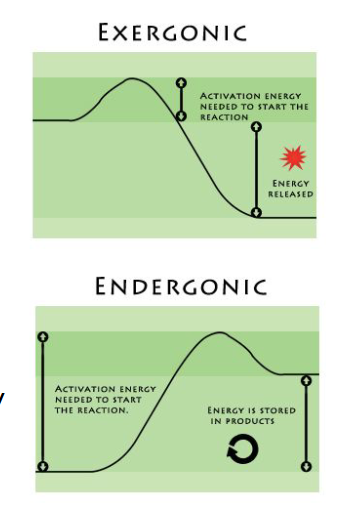
what is spontaneous in the forward direction?
exergonic rxns
what is not spontaneous in forward direction w a positive G?
endergonic rxns
endergonic
delta G is POSITIVE
rxn will not proceed spontaneously
a lot of activation energy required
energy of products is higher than reactants → energy stored in products

ATP
adenosine 5’ - triphosphate aka nucleoside triphosphate
A high-energy molecule that serves as the cell’s major form of energy currency. “universal”
has ribose sugar
has high phosphate transfer potential → composed of 2 high energy bonds
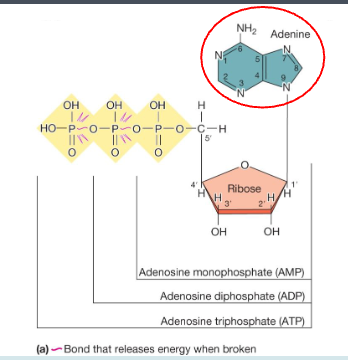
atp in endergonic rxns
ATP hydrolysis is exergonic and is used to drive endergonic rxns such as anabolism, transport, and mechanical work

how much energy is released when ATP → ADP + P
-7.3 kcal/mol or -30.5 kJ/mol
phosphate transfer potential
A characteristic of a phosphorylated compound that transfers a phosphoryl group to another molecule with a large energy release.
ATP has high phosphate transfer potential!

what molecule has the highest phosphate transfer potential?
phosphoenolpyruvate (-61.9)

what is the order of highest → lowest energy phosphate transfer potential?
phosphoenolpyruvate
1,3-bisphosphoglycerate
ATP → AMP
ATP → ADP
Glucose 6-phosphate
Glycerol 1-phosphate

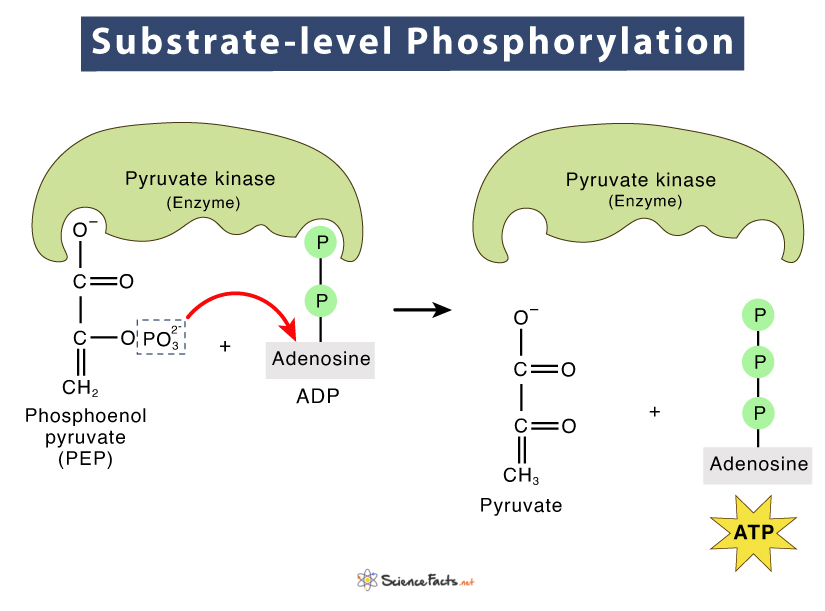
what is synthesis of high-energy phosphate bonds through the reaction of inorganic phosphate with an activated organic substrate
substrate-level phosphorylation
substrate-level phosphorylation (SLP)
directly produces ATP (or GTP) by transferring a phosphate group from a high-energy organic substrate molecule to ADP, a synthesis that is directly coupled with the exergonic breakdown of that substrate molecule
makes ATP using a diff molecule, not ETC, but using an enzyme
GTP
Guanosine 5’ -triphosphate
supplies some of the energy used in protein synthesis
what energy is used for protein synthesis?
GTP
CTP
cytidine 5’ -triphosphate
used during lipid synthesis
what energy is used for lipid synthesis?
CTP
UTP
uridine 5’- triphosphate
used in synthesis of peptidoglycan
equilibrium constant (Keq)
A value that relates the concentration of reactants and products to each other when a reaction is at equilibrium.
if the equilibrium constant is greater than one, the products are in greater concentration than the reactants at equilibrium; reaction tends to go to completion as written.

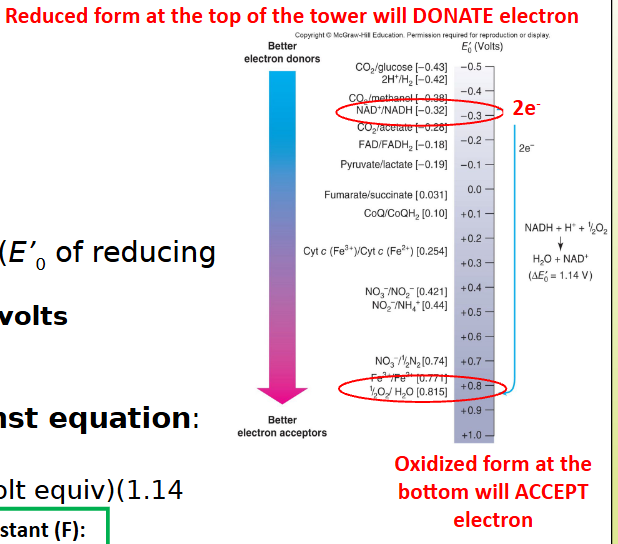
standard reduction potential (Eo)
A measure of the tendency of an electron donor to lose electrons in an oxidation-reduction (redox) reaction. Measured in volts (V)
The more negative the reduction potential of a compound, the better electron donor (reducing agent)
the more positive the reduction potential, the better electron acceptor (oxidizing agent)
the greater the delta Eo btwn redox pairs, the greater the delta G energy

electron donor
molecule that becomes oxidized by giving up an electron.
aka reducing agent or reductant
more negative Eo (reduction potential) = better electron donor

electron acceptor
A compound that accepts electrons (gets reduced) in an oxidation-reduction reaction.
aka oxidizing agent or oxidant.
more positive Eo (reduction potential) = better electron acceptor

conjugate redox pair
The electron acceptor and electron donor of a redox half reaction.

half rxns
each redox rxn has 2 half rxns:
the electron donating half (oxidation)
electron accepting half (reduction)
acceptor and donator of a half rxn r the conjugate redox pair

what r the 2 rules of redox pairs?
1) when writing a redox couple, the reduced member of the pair that is more negative donates e- to the oxidized member of the pair that is more positive.
2) the greater the diff. in redox potential (Eo) btwn the redox pairs that serve as the e- donor and acceptor, the greater the amt of energy available (delta G) in the oxidation-reduction rxn

if delta G is negative, but the Eo is positive, what is the direction of the rxn?
spontaneous in the forward direction

if delta G is positive, but the Eo is negative, what is the direction of the rxn?
spontaneous in reverse direction

if delta G and Eo are 0, what is the direction of the rxn?
no net rxn → system at equilibrium

electrons move from the _____ in the list to _____
e- move from donors at the top of the list to acceptors at the bottom of the list.
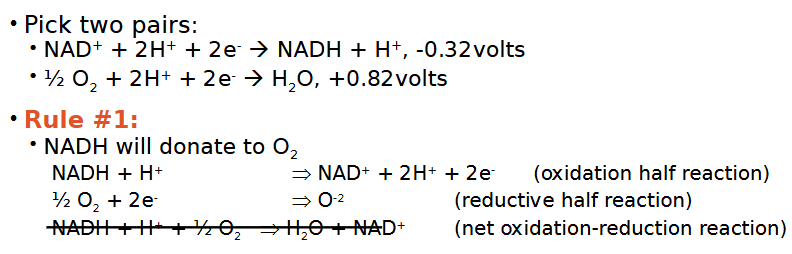
rule #1 of redox rxns
substance being oxidized is…
reducing agent aka electron donor aka reductant

substance being reduced is..
electron acceptor aka oxidizing agent aka oxidant

how do u calculate delta Eo?
delta Eo = (Eo of oxidizing agent) - (Eo of reducing agent)
answer in volts (V)
how do u calculate delta G?
using the Nernst equation:
delta G = -nF(delta Eo)
n = # of moles of e- transferred
F = Faraday’s constant → 23 kcal/volt or 96.5 kJ/volt
Eo = reduction potential

what is Faraday’s constant?
23 kcal/volt or 96.5 kJ/volt
used to calculate delta G in Nernst equation
what is Faraday’s constant in kcal?
23 kcal/volt
what is Faraday’s constant in kJ?
96.5 kJ/volt
metabolites
Chemical compounds produced by the metabolic activities of organisms.
activation energy
The energy required to bring reacting molecules together to reach the transition state in a chemical reaction.
enzymes lower activation energy

active/catalytic site
The part of an enzyme that binds the substrate to form an enzyme-substrate complex and catalyze the reaction. Also called the catalytic site.
diff from allosteric site

induced fit model
an enzyme's active site is flexible and changes its shape slightly to tightly bind and catalyze a specific substrate

electron transport chain
a series of e- carriers that work to transfer e- from donors → acceptors. Create ways to capture energy to make ATP
eukaryotes: in mitochondrial membrane or thylakoid membrane of chloroplast
prokaryotes: in cell membrane
1st electron carrier has the most negative E’o

the 1st e- carrier in the ETC is the one with?
the most negative E’o (best e- donor)

where is the ETC found in eukaryotes?
inner mitochondrial membrane or thylakoid membrane in chloroplast
where is the ETC found in prokaryotes?
cell membrane
what r the main electron carriers?
NADH and NADPH
FAD (flavinadenine nucleotide) and FMN (flavin mononucleotide)
CoQ/Ubiquinone
Nonheme iron-sulfur proteins
NADH and NADPH carry how many e- and protons?
2 electrons 1 proton
have a nicotinamide ring
NADH is normally used in ______
catabolism! used in Glycolysis, pyruvate oxidation, TCA cycle and transfers e- to ETC to make ATP
favors oxidizing other molecules when it gets reduced cuz absorbing e-

NADPH is normally used in ______
anabolism! in Pentose phosphate pathway (PPP), malic enzyme, and isocitrate dehydrogenase
in anabolism reduces other molecules by giving its e- to building blocks

FAD and FMN
flavinoadenine nucleotide and flavin mononucleotide
found in flavoproteins (proteins bearing FMN + FAD)
carry 2 e- and 2 protons
how many protons and electrons do FMN and FAD carry?
2 electrons and 2 protons
how many electrons and protons do CoQ/ubiquinone have?
2 electrons and 2 protons
CoQ/ubiquinone
they r lipids embedded in membrane
CoQ = Coenzyme Q
transfer 2 electrons and 2 protons
Cytochromes
have iron-poryphrin rings where iron is part of heme group!
carry 1 electron at a time
how many protons and electrons do cytochromes carry?
1 electron at a time
nonheme iron-sulfur proteins
have iron but it is not part of a hem group cuz they have no heme
ex: ferredoxin
carry one electron at a time
how many proteins and electrons do nonheme iron-sulfur proteins carry?
1 electron at a time
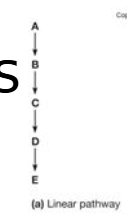
linear pathway
has clear starting and end product
cyclic pathway
all molecules can be thought of as intermediates

branched pathway
linear w/ multiple products

biochemical pathways
have a substrate, intermediate, and end product where u use an enzyme for every step.
pathways often overlap/feed into each other and monitor changes in metabolite lvls (flux)
enzymes
protein catalysts w/ great specificity that carry out rxns at physiological conditions
speed up the rate by lowering activation rate
do NOT alter equilibrium!!
catalysts
end w/ “-ase”
catalysts
speed up the rate of a rxn w/o being permanently changed itself
these r what enzymes are
lyase
an enzyme that dissociates molecules, breaks covalent bonds w/o using water, oxidation, or reduction
ex: decarboxylase
A → B + C
ligase
enzyme that joins 2 molecules together, forms covalent bonds btwn 2 molecules
ex: DNA ligase
A + B → AB
isomerase
enzyme that rearranges bonds of a molecule, a reactant forms one of its isomers
ex: mutase
A → B
transferase
enzyme that transfers a functional group from one molecule to another.
ex: kinase (transfers P)
A + BX → AX + B
hydrolase
enzyme that uses water to cleave a molecule, breaks covalent bonds w/ water
ex: protease
A + H2O → B + C
oxidoreductase
enzyme that transfers electrons from one molecule to another, alters oxidation state of reactants
ex: lactate dehydrogenase
A + B: → A: + B
what are enzymes composed of?
one or more polypeptides (apoenzyme)
nonprotein component (cofactor)
together forms holoenzyme

apoenzyme
the protein part of an enzyme

holoenzyme
the protein (apoenzyme) part + nonprotein component (cofactor) → make up this whole
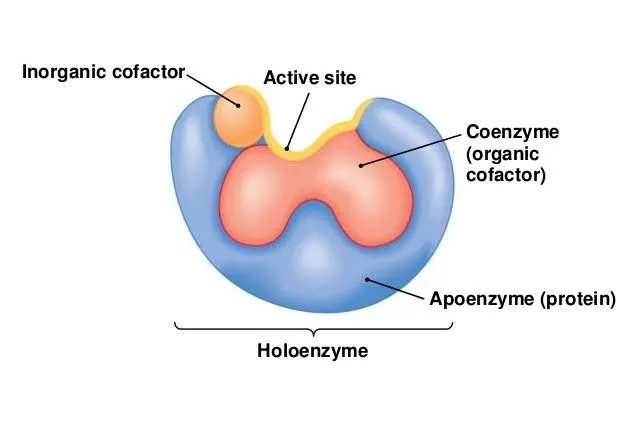
cofactor
the nonprotein component of an enzyme. made up of:
prosthetic group
tightly bounded
coenzyme
loosely bounded

prosthetic group
tightly bonded to enzyme.Permanent cuz covalently bonded
part of the cofactor in the enzyme

coenzyme
the part of the cofactor of an enzyme that is loosely bonded and can dissociate after products r formed.

activation energy (Ea)
energy required to bring reacting molecules to reach the transition state
enzymes lower this

how do enzymes speed up rxns?
by lowering the activation energy (Ea)
