Exam 3 bio

0.0(0)
Studied by 0 people
call kaiCall Kai
learnLearn
examPractice Test
spaced repetitionSpaced Repetition
heart puzzleMatch
flashcardsFlashcards
GameKnowt Play
Card Sorting

1/173

encourage image

There's no tags or description

Looks like no tags are added yet.

174 Terms

1
New cards
Which of the following are reasons cells divide? (Choose all correct answers) a) Reproduction b) Regeneration of worn-out cells in the body c) Growth of the body d) Repair of injury to the body
a b c d
2
New cards
Most cells in your body have a limited life-span and become worn-out; some in just a few days. How does your body stay healthy and maintain all the cells you need in spite of this? a) Actually this is not true. Your body cells generally can survive for your whole lifetime. b) When a cell begins to wear out; it goes into your bone marrow or spleen to be repaired. c) You are born with a supply of many more cells than you will ever need. When a cell becomes worn out one of your back-up supply takes its place. d) Cells in your body divide to replace worn-out cells. This is called regeneration.
d
3
New cards
Which of the following best describes how a cut on your skin heals? a) Cells that were not damaged become bigger and fill in the cut. New cells are not needed. b) Cells that were damaged in the cut are able to repair themselves and become like they were before. New cells are not needed. c) Cells make proteins that stretch across the cut. New cells are not needed. d) Cells divide to produce new cells and make new skin.
d
4
New cards
Which of the following is true of cell division? a) Exactly one copy of all the cell's DNA must go into each new cell. b) Every time cells divide it reduces the amount of DNA in the cells produced. Over generations the amount of DNA becomes less and less. c) DNA is easy to divide during cell division because cells can regenerate any genes they may have not gotten so it doesn't need to be exact. d) If one of the new cells doesn't get a copy of some of the DNA; it can get the DNA it needs from another cell.
a
5
New cards
What is the genome of a cell? a) All the DNA in the cell. b) An organelle that reads genes. c) All the types of proteins a cell makes. d) Everywhere in the cell that genes are found.
a
6
New cards
Genes are made of a) DNA. b) enzymes. c) carbohydrate. d) protein.
a
7
New cards
How do chromosomes change before cell division? a) They copy themselves and the copies are attached end to end so they are twice as long as normal. b) Chromosomes don't have to change before cell division. c) They become shorter because they lose all the genes that won't be copied. d) They make copies of themselves and then coil up to look short and fat.
d
8
New cards
<p>Which choice is the best description of what this picture shows? [Picture1-1.png] a) DNA molecules are amazingly long. The DNA supercoils above are what is needed for cell division. This picture shows that before cell division chromosomes unwind so that the supercoils can be divided into the new cells during cell division. b) Just before a cell divides; the chromosomes unravel so that single threads of DNA can come out. This is so they can be divided into the new cells. c) DNA molecules are incredibly long. Before cell division; cells make condensed chromosomes. When making condensed chromosomes the DNA coils and then the coils coil and fold up to form the chromosome. The chromosome shown contains two DNA molecules; one on the left side and one on the right side. d) Each chromosome contains many millions of DNA molecules all packed together to make the shape of the condensed chromosome. Each of those millions of molecules is present in an exact copy on each side of the chromosome</p>

Which choice is the best description of what this picture shows? [Picture1-1.png] a) DNA molecules are amazingly long. The DNA supercoils above are what is needed for cell division. This picture shows that before cell division chromosomes unwind so that the supercoils can be divided into the new cells during cell division. b) Just before a cell divides; the chromosomes unravel so that single threads of DNA can come out. This is so they can be divided into the new cells. c) DNA molecules are incredibly long. Before cell division; cells make condensed chromosomes. When making condensed chromosomes the DNA coils and then the coils coil and fold up to form the chromosome. The chromosome shown contains two DNA molecules; one on the left side and one on the right side. d) Each chromosome contains many millions of DNA molecules all packed together to make the shape of the condensed chromosome. Each of those millions of molecules is present in an exact copy on each side of the chromosome

c

9
New cards
What are the two MAIN parts of the cell cycle a) Mitosis and cytokinesis b) Gap and Synthesis c) Interphase and mitotic phase d) Mitosis and Meiosis
c
10
New cards
During which phase of interphase does the cell copy its DNA? a) G2 phase b) S phase c) Chromatid phase d) G1 phase
b
11
New cards
How many chromosomes are found in each cell in your body? a) 64 b) 46 c) 78 d) 23
b
12
New cards
The cells in your body normally only divide when they are supposed to. If cells start ignoring normal controls and dividing too much; the result is a) glaucoma. b) you become abnormally tall. c) weight gain. d) cancer.
d
13
New cards
What is the name of the part of the cell cycle where the cell is NOT dividing? a) Interphase b) Cytokinesis c) Metaphase d) Mitotic phase
a
14
New cards
Does the cell copy its DNA during interphase or mitotic phase? a) Mitotic phase b) Interphase
b
15
New cards
What is cytokinesis? a) Cytokinesis makes sister chromatids. b) Cytokinesis is division of the cell's cytoplasm. c) Cytokinesis is division of the nucleus. d) Cytokinesis is how the spindle forms.
b
16
New cards
Which option below describes telophase of mitosis? a) The chromosomes condense (coil up) and the nuclear envelope breaks down. b) The chromosomes line up across the middle of the cell ready for sister chromatids to be pulled apart. c) Sister chromatids have separated into new chromosomes and are being pulled to opposite sides of the cell. d) The chromosomes have separated into either side of the cell and the new nuclear envelopes are forming.
d
17
New cards
Which option below describes prophase of mitosis? a) The chromosomes condense (coil up) and the nuclear envelope breaks down. b) The chromosomes line up across the middle of the cell ready for sister chromatids to be pulled apart. c) Sister chromatids have separated into new chromosomes and are being pulled to opposite sides of the cell. d) The chromosomes have separated into either side of the cell and the new nuclear envelopes are forming.
a
18
New cards
Synthesis or S phase is a phase during interphase. Immediately AFTER synthesis occurs which of the following is true? a) The cell is haploid. b) The chromosomes are duplicated. c) The nuclear envelope has disappeared. d) Sister chromatids have separated.
b
19
New cards
Match Centrosome with its meaning. a) A structure in a cell that forms the spindle during cell division. b) Part of a chromosome that attaches to the spindle during cell division. c) One side of a duplicated chromosome containing a copy of the DNA. d) A word that refers to the DNA in a cell along with the protein that helps support and organize it.
a
20
New cards
Match Centromere with its meaning. a) A structure in a cell that forms the spindle during cell division. b) Part of a chromosome that attaches to the spindle during cell division. c) One side of a duplicated chromosome containing a copy of the DNA. d) A word that refers to the DNA in a cell along with the protein that helps support and organize it.
b
21
New cards
Match Sister chromatid with its meaning. a) A structure in a cell that forms the spindle during cell division. b) Part of a chromosome that attaches to the spindle during cell division. c) One side of a duplicated chromosome containing a copy of the DNA. d) A word that refers to the DNA in a cell along with the protein that helps support and organize it.
c
22
New cards
Match Chromatin with its meaning. a) A structure in a cell that forms the spindle during cell division. b) Part of a chromosome that attaches to the spindle during cell division. c) One side of a duplicated chromosome containing a copy of the DNA. d) A word that refers to the DNA in a cell along with the protein that helps support and organize it.
d
23
New cards
Match Prophase with what is occurring during that phase. a) The chromosomes condense (coil up) and the nuclear envelope breaks down. b) The chromosomes line up across the middle of the cell ready for sister chromatids to be pulled apart. c) Sister chromatids have separated into new chromosomes and are being pulled to opposite sides of the cell. d) The chromosomes have separated into either side of the cell and the new nuclear envelopes are forming.
a
24
New cards
Match Metaphase with what is occurring during that phase. a) The chromosomes condense (coil up) and the nuclear envelope breaks down. b) The chromosomes line up across the middle of the cell ready for sister chromatids to be pulled apart. c) Sister chromatids have separated into new chromosomes and are being pulled to opposite sides of the cell. d) The chromosomes have separated into either side of the cell and the new nuclear envelopes are forming.
b
25
New cards
Match Anaphase with what is occurring during that phase. a) The chromosomes condense (coil up) and the nuclear envelope breaks down. b) The chromosomes line up across the middle of the cell ready for sister chromatids to be pulled apart. c) Sister chromatids have separated into new chromosomes and are being pulled to opposite sides of the cell. d) The chromosomes have separated into either side of the cell and the new nuclear envelopes are forming.
c
26
New cards
Match Telophase with what is occurring during that phase. a) The chromosomes condense (coil up) and the nuclear envelope breaks down. b) The chromosomes line up across the middle of the cell ready for sister chromatids to be pulled apart. c) Sister chromatids have separated into new chromosomes and are being pulled to opposite sides of the cell. d) The chromosomes have separated into either side of the cell and the new nuclear envelopes are forming.
d
27
New cards
In G1 of interphase; chromosomes are ___. a) nonduplicated b) duplicated (have 2 sister chromatids)
a
28
New cards
In G2 of interphase; chromosomes are ___. a) nonduplicated b) duplicated (have 2 sister chromatids)
b
29
New cards
In prophase and metaphase of mitosis; chromosomes are ___. a) nonduplicated b) duplicated (have 2 sister chromatids)
b
30
New cards
In telophase of mitosis; chromosomes are ___. a) nonduplicated b) duplicated (have 2 sister chromatids)
a
31
New cards
Which group(s) of organisms reproduce sexually using EGGS and SPERM? (Select all correct answers) a) Pllants b) Fungi c) Animals d) Bacteria
a c
32
New cards
What is/are the advantage(s) of sexual reproduction? (Select all correct answers) a) It is faster than asexual reproduction b) It produces genetic variation c) It uses less resources than asexual reproduction d) It is possible to do in a wider range of conditions than asexual reproduction
b
33
New cards
Which of the following is NOT a reason that a human SOMATIC cell would divide? a) Repair of damaged human tissue b) Human reproduction c) Regeneration of worn-out human tissue d) Growth of the human
b
34
New cards
Which of the following is true of SEXUAL reproduction? a) Yeast cell budding is an example of this type of reproduction. b) It requires two parents. c) It produces new individuals that are genetically identical to each other. d) Growing a new plant from a piece cut off of an old plant is an example of this type of reproduction.
b
35
New cards
Which of the following is NOT a reason cells do MITOSIS? a) Reproduction of a single-celled organism. b) To repair injury to the body of a multicellular organism. c) Making gametes in a multicellular organism. d) Growth of a multicellular organism.
c
36
New cards
Which of the following are advantages of ASEXUAL reproduction? Select all correct answers. a) You can pass on ALL your genes b) Variation is produced in the population. c) You don't need to find a mate in order to reproduce. d) All individuals in the population can produce young.
a c d
37
New cards
In biology; what do we call an individual with the exact same DNA as another (as in the case of asexual reproduction)? a) A bud b) A drone c) A clone d) A replicant
c
38
New cards
Which is true of ASEXUAL reproduction? a) In asexual reproduction; each parent gives 1/2 of their genes to the offspring. b) The offspring produced in asexual reproduction is genetically identical to the parent. c) Aexual reproduction requires production of gametes. d) Asexual reproduction produces variation.
b
39
New cards
What is a homologous pair of chromosomes? a) Chromosomes in an individual that all came from the same parent. b) Two chromosomes that contain the same genes; one of which came from the mom and one of which came from the dad. c) Two attached and identical copies of the same DNA molecule. d) Chromosomes that are nonduplicated.
b
40
New cards
What is the term that means having 2 copies of each chromosome in your cells? a) Haploid b) Diaspora c) Homologous d) Diploid
d
41
New cards
Which of the following are true of fertilization? a) Fertilization is when gametes fuse in reproduction. b) After fertilization; the first cell of the baby has the same number of chromosomes as an adult. c) In fertilization; the sperm injects its DNA into the egg. d) After fertilization; the first cell of the baby is haploid.
a b
42
New cards
SISTER CHROMATIDS are a) the same size and have the same genes; but may have different alleles. b) present in a cell that has just completed mitosis. c) present in a cell that has just completed meiosis II. d) identical because they are both copies of the same original DNA molecule.
d
43
New cards
Which is true of the homologous pairs of chromosomes in each of your cells? a) The two chromosomes in each pair MAY have the same genes on them but usually do not. b) The two chromosomes in each pair are identical to each other. c) The two chromosomes in each pair contain the same genes but are not identical. d) In some homologous pairs BOTH chromosomes in the pair came from one parent (your dad or your mom).
c
44
New cards
What are the names of the human chromosomes? a) There are only 23 different human chromosomes. They are called by their numbers (1; 2; 3; etc). In addition there are the 2 sex chromosomes; X and Y. b) Human chromosomes are given letters (A; B; C; etc.). X and Y are the sex chromosomes. c) There are 46 different human chromosomes that are just designated by numbers (1; 2; 3; .. 46) d) There are 22 different human chromosomes that are just given numbers (1; 2; 3; etc). There are also 2 sex chromosomes called X and Y.
d
45
New cards
What is the maximum number of different alleles someone can have for a gene. a) 1 b) Thousands depending on how many alleles there are c) 2 d) 46
c
46
New cards
What is true of human gametes? (Choose all that apply...) a) They are haploid. b) They each have 23 chromosomes. c) They contain homologous pairs of chromosomes. d) They are sex cells (eggs or sperm).
a b d
47
New cards
ONE duplicated chromosome consists of TWO a) homologous chromosomes. b) homologous pairs. c) sister chromatids. d) centromeres.
c
48
New cards
In your body cells a) some of the chromosomes are found in the cytoplasm. b) the chromosomes occur in pairs. c) you have only one copy of each gene. d) there are 23 chromosomes.
b
49
New cards
Fertilization is a) when chromosomes fuse during meiosis. b) when germ cells fuse in asexual reproduction. c) when a cell becomes hapoid during meiosis. d) when gametes fuse in sexual reproduction.
d
50
New cards
Which one of the following is true of MEIOSIS? a) The first division of meiosis separates sister chromatids. b) The first division of meiosis separates members of homologous pairs of chromosomes. c) Meiosis is involved in growth and regeneration. d) Chromosomes are not duplicated during prophase I of meiosis.
b
51
New cards
<p>What is true of Picture A and Picture B? Choose all correct answers. [Picture2.png] a) There are more chromosomes in Picture B than in Picture A b) Picture A and Picture B both show a pair of homologous chromosomes. c) The purple and the green chromosomes have all the same genes on them in all the same locations. d) The chromosomes in Picture A are in a cell that is not ready to divide.</p>

What is true of Picture A and Picture B? Choose all correct answers. [Picture2.png] a) There are more chromosomes in Picture B than in Picture A b) Picture A and Picture B both show a pair of homologous chromosomes. c) The purple and the green chromosomes have all the same genes on them in all the same locations. d) The chromosomes in Picture A are in a cell that is not ready to divide.

b c d
52
New cards
What is the name of the type of cells that give rise to gametes? a) Gonadic cells b) Germ cells c) Somatic cells d) Gametic cells
b
53
New cards
Human body cells are ___. a) diploid b) haploid
a
54
New cards
A cell just about to begin meiosis is ___. a) diploid b) haploid
a
55
New cards
After meiosis I; a cell is ___. a) diploid b) haploid
b
56
New cards
At the end of meiosis; the egg or sperm produced is ___. a) diploid b) haploid
b
57
New cards
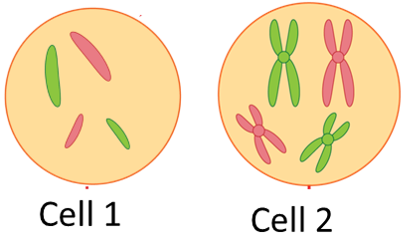
<p>What is true of cell 1 and cell 2? Choose all correct answers. [Picture1-2.png] a) They both have 4 chromosomes. b) In each cell; the pink chromosomes are homologous to each other and the green chromosomes are homologous to each other. c) Cell 1 has 4 chromosomes but cell 2 has more. d) Each cell has 2 pairs of homologous chromosomes.</p>

What is true of cell 1 and cell 2? Choose all correct answers. [Picture1-2.png] a) They both have 4 chromosomes. b) In each cell; the pink chromosomes are homologous to each other and the green chromosomes are homologous to each other. c) Cell 1 has 4 chromosomes but cell 2 has more. d) Each cell has 2 pairs of homologous chromosomes.

a d

58
New cards
Which option below correctly describes meiosis I and meiosis II? a) Sister chromatids are the only thing that separates and they separate in both meiosis I and meiosis II. b) Both sister chromatids and homologous chromosomes separate in meiosis I and then again both sister chromatids and homologous chromosomes separate in meiosis II. c) In meiosis I homologous pairs of chromosomes separate; while in meiosis II sister chromatids separate. d) In meiosis I sister chromatids separate; while in meiosis II homologous pairs of chromosomes separate.
c
59
New cards
Match Prophase I with what is happening in that phase. a) Crossing over happens. b) Cell is haploid. Chromosomes not yet lined up. c) Homologous pairs line up. d) Cell is haploid. Chromosomes lined up singly.
a
60
New cards
Match Prophase II with what is happening in that phase. a) Crossing over happens. b) Cell is haploid. Chromosomes not yet lined up. c) Homologous pairs line up. d) Cell is haploid. Chromosomes lined up singly.
b
61
New cards
Match Metaphase I with what is happening in that phase. a) Crossing over happens. b) Cell is haploid. Chromosomes not yet lined up. c) Homologous pairs line up. d) Cell is haploid. Chromosomes lined up singly.
c
62
New cards
Match Metaphase II with what is happening in that phase. a) Crossing over happens. b) Cell is haploid. Chromosomes not yet lined up. c) Homologous pairs line up. d) Cell is haploid. Chromosomes lined up singly.
d
63
New cards
Crossing over a) is caused by the way maternal and paternal chromosomes line up in metaphase II of meiosis. b) is when chromosomes break and trade pieces in prophase II of meiosis. c) is when chromosomes break and trade pieces in prophase I of meiosis. d) is caused by the way maternal and paternal chromosomes line up in metaphase I of meiosis.
c
64
New cards
The evolutionary advantage of sexual reproduction is a) that it is easy to produce a lot of offspring. b) that many genetically identical offspring can be produced. c) having two parents. d) production of genetic variation.
d
65
New cards
Independent assortment and crossing over a) produce genetic variation during mitosis so that somatic cells are different from each other. b) produce genetic variation during meiosis so that gametes are different from each other. c) happen in meiosis but do not produce genetic variation. d) happen in ALL cell division – both mitosis and meiosis.
b
66
New cards
What are the processes that produce variation in sexual reproduction? a) Independent assortment; crossing over; and random fertilization b) Random assortment; crossing under; and independent fertilization c) Random synthesis; chromatid segregation; and diploid fertilization d) Chromosome duplication; allele segregation; and metaphase II
a
67
New cards
In metaphase II of meiosis; which of the following is happening? a) The cell is haploid and chromosomes are lined up singly (not in pairs). b) The cell is haploid but chromosomes are not yet lined up. c) Homologous pairs line up and independent assortment happens. d) Crossing over happens.
a
68
New cards
Which is NOT TRUE of CROSSING OVER? a) It is one cause of genetic variation in sexual reproduction. b) It can happen in mitosis. c) It happens when homologous chromosomes associate closely during prophase I of meiosis. d) It involves chromosomes actually breaking and trading pieces.
b
69
New cards
Independent assortment a) is caused by random chance the way maternal and paternal chromosomes line up in metaphase I. b) is when chromosomes duplicate in a way that makes sister chromatids that are NOT identical. c) is when chromosomes break and trade pieces producing new combinations of alleles. d) is the random separation of chromosomes so that daugter cells all get different numbers of chromosomes.
a
70
New cards
What does Mendel's Law of Dominance say? a) Adults contain two alleles for each gene but these alleles separate during gamete formation so that each gamete only gets one allele for each gene. b) Every character has at least two traits. c) Which allele will go into a gamete is a matter of chance. d) Some traits show and some traits hide in individuals that inherit both.
d
71
New cards
What do we call a trait that SHOWS in a heterozygous individual? a) Dominant b) Wild type c) Recessive d) Powerful
a
72
New cards
Match Heredity with its definition. a) The transmission of traits from one generation to the next. b) A picture showing all chromosomes in the genome laid out in homologous pairs. c) A heritable feature (like flower color). d) A version of a heritable feature (like white or purple flower color).
a
73
New cards
Match Karyotype with its definition. a) The transmission of traits from one generation to the next. b) A picture showing all chromosomes in the genome laid out in homologous pairs. c) A heritable feature (like flower color). d) A version of a heritable feature (like white or purple flower color).
b
74
New cards
Match Character with its definition. a) The transmission of traits from one generation to the next. b) A picture showing all chromosomes in the genome laid out in homologous pairs. c) A heritable feature (like flower color). d) A version of a heritable feature (like white or purple flower color).
c
75
New cards
Match Trait with its definition. a) The transmission of traits from one generation to the next. b) A picture showing all chromosomes in the genome laid out in homologous pairs. c) A heritable feature (like flower color). d) A version of a heritable feature (like white or purple flower color).
d
76
New cards
Genetics is a) The transmission of traits from one generation to the next. b) The scientific study of molecules. c) The scientific study of heredity. d) The study of alleles in populations.
c
77
New cards
A ___ is a feature that all individuals have (such as eye color). a) character b) trait
a
78
New cards
A ___ is a particular version of that feature seen in an individual; like BROWN eyes. a) character b) trait
b
79
New cards
Gregor Mendel was a a) Monk b) Doctor c) Wealthy banker d) Professor
a
80
New cards
Heredity is a) The study of alleles in populations. b) The scientific study of heredity. c) The transmission of traits from one generation to the next. d) The scientific study of molecules.
c
81
New cards
What surprising things did Mendel observe? Select all correct answers. a) Two true-breeding purple-flowered pea plants could produce white offspring when crossed. b) It was sometimes possible for two purple flowered pea plants to have white offspring c) It was sometimes possible for two white flowered pea plants to have purple offspring d) All of the offspring between a true-breeding purple flowered pea plant and a white flowered pea plant had purple flowers.
b d
82
New cards
What are Mendel's three laws called? a) The Law of Dominance; The Law of Alleles; The Law of Heterozygotes b) The Law of Segregation; The Law of Pleiotropy; The Law of Independent Alleles c) The Law of Heredity; The Law of Genetics; The Law of Alleles d) The Law of Dominance; The Law of Segregation; The Law of Independent Assortment
d
83
New cards
Why is Gregor Mendel called 'the father of genetics?' a) He was a religious man (monk) whose title was 'father' and he studied genetics. b) He was one of the earliest people to breed plants. c) He was the first to discover basic principles of genetics by applying the scientific method to answer questions about heredity. d) He was the first to realize that genes are made of DNA.
c
84
New cards
<p>This picture shows the alleles on a pair of homologous chromosomes in a pea plant. Y is the yellow seed allele. Which of the following are true of this individual? Select all that apply? [5.png] a) This individual has 6 other pairs of homologous chromosomes that aren't shown b) This individual is diploid c) This individual will have yellow seeds. d) This individual is heterozygous</p>

This picture shows the alleles on a pair of homologous chromosomes in a pea plant. Y is the yellow seed allele. Which of the following are true of this individual? Select all that apply? [5.png] a) This individual has 6 other pairs of homologous chromosomes that aren't shown b) This individual is diploid c) This individual will have yellow seeds. d) This individual is heterozygous

a b c

85
New cards
<p>This picture shows the alleles on a pair of homologous chromosomes in a pea plant. Y is the yellow seed allele and y is the green seed allele. Why is the green seed allele called y? [6.png] a) This gene is on the pea chromosome #1. When you look at the pea karyotype; there is a slight fork structure at this gene locus that looks like a Y. b) It is the recessive allele. The alleles are named after the dominant allele; which is Yellow; but the recessive allele is given a lower-case letter. c) Letters for naming alleles are given at random. Y was selected because it is a letter where the capital and lower case versions are easy to tell apart. d) These alleles were the 25th ones discovered in peas and so were designated with the 25th letter of the alphabet. The allele that got the lower case letter is arbitrary.</p>

This picture shows the alleles on a pair of homologous chromosomes in a pea plant. Y is the yellow seed allele and y is the green seed allele. Why is the green seed allele called y? [6.png] a) This gene is on the pea chromosome #1. When you look at the pea karyotype; there is a slight fork structure at this gene locus that looks like a Y. b) It is the recessive allele. The alleles are named after the dominant allele; which is Yellow; but the recessive allele is given a lower-case letter. c) Letters for naming alleles are given at random. Y was selected because it is a letter where the capital and lower case versions are easy to tell apart. d) These alleles were the 25th ones discovered in peas and so were designated with the 25th letter of the alphabet. The allele that got the lower case letter is arbitrary.

b

86
New cards
<p>This picture shows the alleles on a pair of homologous chromosomes in a pea plant. Y is the yellow seed allele. What is the genotype of this individual? [5.png] a) Diploid b) Yellow c) YY d) Homozygous</p>

This picture shows the alleles on a pair of homologous chromosomes in a pea plant. Y is the yellow seed allele. What is the genotype of this individual? [5.png] a) Diploid b) Yellow c) YY d) Homozygous

c

87
New cards
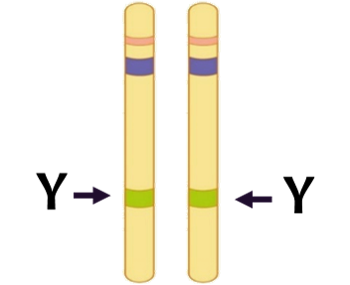
<p>As shown in the figure below; yellow seeds (Y) is dominant to green seeds (y). What are the possible genotypes of an individual with yellow seeds? a) Yy or yy b) YY or Yy c) YY or yy d) YY is the only possible genotype for a plant with yellow seeds.</p>

As shown in the figure below; yellow seeds (Y) is dominant to green seeds (y). What are the possible genotypes of an individual with yellow seeds? a) Yy or yy b) YY or Yy c) YY or yy d) YY is the only possible genotype for a plant with yellow seeds.

b
88
New cards
<p>This picture shows the alleles on a pair of homologous chromosomes in a pea plant. Y is the yellow seed allele. What is the PHENOTYPE of this individual? [5.png] a) Diploid b) Yellow c) Homozygous d) YY</p>

This picture shows the alleles on a pair of homologous chromosomes in a pea plant. Y is the yellow seed allele. What is the PHENOTYPE of this individual? [5.png] a) Diploid b) Yellow c) Homozygous d) YY

b

89
New cards
<p>As shown in the figure below; yellow seeds (Y) is dominant to green seeds (y). If a plant that is true-breeding for yellow seeds is crossed with a plant that is true-breeding for green seeds; what will the PHENOTYPES of the offspring be? a) There will be a ratio of 1 YY: 2 Yy: 1 yy. b) There will be a ratio of 3 yellow-seeded : 1 green-seeded. c) All offspring will have yellow seeds. d) All offspring will have some green seeds and some yellow seeds.</p>

As shown in the figure below; yellow seeds (Y) is dominant to green seeds (y). If a plant that is true-breeding for yellow seeds is crossed with a plant that is true-breeding for green seeds; what will the PHENOTYPES of the offspring be? a) There will be a ratio of 1 YY: 2 Yy: 1 yy. b) There will be a ratio of 3 yellow-seeded : 1 green-seeded. c) All offspring will have yellow seeds. d) All offspring will have some green seeds and some yellow seeds.

c

90
New cards
Match Genotype with the definition. a) The alleles an individual has for a gene b) Physical location of a gene on a chromosome c) A segment of a DNA molecule that contains information to produce a character (like flower color). d) A DNA sequence that produces particular version of a gene (like white or purple flower color).
a
91
New cards
Match Gene locus with the definition. a) The alleles an individual has for a gene b) Physical location of a gene on a chromosome c) A segment of a DNA molecule that contains information to produce a character (like flower color). d) A DNA sequence that produces particular version of a gene (like white or purple flower color).
b
92
New cards
Match Gene with the definition. a) The alleles an individual has for a gene b) Physical location of a gene on a chromosome c) A segment of a DNA molecule that contains information to produce a character (like flower color). d) A DNA sequence that produces particular version of a gene (like white or purple flower color).
c
93
New cards
Match Allele with the definition. a) The alleles an individual has for a gene b) Physical location of a gene on a chromosome c) A segment of a DNA molecule that contains information to produce a character (like flower color). d) A DNA sequence that produces particular version of a gene (like white or purple flower color).
d
94
New cards
<p>In the picture shown; the yellow line on the chromosome is a yellow seed allele (Y) and the green line on the chromosome is the green seed allele (y). What is true of the image below? [Capture.JPG] a) The 'cells' shown are actually supposed to be the SAME cell. It is shown both before the DNA is copied and after. b) The genotype of the cell shown on the right is the SAME as the genotype of the cell shown on the left (Yy) c) The cells shown are diploid d) Both images show a cell with 2 chromosomes in it</p>

In the picture shown; the yellow line on the chromosome is a yellow seed allele (Y) and the green line on the chromosome is the green seed allele (y). What is true of the image below? [Capture.JPG] a) The 'cells' shown are actually supposed to be the SAME cell. It is shown both before the DNA is copied and after. b) The genotype of the cell shown on the right is the SAME as the genotype of the cell shown on the left (Yy) c) The cells shown are diploid d) Both images show a cell with 2 chromosomes in it

a b c d

95
New cards
<p>This picture shows the alleles on a pair of homologous chromosomes in a pea plant. Y is the yellow seed allele and y is the green seed allele. Which of the following are true regarding these alleles? Select all that apply. [6.png] a) Both alleles are actually long stretches of a DNA molecule and can be written as a long sequence of A; T; G; and C b) These alleles are MOSTLY identical but differ in just a few places. c) This gene is on the pea chromosome #1. These alleles will ALWAYS be found on chromosome #1 and in the same location. They would never be found in a different location or on a different chromosome. d) Like all alleles; these alleles are made of proteins. They are different because they contain different amino acids.</p>

This picture shows the alleles on a pair of homologous chromosomes in a pea plant. Y is the yellow seed allele and y is the green seed allele. Which of the following are true regarding these alleles? Select all that apply. [6.png] a) Both alleles are actually long stretches of a DNA molecule and can be written as a long sequence of A; T; G; and C b) These alleles are MOSTLY identical but differ in just a few places. c) This gene is on the pea chromosome #1. These alleles will ALWAYS be found on chromosome #1 and in the same location. They would never be found in a different location or on a different chromosome. d) Like all alleles; these alleles are made of proteins. They are different because they contain different amino acids.

a b c

96
New cards
Which phase of meiosis is responsible for Mendel's Law of Segregation? (Think carefully - There is a question SIMILAR to this one!) a) Prophase II b) Anaphase II c) Metaphase I d) Anaphase I
d
97
New cards
<p>This picture shows the alleles on a pair of homologous chromosomes in a pea plant. Y is the yellow seed allele and y is the green seed allele. Which of the following are true of this individual. Select all that apply. [6.png] a) This individual is diploid b) This individual is heterozygous c) This individual has green seeds d) This individual can produce gametes with both the Y and the y allele together in one gamete (EACH gamete has Y and y)</p>

This picture shows the alleles on a pair of homologous chromosomes in a pea plant. Y is the yellow seed allele and y is the green seed allele. Which of the following are true of this individual. Select all that apply. [6.png] a) This individual is diploid b) This individual is heterozygous c) This individual has green seeds d) This individual can produce gametes with both the Y and the y allele together in one gamete (EACH gamete has Y and y)

a b

98
New cards
<p>Cheek dimples in humans is controlled by a single gene with complete dominance where dimples (D) is the dominant trait and no dimples (d) is recessive. If an individual is heterozygous for this trait; what is his or her GENOTYPE? a) This person has dimples. b) DD c) Dd d) This person does not have dimples.</p>

Cheek dimples in humans is controlled by a single gene with complete dominance where dimples (D) is the dominant trait and no dimples (d) is recessive. If an individual is heterozygous for this trait; what is his or her GENOTYPE? a) This person has dimples. b) DD c) Dd d) This person does not have dimples.

c

99
New cards
As shown in the figure below; yellow seeds (Y) is dominant to green seeds (y). If two plants heterozygous for this trait are crossed; what is the expected genotype ratio of the offspring? a) 3 yellow-seeded:1 green-seeded b) All Yy c) All yellow-seeded d) 1 YY: 2 Yy: 1 yy
d
100
New cards
Match Homozygous with the definition. a) Having the SAME allele for a certain gene on both homologous chromosomes. b) When alleles for a certain gene are NOT the same on both homologous chromosomes. c) The observable traits of an individual -- like 'yellow' d) The alleles an individual has for a certain character -- like 'AA' or 'Aa'
a



