OA Module
 Call Kai
 Learn
Learn Practice Test
 Spaced Repetition
 Match
Match Flashcards
 Knowt Play
1/76

There's no tags or description
Looks like no tags are added yet.
Name | Mastery | Learn | Test | Matching | Spaced | Call with Kai | Chat |
|---|
No analytics yet
Send a link to your students to track their progress
77 Terms
What is the main reason why ppl w/ OA have co morbidities?
Due to walking limitations
Sedentary behaviour
High incidence of CVD
OA Myths
Natural + inevitable: ppl make it far w/o symptomatic OA
Wear & tear?: fear of movement
Just a disease of cartilage
What is OA?
Progressive disease of synovial joints
Failed repair of joint damage
From joint level/systemic stresses on joint tissues: synovium, subchondral bone, ligaments, menisci, cartilage
Break down cartilage + bone
Signs + symptoms of OA
Atrophy
Bone remodelling + sclerosis
Cartilage breakdown
Meniscal damage
Synovial hypertrophy
Osteophytes
Ligament dysfxn
Altered fat metabolism
Inflammed synovium
Capsule hypertrophy
Osteophytes
Thickening of subchondral bone
Degradation of cartilage
Does OA involve whole joint?
Yes, all tissues
Unknown pathological change
What happens in early & late stages of OA?
Synovial inflammation (synovitis)
Chronic low grade inflammation
What’s released that causes cartilage breakdown?
Inflammatory degradative substances
Cartilage breakdown is “by stander effect”
Is there a common OA pathway?
No common etiology
Share a final common pathway with similar clinical outcomes
OA Pathogenesis
Joint level factors [affects loading + biomech] + Systemic factors
= Cartilage matrix destruction, failed repair, mechanical failure of joint
→ joint destruction
Joint level risk factors that alter joint loading
Obesity/BMI: most significant factor. Lose weight, reduce risk of OA
Joint injury: ACL/Meniscal tears. Surgery not prevent OA
Limb mal-alignment/asymmetry= imbalanced loading. Makes joint more lax.
Bone shape: hip dysplasia, shallow acetabulum, abnormal femoral head shape
Neuromuscular abnormalities: mm weakness predicts pain + fxnl decline
MODIFIABLE
Valgus Knees
Lateral OA
Varus OA
Medial OA
What precedes knee OA?
Quad weakness
What is involved in dynamic movement?
MM + spinal reflex coordination
Intact proprioception
Systemic Risk Factors
Affect the whole body
Aging: ↑ bone turnover, less bone mass, sub chondral fx
Sex/gender
Genetics
BMI
NON-MODIFIABLE
Aging & OA
↑ Bone turnover, less bone mass, subchondral fx
↓ chondrocyte maintain + repair cartilage
soften articular surface, lose matrix tensile strength + stiffness
Sarcopenia
Mm weakness
Sex/gender @ risk for OA
Females
Hormones, body shape, genetics, social determinants of health
Live alone
Genetics & OA
No specifc gene found
Hip + hand OA runs in families (NOT KNEE)
Genes determine shape + quality of bone
BMI
Systemic inflammation
↑ Stress on WB joints
Fat tissue makes inflammatory mediators that affect bones, cartilage → degradation of joint
Systemic inflammation is due to….
Metabolic syndrome
Do you need an xxray to diagnose OA?
NO
Symptoms ≠ structural changes
Can just be made based of clinical exam
Signs of OA on Imaging
Joint space narrowing
Osteophytes
Indicates late stage of disease
Early symptoms of OA? Is it visible on an X-ray
NO!
Synovitis
Subjective symptoms of OA
Fluctuates w/ ↑ pain over time
Gradual, insidious onset
Stiff in morning + after inactivity < 30 mins
Pain w/ WB activities (Knee + hip): stairs, kneel, squat, high impact
Intermittent → constant
Pain w/ pinch grip (thumb OA), gripping objects (hand OA)
Trajectory of OA Pain
Mild/mod, intermittent pain after trigger. Predictable sharp pain. Limits high-impact or excessive activities. Not much impact on ADL
Mild constant pain ± intermittent pain. Predictable → unpredictable locking/buckling. Affects ADL (stairs, walking)
Moderate-to-severe constant pain ± intense intermittent pain. Dull/achy pain. Unpredictable/intense hip/knee pain. Significant avoidance of ADL (social + rec)
Change in pain processing mechanisms - central sensitization
Objective symptoms of OA
Less ROM- capsular restriction [later stages]
Pain w/ overpressure
Crepitus
Tenderness
Mild effusion
Bony enlargement
Deformities @ DIP/PIP
Red flags of OA
Recent injury
Frequent locking
Prolonged morning stiffness
Rapid onset of symptoms
Hot, swollen
Fever, chills, sweats, feeling unwell
Gout, inflammatory arthritis, septic arthritis, malignancy
Goals of OA Management
Pain
Improve fxn/prevent disability → improve QoL
Prevent symptom progression
Treatment pyramid
Core therapies: Exercise, weight management, self-management program > EVERYONE
Injections/creams: topical NSAID, corticosteroid injections + brace, orthotics, walking aids
Systemic therapies: acetaminophen, oral NSAIDS, duloxetine
Joint replacement
Higher risk of adverse effects

Inconclusive evidence for…
Glucosamine
Chondroitin
Rosehip
Mineral baths
Hyaluronic acid injections for knee + thumb OA
Self management
Problem-based approach to gain confidence in the ability to develop skills to manage their OA
Active role in OA care
Involve family
Individual programs or groups
Patient: Identify challenges, set goals, action plan, problem solve, monitor progress
Provider: Support in developing plan, review plan continuously, info on access to services!
Patient Education
1-1
Group edu
Community-based edu programs
Include
Causes, consequences, prognosis
Chronic pain, pain science, limits of rx
Address myths/maladaptive beliefs
Goal setting
Activity pacing
Self regulate (meditation)
Problem solving
Importance of active lifestyle, weight management
Protect joints (pace/rest)
train w/ walking aides + braces
Weight loss
Decreases pain + disability
Improves systemic inflammation.
Dose-response relationship btwn weight loss + pain/fxn
Diet + exercise > diet
Exercise and OA
Most effective non-surgical treatment for Hip + knee OA
Prescribe exercise management regardless of OA severity
No 1 exercise best. Supervised > non
Therapeutic Exercise
Plan of PA designed + prescribed for specific therapeutic goals
Goal to restore normal MSK fxn or reduce pain caused by disease or injury
PA Guidelines for OA
150 min/wk of mod-vig in >10 min bouts
Not necessarily an increased level of PA
Not necessarily meet PA guidelines to see benefit. No min threshold for activity
Small amounts of PA improve pain + disability
Pain cycle of OA
Joint pain → activity avoidance → sedentary behaviour → increases pain and contd
Walking programs for OA
Effective in relieving pain and promoting remodelling
Improves stability, biomechanics, neuro fxn, aerobic capacity + activity tolerance
Start w/ 70 min/wk of brisk walking
How to progress walking program
Use time or step count goals
Time: 25 min 3x/wk, ↑ 5 min/mo until 45 min 3x/wk
STEP: ↑ step count by 10%/mo until 30% above baseline count
Intensity: difficulty talking/100 steps/min = mod-vig PA
Components of Therapeutic exercise
Strengthening exercises
ROM/Flexibility
Neuromuscular training
Benefits: ↑ mm strength, joint stability, rom, fxn, less pain, better cartilage quality
Strengthening + flexibility Exercises
No conclusive dosage
Min 3x/wk
Individualized approach
Ex. Bridge, knee flex stretch, butterfly stretch, Quad ext, hamstring curl, sit-stand, step ups, step down
Neuromuscular training
Sensorimotor dysfxn contributes to fxnl instability → abnormal joint loading
Goal: restore fxnl stability by improving sensorimotor control
Fxnl (dynamic) stability
Stay stable in PA
Sensorimotor control
Produce controlled movement thru coordinated mm activity
Neuromm Training Principles
CKC exercises
Multiple joints + mm groups in fxnl WB positions
Quality + efficiency of movement + Alignment
Target: postural control, proprioception, mm activation, mm strength, coordination
Pain management during exercise
Pain is ok during exercise
Pain ≠ harm/damage
Stay btwn 2-3/10
Pain should subside within 24 hrs
What to do during flare ups
Stop aggravating activity until back to baseline
Restart w/ lower dosage
Encourage to continue exercise after flare. This is normal.
Gentle ROM, core
fewer mins, lower reps, weight
OA exercises + Co morbidies
Hypertension: no HITT
Coronary heart disease: use max/symptom limited ex test to determine aerobic capacity, prolong warm up + cool down, monitor HR + BP
T2DM: Monitor glucose, foot ulcers, sensory deficits, autonomic neuropathy
Other non-surgical interventions
Biomechanical aids: walkers, braces, orthotics, splints, shock-absorbing insoles
Splints for thumb OA
THERMAL THERAPY: paraffin wax for hand OA, heat pad-self management
Unloader braces for knee OA
Uni-compartmental knee OA
Lowers load on part of joint most damaged
Alter abnormal force made by valgus or varus malalignment
Can pain be a facilitator?
Yes
Facilitators for exercise adherence in OA
Pain
Specific advice
Individualized program
FITT-P
Pain management
BCTs
Strategies to overcome barriers
Offer reassurance, pain guidelines
Written ex handouts
Pics + videos
Motivational Interviewing
Collaboration w/ patient
OA is what type of pain
Nociceptive [mechanical or inflammatory] or nociplastic
Mechanical normal nociceptive pain
Noxious stimulus
In early OA
Relieved by rest
Aggravating factors
Distinct location of pain
Intensity related to strength of stimulus
Sharp, pinch, catching
Tissue inflammation
Inflammatory Nociceptive Pain - Tissue pathology
Release of inflammatory mediators
Evoked pain
Hyperalgesia: tenderness around a localized area
Spontaneous pain: larger area w/ less distinct boundary
Fluctuates in intensity follows edema
Peripheral neuropathic pain
spontaenous + evoked
no clear stimulus
area of pain = nerve root innervation
radiating, stabbing, burning, sharp, sudden, electric
NOT IN OA
Nociplastic Pain
Change in fxn of NS
General pain/location
Injury/pathology not account for degrees of self-reported pain + disability
Intensity not related to stimulus
RANGE of aggravating/easing factors
Location not related to stimulus [widespread]
OA Pain causes
Tissue-related nociceptive mechanical/inflammatory
NS sensitization → nociplastic
What causes acute → chronic pain
NS sensitization
Guidelines for clinical decision
Pain intensity and pattern: can injury, pathology, and dysfxn account for self reported pain + disability?
Distribution of symptoms: local to nerve innervation pattern?
BPS Model of Pain
Bio: tissue, comorbidities, pain mechanisms
Psych: emotions, thoughts, feelings, knowledge, previous rx response
Social factors: social support, culture, home, job factors
ABCDEFW Pain processing BPS Factors
Attitudes/beliefs: what do you believe is causing pain
Behaviour: what do you do in pain?
Compensation: financial issues
Diagnosis
Emotional: mood
Family: react to your pain
Work: managing @ work
Exercise for Nociplastic pain
Less on pain level
Time-contingent to grade exercise
Reassurance that discomfort normal
Pain education to understand flare ups (not tissue damage)
General exercise/PA program focus on strength/mobility/endurance
Restore movement confidence
Adapting exercise thru pain changes
Short term: endogenous pain control
Long term effects:
CNS: retrain brain, normalize central pain processing
Immune: systemic inflammation, CNS: neuroimmune signalling prevents central sensitization
Mood/cognition: general mood effects
Criteria for Total replacement
Symptoms significantly impacting QoL
Tried non surgical therapy and failed
Benefits of TJA > risks
Which replacement is better? THA or TKA?
THA > TKA
THA
Remove femoral head
New articular surface for acetabulum + femoral head
Surgical approaches

THA Precautions post-surgical
Follow surgeon protocol
No hip flex > 90
No adduction > neutral - no crossed legs, no trunk flexion, no sit in low soft chairs
No IR beyond neutral- pivot on non-operated leg
TKA
Replace both articular surfaces of tibiofemoral joint
Restore proper alignment
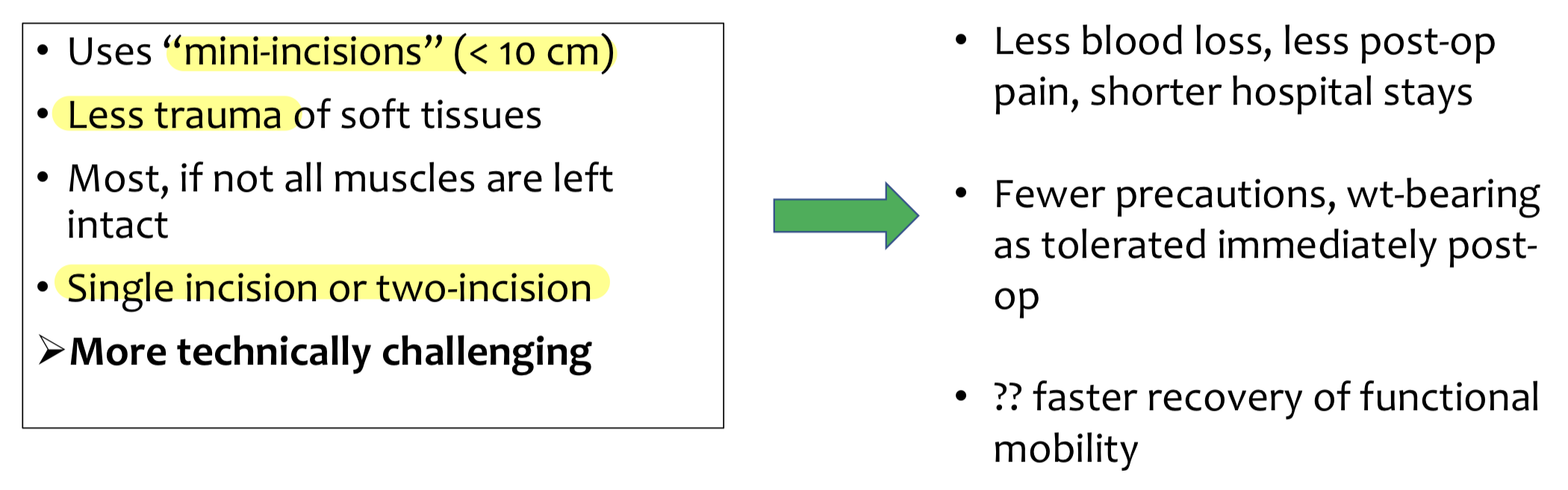
Anterio-medial approach vs minimally invasive

General principles for TJA Management
Assess: vitals, complaints, neuro assess
Treat: deep breathe, circulation, bed mobility, transfer, walk, stairs, rom, education
Discharge plan
1-3 days home
Depends on surgical techniques, complications
Apply knowledge to stages of healing
Acute inflammatory: max protection
Sub-acute proliferation: controlled motion or moderate protection phase
Chronic maturation + remodel: return to fxn of minimal protection
General management of TJA
ROM (assisted - active)
Strengthening (iso - active assisted - active)
Gait training/stairs
Balance proprioception
Fxnl activities
ROM Progression post TKA
Flexion goal: 120 deg
110 arom for fxnl rom (stairs, sit to stand, gait)
120 arom for kneel
Extension goal: 0 deg
Flexion deformity > 10 deg, fxnl leg length issue
TKA No-nos
No OKC resisted
High patellofemoral compression
Greater anterior tibial displacement bc NO ACL
Less fxnl
Do CKC neuro training
Return to PA
Need PA plan to reverse sedentary behaviour