Hematology I CBC, Indices, Smears Oh My
 Call Kai
 Learn
 Practice Test
 Spaced Repetition
 Match
 Flashcards
 Knowt Play
1/107

Earn XP
Description and Tags
CLS 536 Unit 1 - 9/#/2026
108 Terms
What are the 3 phases of testing involved in a CBC?
What assays are included in the CBC?
What does the HCT measure?
What are the RBC indices?
What does the MCV measure?
What are the classifications associated with MCV?
Microcytic, normocytic, and macrocytic
What does a higher MCV correlate with?
Macrocytic larger cells >100%
What does a lower MCV correlate with?
Microcytic smaller cells <80 fL
What is the adult reference range for MCV?
80 - 100 fL
What does the MCH measure?
What does MCHC measure?
What are the classifications associated with MCV?
Hypochromic, normochromic, and hyperchromic
What does a lower MCHC correlate with and what. is the range?
Hypochromic cells <32 g/dL
What does a higher MCHC correlate with?
Hypechromic BUT it should be used sparingly >36 g/dL but <37 g/dL
What is the only cell with an MCHC>36 g/dL but <37 g/dL?
Spherocyte
What are some causes of macrocytosis?
Increase retics, alcoholism, vitamin B12/folate deficiency, antiviral HIV and chemotherapy treatments, and the presence of one myelodysplastic disorder
What are some causes of microcytosis?
Iron deficiency, anemia of chronic inflammation, lead poisoning, sideroblastic anemia, thalassemia disorders, and other hemoglobinopathies

How should the RBC population be described?
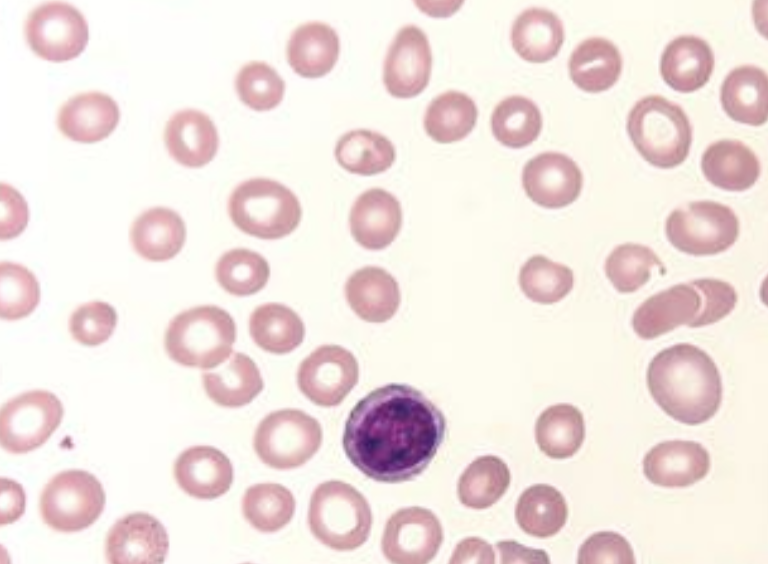
How should the RBC population be described?
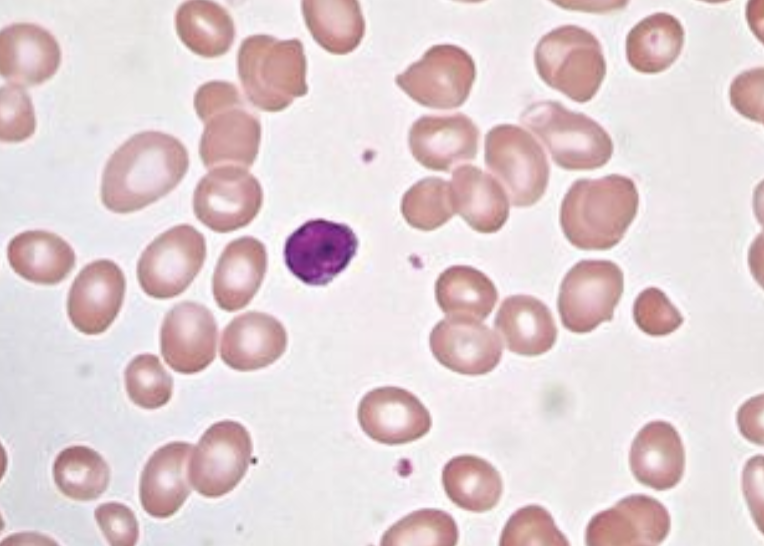
How should the RBC population be described?
Given MCV <80 fL and MCHC < 32 g/dL, how should the RBC population be described?
Microcytic, hypochromic
Given MCV 80-100 fL and MCHC 32-36 g/dL, how should the RBC population be described?
Normocytic, normochromic
Given MCV > 100 fL and MCHC 32-36 g/dL, how should the RBC population be described?
Marcocytic, normochromic
What conditions are associated with microcytic, hypochromic RBC morphology?
IDA, thalassemia, sideroblastic anemia, and anemia of chronic infection
What conditions are associated with normocytic, normochromic RBC morphology?
Hemolytic anemia, leukemia, metastatic malignancy, bone marrow failure, and chronic renal disease
What conditions are associated with macrocytic, normochromic RBC morphology?
Liver disease, myelodisplasias, and megaloblastic anemias
Which parameters are directly measured on the Coulter?
Which parameters are calculated on the Coulter?
What is the MCV calculation?
HCT / RBC *10 = MCV
What is the rule of 3?
What condistions are suspect if MCHC >37 g/dL?
What is the calculation for correcting lipemia?
MCV * RBC / 2.98×10
What parameters are derived on the Coulter?

What is this histogram, and what parameters are shown?
RBC histogram with the black being MCV and green being RDW

What is this histogram, and what parameters are shown?
PLT histogram and green is MPV, pink is PDW and blue is PLT count
What are PLT count and MPV used to assess?
Thrombopoiesis and pathological conditions related to PLTs
What does a decreased PLT represent?
Decreased thrombopoiesis and increased PLT destruction
Why do we need ranges?
What is the difference range between a reference range and a QC range
What is the difference between relative and absolute?
What is the use of a blood smear?
Reviewed for overall quality, morphology of WBCs, RBCs, PLTs, and WBC differential is performed
What do the values of a blood smear correlate to?
The parameters reported by the instrument
What is a 10X magnification used for in a peripheral blood smear?
Quickly assess the general appearance and distribution of RBCs, WBCs, and PLTS
What are cold agglutinins?
IgM ABYs that directed against RBC AGNs
What do cold agglutinins appear like?
Irregular grape-like clusters
What would an automated cell counter show for cold agglutinins?
Extremely increased MCH, decreased RBC, and normal Hgb
How can cold agglutinins be prevented?
Rewarming blood to 37ºC

What is happening to the RBC cells?
Cold agglutinins
What is rouleaux?
Alignment of RBCs one on top of the other
What is rouleaux commonly seen in?
Seen with an increase in fibrinogen or globulins (multiple myeloma)
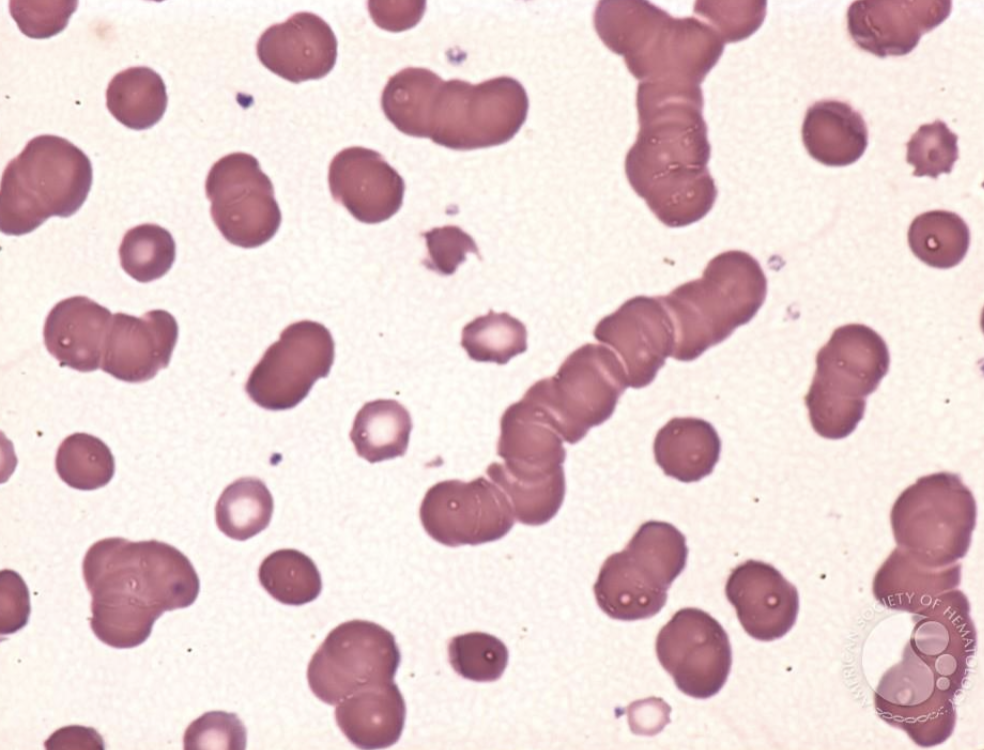
What is happening to the RBC cells?
Rouleaux
What is the difference between agglutination and rouleaux?
What is a 40X magnification used for in a peripheral blood smear?
WBC estimate and determine critical areaa
What is a 100X magnification used for in a peripheral blood smear?
Evaluate WBC morphology, perform diff, evaluate RBC morphology, rvaluate PLT morphology, and PLT estimate
What is PLT satellitism?
PLTs adhere to neutrophils
What can eliminate PLT satellitism?
Sodiam citrate as anticoagulant
What does PLT satellitism do to PLT count?
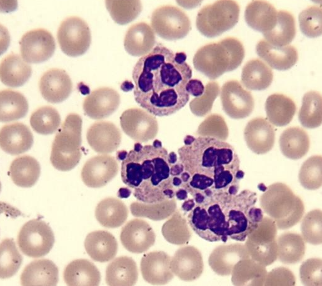
What is happening to these cells?
PLT staliteism
What does a WBC differential do?
Classify 100 cells to determine relative value and identify any morphologic abnormalities
What does a PLT estimate do?
Notes any abnormal morphology
What does RBC morphology do?
Evaluate size, shape, color, and inclusions
What is an acanthocyte?
AKA a spur cell and it is a RBC with irregular spikes over the surface
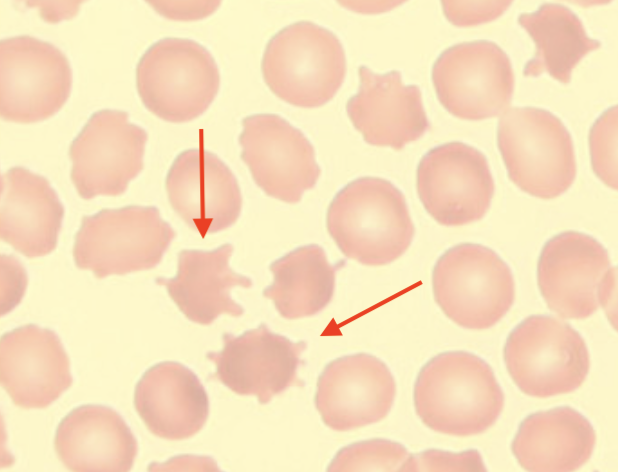
What is this poikilocytosis?
Acanthocytes
What is a codocyte?
AKA target cell, and it appears as a bulls-eye with an outer ring of Hgb

What is this poikilocytosis?
Target cells
What is a dacryocyte?
AKA teardrop cell that is round with a singles elongated extremity

What is this poikilocytosis?
Darcyocyte
What is a drepanocyte?
AKA sickle cell which is contained polymerized Hgb
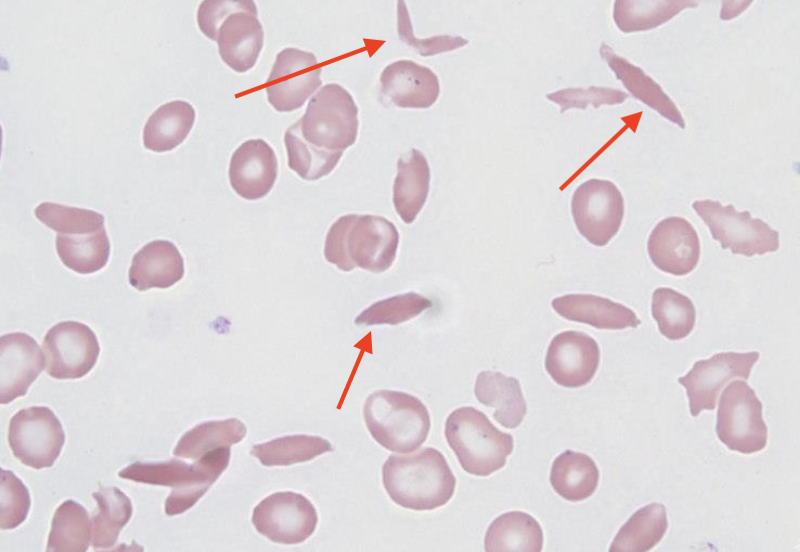
What is this poikilocytosis?
Sickle cell
What is an echinocyte?
AKA burr cell and is is a speculated cell with equally spaced spikes

What is this poikilocytosis?
Burr cell
What is an elliptocyte?
AKA ovalcyte that is an elongated cell with a central pallor

What is this poikilocytosis?
Elliptocyte
What are keratocytes?
AKA helmet cells with several projections that look like horns

What is this poikilocytosis?
Keratocytes
What is a leptocyte?
AKA thin cell that had Hgb at periphery
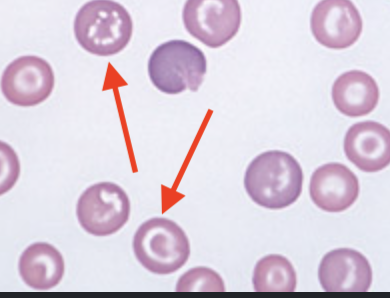
What is this poikilocytosis?
Leptocyte
What is a schistocyte?
AKA fragmented cells that are various shaped fragments of RBCs
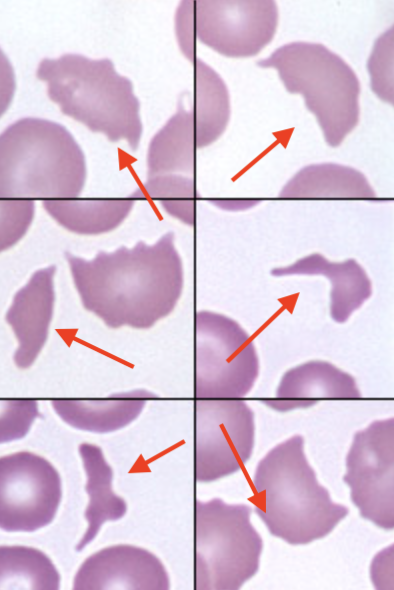
What is this poikilocytosis?
Schistocytes
What is a spherocyte?
RBCs with dense Hgb content and lack central pallor
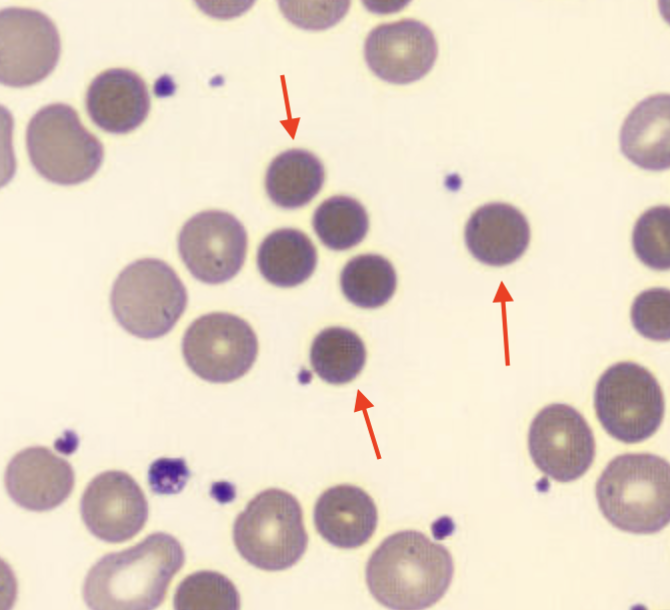
What is this poikilocytosis?
Spherocytes
What is a stomatocyte?
AKA mouth cell that have an oval/slitlike central pallor
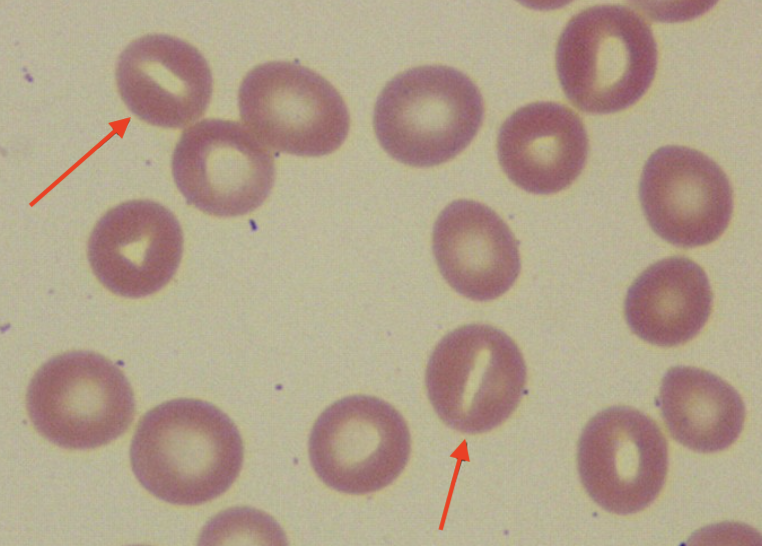
What is this poikilocytosis?
Stomatocyte
What is basophilic stippling?
Irregular granules distributed throughout RBC
What is basophilic stippling made of?
RNA
What conditions are associated with basophilic stippling?
Lead poisoning, anemia associated with abnormal Hgb synthesis and thalassemia

What is this inclusion?
Basophilic stippling
What is cabot ring?
Appears as a figure 8 stained deeper red resting on the RBC
What is cabot ring made of?
Microtubules or mitotic spindle
What conditions are associated with Cabot rings?
Severe anemias and dyserthropoiesis

What is this inclusion?
Cabot ring
What is Howell-Jolly bodies?
Small round bodies located towards the outside of the RBC
What are Howell-Jolly bodies made of?
DNA
What conditions are associated with Howell-Jolly bodies?
Post-splenectomy, megaloblastic anemias, hemolytic anemia, functional asplenia, and severe anemia
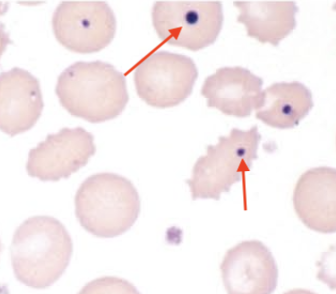
What inclusion is this?
Howell-Jolly bodies
What are Pappenhimer bodies?
Clusters of granules containing iron that is usually found in periphery of RBC
What are Pappenheimer bodies made of?
Iron
What conditions are associated with Pappenheimer bodies?
Sideroblastic anemia and thalassemia
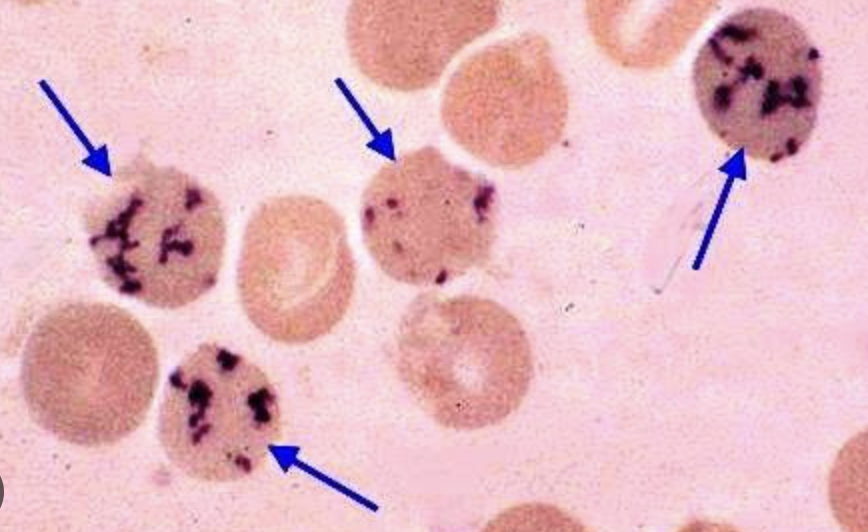
What inclusion is this?
Pappenheimer body
What is Heinz body?
Bodies composed of denatured Hgb that are only visible