MEDS 7/1 - Bones
 Call Kai
 Learn
Learn Practice Test
 Spaced Repetition
 Match
Match Flashcards
 Knowt Play
1/33

Earn XP
Description and Tags
1. Describe bone function, structure and components in overview. 2. Describe bone classifications with examples and Identify selected individual bones of the human skeleton. 3. Describe and discuss the human skeleton using anatomical terminology. 4. Describe and identify marking and features on bones. 5. Describe the basic vasculature system in relation to bone
Name | Mastery | Learn | Test | Matching | Spaced | Call with Kai | Chat |
|---|
No analytics yet
Send a link to your students to track their progress
34 Terms
What are the major functions of the skeletal system? (5)
Movement
Storage
Stability
Protection
Blood cell production
What are the two types of cells involved in bone formation?
Osteoblasts
Osteoclasts
What are osteoblasts responsible for?
Building bone
What are osteoclasts responsible for?
Breaking down damaged bone.
Why are bones constantly changing?
Adapting to loading and activity
Healing
Responding to changes in muscle
What are the two types of tissue that make up bones?
Cancellous
Cortical
Describe Cancellous bone tissue.
Spongy
Inside of bone
Made up of trabeculae
Describe Cortical bone tissue.
Dense
Outside of bone
Made up of osteons
What are trabeculae?
Small beams of bone making up cancellous tissue.

What is the function of trabeculae?
Structural support
Distribute force
Ensure our bones aren’t super heavy
What are osteons?
Cyclindrical units which form compact bone.
Include: Osteocytes, lamellae, blood vessels and nerves.

What is the Periosteum?
Fibrous sheet that covers the bone
Includes blood vessels and nerves
What does the Periosteum provide to the bone?
Nourishment (blood vessels)
Sensation (nerves)
What are the two main components of bones?
Hydroxyapatite
Collagen
What is Hydroxyapatite and what is its function in bones?
Mainly calcium and phosporus
Provides strength and rigidity
What is collagen and its purpose in bones?
Made up of protein
Provides flexibility and elasticity to bone.
What are the four sections of a bone?
Epiphysis - End of bone
Epiphiseal Line - growth plate
Metaphysis - part of shaft next to growth plate
Diaphysis - shaft
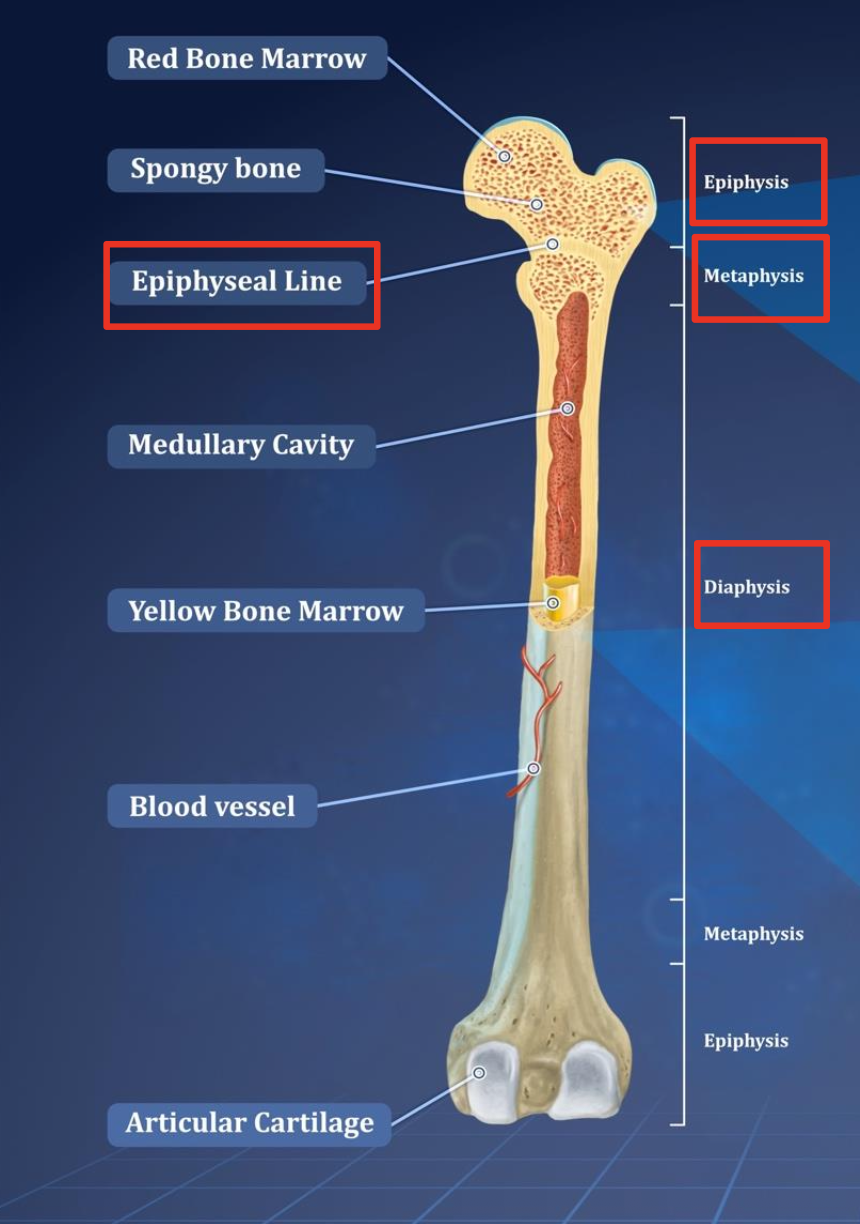
What is the Epiphyseal line (growth plate)?
Section of cartilage which is gradually replaced by bone until the metaphysis and epiphysis join and growth stops.

What are the two divisions of the skeleton?
Axial
Appendicular
What makes up the Axial portion of the skeleton?
Skull
Thoracic cage
Vertebral Column

What makes up the appendicular portion of the skeleton?
All of the bones in our appendages.

What are the 5 shape classifications of bone?
Long
Short
Irregular
Sesamoid
Flat
What is the function and an example of a long bone?
Lever for movement
Humerus
What are two examples of short bones?
Carpals
Tarsals
What is the function and an example of a flat bone?
Protection of internal organs.
Frontal bone of the skull
What are two examples of irregular bones?
Vertebra
Maxilla
What is unique about sesamoid bones (location)
They are embedded in a tendon.
What is the function and an example of a sesamoid bone?
Improve mechanical efficiency of tendons
Patella
What are markings on bones?
The attachment sites of tendons, ligaments and fascia.
What are features of bones?
Hollows and elevations
Holes/openings
What is a bone crest (+ example)?
Ridge of bone
Iliac crest

What is a bone foramen (+ example)?
Opening/hole in bone
Obturator foramen in the hip bone.

What is a bone fossa (+ example)?
Hollow/depression in bone surface
Iliac fossa

What is a bone tuberosity (+ example)?
Roughened area for muscle/ligament attachment.
Ischial tuberosity - attachment point for hamstrings.