Ch. 11 Module 1-4 Dynamic Study Module
 Call Kai
 Learn
 Practice Test
 Spaced Repetition
 Match
 Flashcards
 Knowt Play
1/46

There's no tags or description
Looks like no tags are added yet.
47 Terms
skin, skeletal muscles, and joints to the CNS
Somatic sensory (afferent) fibers carry information from the _______.
Astrocytes
Which of the following types of glial cells are the most abundant and versatile and aid in making exchanges between capillaries and neurons?
skin
The somatic sensory (afferent) fibers of the peripheral nervous system transmit information from the __________ to the CNS.
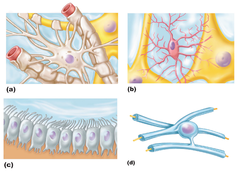
Oligodendrocyte, which is depicted by (d)
Based on your understanding of this cell's function, diseases such as multiple sclerosis, that damage the myelin sheath of neurons, likely affect which of the cells in the figure?
Astrocytes
Which of the following neuroglia is most responsible for helping determine capillary permeability in nervous tissue?
Schwann cell
Pictured is a cross section of a myelinated axon in the peripheral nervous system (PNS). Which glial cell type produces the myelin sheath, indicated by the arrow, in the PNS?

Microglial cell, which is depicted by (b)
Based on your understanding of this cell's function, you might expect this cell to be active in neurodegenerative disorders like Alzheimers where this cell removes damaged neurons. Additionally, this cell is active in preventing encephalitis and meningitis due to its ability to phagocytize microorganisms.

the somatic nervous system is to the autonomic nervous system
The voluntary nervous system is to the involuntary nervous system as ________.
the autonomic nervous system (ANS); conduct impulses from the CNS to cardiac muscle, smooth muscle, and glands
Bodily functions that follow "a law unto itself" are controlled by the involuntary nervous system. This system is also termed __________ and functions to __________.
consists of cranial and spinal nerves carrying impulses to and from the brain and spinal cord
Match the system with its correct description: The peripheral nervous system __________.
Both A and C represent portions of the peripheral nervous system (PNS).
In the figure above, which letter(s) correspond(s) to the peripheral nervous system?

Ependymal cells
Which of the following types of glial cells line the central cavities of the brain and spinal cord, where they help to circulate the cerebrospinal fluid?
central nervous system
An appropriate label for B in the figure shown here could also be the ________.

conducts impulses from the CNS to the skeletal muscles
Match the system with its correct description: The somatic nervous system __________.
Ependymal cells
Which of the following neuroglia line the central cavities of the brain and spinal cord and provide a fairly permeable barrier between the CSF and nervous tissue?
organs in the ventral body cavity to the CNS
Visceral sensory (afferent) fibers carry information from the _______.
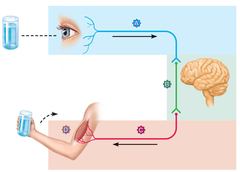
B. Integration
You are driving and see a red light ahead. Your nervous system indicates "stop", and your foot hits the brake. Which portion of the nervous system, as indicated in the figure, is responsible for the decision to stop?

The autonomic nervous system
Which of the following divisions of the nervous system is also known as the involuntary nervous system?
Astrocyte, which is depicted by (a)
Which of the pictured cell types influences neuronal function by "mopping up" leaked potassium ions and by recapturing and recycling released neurotransmitters? These cells also participate in information processing in the brain.

consists of the brain and spinal cord
Match the system with its correct description: The central nervous system __________.
Sensory nerve fiber within a cranial nerve
In the figure shown, A represents a neuron carrying information from the eye to the brain. Which of the following correctly describes A?
The somatic nervous system
In the figure above, C most specifically represents which subdivision of the nervous system?

This glial cell has processes that touch nearby neurons, monitoring their health, and when this glial cell senses that certain neurons are injured or in other trouble, this microglial cell migrates toward them.
Which statement is true of the glial cell pictured above?

CNS to skeletal muscles
Somatic motor fibers carry information from the _______.
The somatic nervous system allows us to consciously control our skeletal muscles, and the autonomic nervous system controls activities that humans cannot consciously control, such as the pumping of the heart and the movement of food through the digestive tract.
What is the primary difference between the somatic nervous system and the autonomic nervous system?
Multipolar neurons
Interneurons and motor neurons are which of the following?
A. dendrites
Indicate, by letter, where one would find short-distance signals called graded potentials that travel toward the cell body.
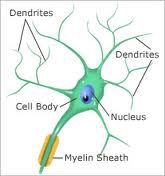
Almost all interneurons are multipolar and most are confined within the CNS.
Identify the correctly classified neurons.
(A) dendrites and (B) cell body
If we consider neurons to be carrying on conversations, which portion(s) of the neuron "listen(s)?"

Worn out organelles
In axonal transport, retrograde movement is transport toward the cell body. Which of the following move in this direction?
Rough endoplasmic reticulum
The chromatophilic substance, or Nissl bodies, seen in the neuron cell body represents which cellular organelle(s)?
Slow conduction of nerve impulses
Which of the following characteristics is not associated with a myelinated nerve fiber in the peripheral nervous system?
retrograde movement
Organelles for degradation or recycling are moved through the axon by __________.
afferent is to unipolar
In considering the types of neurons and their predominant functions, efferent is to multipolar as __________.
Mitochondria and enzymes needed to synthesize certain neurotransmitters
In axonal transport, anterograde movement is transport away from the cell body. Which of the following move in this direction?
Motor (efferent) neurons are bipolar.
Which of the following is not true of motor (efferent) neurons?
a sensory neuron
A neuron with a distal peripheral process and a central process that extends to the CNS is most likely _________________.
Nucleus: a collection of neuron cell bodies in the CNS
Which of the following terms is correctly matched with its definition?
A. dendrites
Which letter matches the process(es) of the neuron that provide(s) an enormous surface area for receiving signals from other neurons?
D. axon terminal
Which structure is the secretory region of the neuron?
Retrograde transport
Which type of axonal transport allows certain viruses to circumvent the barrier created by astrocytes to enter into the CNS?
At the myelin sheath gaps (nodes of Ranvier)
From where can collaterals emerge on a myelinated nerve?
Conductive region of the neuron
Which of the following does not describe the function of the structure labeled (B)?
D. axon terminal
If we consider neurons to be carrying on conversations, which portion of the neuron "speaks" by releasing neurotransmitters?
Bundles of axons are called tracts in the CNS and nerves in the PNS.
What is the difference between nerves and tracts?
Neurons are relatively small, simple-structured cells.
Which of the following is not a characteristic of neurons?
Multipolar
Neurons can be classified structurally by the number of processes extending from their cell bodies. Which of the following is the most common neuron type in humans?