Chemistry Exam 2
 Call Kai
 Learn
 Practice Test
 Spaced Repetition
 Match
 Flashcards
 Knowt Play
1/149

There's no tags or description
Looks like no tags are added yet.
150 Terms
If an electron travels at a velocity of 1.000 × 10⁷ m s–1 and has a mass of 9.109 × 10⁻²⁸ g, what is its wavelength?
image

Calculate the wavelength of a softball with a mass of 100 g traveling at a velocity of 35 m s–1, assuming that it can be modeled as a single particle.
1.9 × 10⁻³⁴ m.
Indicate the number of subshells, the number of orbitals in each subshell, and the values of l and ml for the orbitals in the n = 4 shell of an atom.
For n = 4, l can have values of 0, 1, 2, and 3. Thus, s, p, d, and f subshells are found in the n = 4 shell of an atom. For l = 0 (the s subshell), ml can only be 0. Thus, there is only one 4s orbital. For l = 1 (p-type orbitals), m can have values of –1, 0, +1, so we find three 4p orbitals. For l = 2 (d-type orbitals), ml can have values of –2, –1, 0, +1, +2, so we have five 4d orbitals. When l = 3 (f-type orbitals), ml can have values of –3, –2, –1, 0, +1, +2, +3, and we can have seven 4f orbitals. Thus, we find a total of 16 orbitals in the n = 4 shell of an atom.
Identify the subshell in which electrons with the following quantum numbers are found: (a) n = 3, l = 1; (b) n = 5, l = 3; (c) n = 2, l = 0.
(a) 3p (b) 5f (c) 2s
Calculate the maximum number of electrons that can occupy a shell with (a) n = 2, (b) n = 5, and (c) n as a variable. Note you are only looking at the orbitals with the specified n value, not those at lower energies.
(a) When n = 2, there are four orbitals (a single 2s orbital, and three orbitals labeled 2p). These four orbitals can contain eight electrons.
(b) When n = 5, there are five subshells of orbitals that we need to sum:
1orbitallabeled5𝑠
3orbitalslabeled5𝑝
5orbitalslabeled5𝑑
7orbitalslabeled5𝑓+
9orbitalslabeled5𝑔̅̅̅̅̅̅̅̅̅̅̅̅̅̅̅̅̅̅̅̅̅̅̅̅̅̅̅̅̅̅̅̅̅̅̅̅̅̅̅̅̅̅̅̅̅̅̅̅̅̅̅2
5orbitalstotal
Again, each orbital holds two electrons, so 50 electrons can fit in this shell.
(c) The number of orbitals in any shell n will equal n2. There can be up to two electrons in each orbital, so the maximum number of electrons will be 2 × n2.
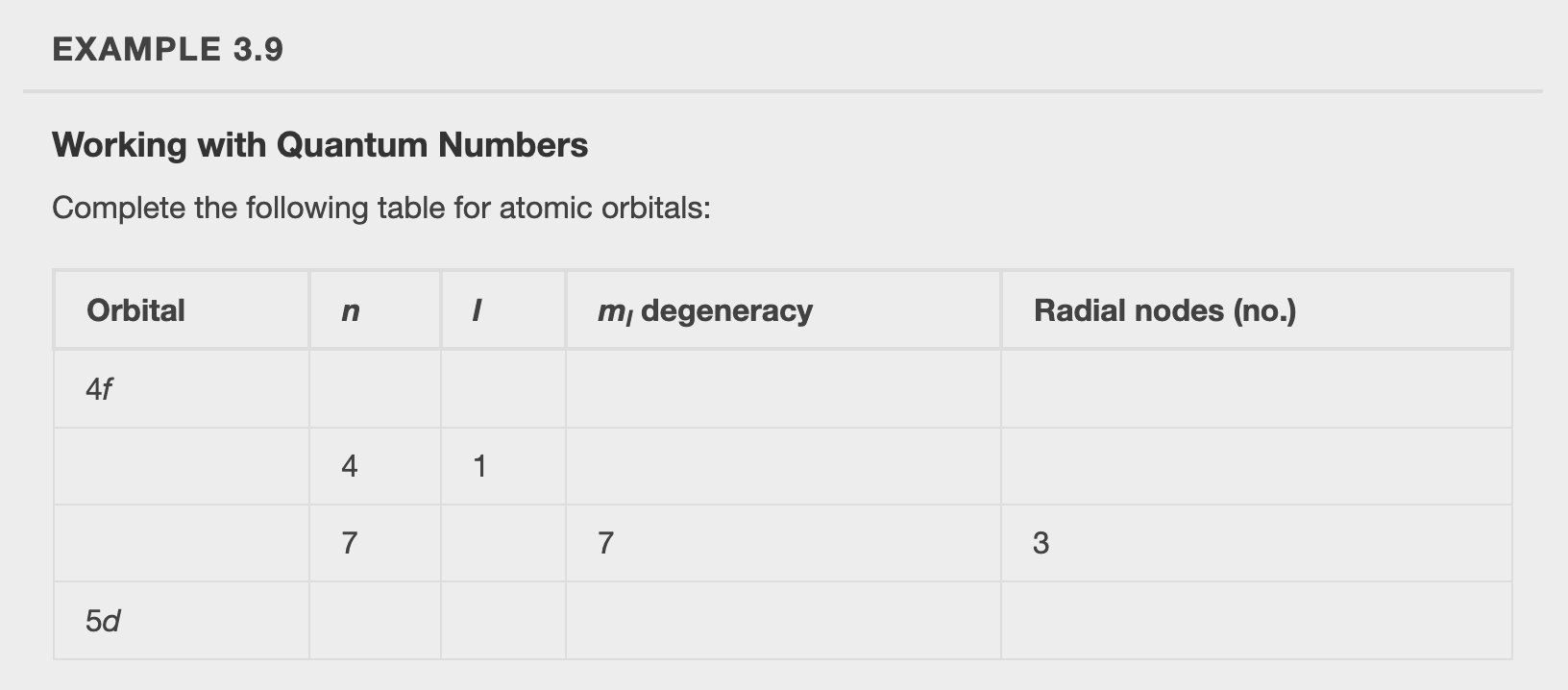
If a shell contains a maximum of 32 electrons, what is the principal quantum number,
n = 4
i
i

How many orbitals have l = 2 and n = 3?
The five degenerate 3d orbitals
What is the electron configuration and orbital diagram for a phosphorus atom? What are the four quantum numbers for the last electron added?
The atomic number of phosphorus is 15. Thus, a phosphorus atom contains 15 electrons. The order of filling of the energy levels is 1s, 2s, 2p, 3s, 3p, 4s, . . . The 15 electrons of the phosphorus atom will fill up to the 3p orbital, which will contain three electrons: The last electron added is a 3p electron. Therefore, n = 3 and, for a p-type orbital, l = 1. The ml value could be –1, 0, or +1. The three p orbitals are degenerate, so any of these ml values is correct. For unpaired electrons, convention assigns the value of +12 for the spin quantum number; thus, 𝑚𝑠=+12.

Identify the atoms from the electron configurations given:
(a) [Ar]4s23d5
(b) [Kr]5s24d105p6
(a) Mn (b) Xe
What is the electron configuration of:
(a) Na+
(b) P3–
(c) Al2+
(d) Fe2+
(e) Sm3+
First, write out the electron configuration for each parent atom. We have chosen to show the full, unabbreviated configurations to provide more practice for students who want it, but listing the core-abbreviated electron configurations is also acceptable.
Next, determine whether an electron is gained or lost. Remember electrons are negatively charged, so ions with a positive charge have lost an electron. For main group elements, the last orbital gains or loses the electron. For transition metals, the last s orbital loses an electron before the d orbitals.
(a) Na: 1s22s22p63s1. Sodium cation loses one electron, so Na+: 1s22s22p63s1 = Na+: 1s22s22p6.
(b) P: 1s22s22p63s23p3. Phosphorus trianion gains three electrons, so P3−: 1s22s22p63s23p6.
(c) Al: 1s22s22p63s23p1. Aluminum dication loses two electrons Al2+: 1s22s22p63s23p1 =
Al2+: 1s22s22p63s1.
(d) Fe: 1s22s22p63s23p64s23d6. Iron(II) loses two electrons and, since it is a transition metal, they are removed from the 4s orbital Fe2+: 1s22s22p63s23p64s23d6 = 1s22s22p63s23p63d6.
(e). Sm: 1s22s22p63s23p64s23d104p65s24d105p66s24f6. Samarium trication loses three electrons. The first two will be lost from the 6s orbital, and the final one is removed from the 4f orbital. Sm3+: 1s22s22p63s23p64s23d104p65s24d105p66s24f6 = 1s22s22p63s23p64s23d104p65s24d105p64
Which ion with a +2 charge has the electron configuration 1s22s22p63s23p64s23d104p64d5? Which ion with a +3 charge has this configuration?
Tc2+, Ru3+
Predict the order of increasing covalent radius for Ge, Fl, Br, Kr.
Radius increases as we move down a group, so Ge < Fl (Note: Fl is the symbol for flerovium, element 114, NOT fluorine). Radius decreases as we move across a period, so Kr < Br < Ge. Putting the trends together, we obtain Kr < Br < Ge < Fl.
Give an example of an atom whose size is smaller than fluorine.
Ne or He
Predict the order of increasing energy for the following processes: IE1 for Al, IE1 for In, IE2 for Na, IE3 for Al.
Removing the 5p1 electron from In is easier than removing the 3p1 electron from Al because the higher n orbital is farther from the nucleus, so IE1(In) < IE1(Al). Ionizing the third electron from Al:(Al2+⟶Al3++e−) requires more energy because the cation Al2+ exerts a stronger pull on the electron than the neutral Al atom, so IE1(Al) < IE3(Al). The second ionization energy for sodium removes a core electron, which is a much higher energy process than removing valence electrons. Putting this all together, we obtain: IE1(In) < IE1(Al) < IE3(Al) < IE2(Na).
Which has the lowest value for IE1: O, Po, Pb, or Ba?
Ba
Naming Groups of ElementsAtoms of each of the following elements are essential for life. Give the group name for the following elements:
(a) chlorine
(b) calcium
(c) sodium
(d) sulfur
The family names are as follows:
(a) halogen
(b) alkaline earth metal
(c) alkali metal
(d) chalcogen
Give the group name for each of the following elements:
(a) krypton
(b) selenium
(c) barium
(d) lithium
(a) noble gas; (b) chalcogen; (c) alkaline earth metal; (d) alkali metal
An ion found in some compounds used as antiperspirants contains 13 protons and 10 electrons. What is its symbol?
Because the number of protons remains unchanged when an atom forms an ion, the atomic number of the element must be 13. Knowing this lets us use the periodic table to identify the element as Al (aluminum). The Al atom has lost three electrons and thus has three more positive charges (13) than it has electrons (10). This is the aluminum cation, Al3+.
Give the symbol and name for the ion with 34 protons and 36 electrons.
Se2−, the selenide ion
Magnesium and nitrogen react to form an ionic compound. Predict which forms an anion, which forms a cation, and the charges of each ion. Write the symbol for each ion and name them.
Magnesium’s position in the periodic table (group 2) tells us that it is a metal. Metals form positive ions (cations). A magnesium atom must lose two electrons to have the same number electrons as an atom of the previous noble gas, neon. Thus, a magnesium atom will form a cation with two fewer electrons than protons and a charge of 2+. The symbol for the ion is Mg2+, and it is called a magnesium ion.
Nitrogen’s position in the periodic table (group 15) reveals that it is a nonmetal. Nonmetals form negative ions (anions). A nitrogen atom must gain three electrons to have the same number of electrons as an atom of the following noble gas, neon. Thus, a nitrogen atom will form an anion with three more electrons than protons and a charge of 3−. The symbol for the ion is N3−, and it is called a nitride ion.
Aluminum and carbon react to form an ionic compound. Predict which forms an anion, which forms a cation, and the charges of each ion. Write the symbol for each ion and name them.
Al will form a cation with a charge of 3+: Al3+, an aluminum ion. Carbon will form an anion with a charge of 4−: C4−, a carbide ion.
The gemstone sapphire (Figure 3.42) is mostly a compound of aluminum and oxygen that contains aluminum cations, Al3+, and oxygen anions, O2−. What is the formula of this compound?
Because the ionic compound must be electrically neutral, it must have the same number of positive and negative charges. Two aluminum ions, each with a charge of 3+, would give us six positive charges, and three oxide ions, each with a charge of 2−, would give us six negative charges. The formula would be Al2O3.
Predict the formula of the ionic compound formed between the sodium cation, Na+, and the sulfide anion, S2−.
Na2S
Baking powder contains calcium dihydrogen phosphate, an ionic compound composed of the ions Ca2+ and H2PO4−. What is the formula of this compound?
The positive and negative charges must balance, and this ionic compound must be electrically neutral. Thus, we must have two negative charges to balance the 2+ charge of the calcium ion. This requires a ratio of one Ca2+ ion to two H2PO4− ions. We designate this by enclosing the formula for the dihydrogen phosphate ion in parentheses and adding a subscript 2. The formula is Ca(H2PO4)2.
Predict the formula of the ionic compound formed between the lithium ion and the peroxide ion, O22− (Hint: Use the periodic table to predict the sign and the charge on the lithium ion.)
Li2O2
Predict whether the following compounds are ionic or molecular:
(a) KI, the compound used as a source of iodine in table salt
(b) H2O2, the bleach and disinfectant hydrogen peroxide
(c) CHCl3, the anesthetic chloroform
(d) Li2CO3, a source of lithium in antidepressants
(a) Potassium (group 1) is a metal, and iodine (group 17) is a nonmetal; KI is predicted to be ionic.
(b) Hydrogen (group 1) is a nonmetal, and oxygen (group 16) is a nonmetal; H2O2 is predicted to be molecular.
(c) Carbon (group 14) is a nonmetal, hydrogen (group 1) is a nonmetal, and chlorine (group 17) is a nonmetal; CHCl3 is predicted to be molecular.
(d) Lithium (group 1) is a metal, and carbonate is a polyatomic ion; Li2CO3 is predicted to be ionic.
Using the periodic table, predict whether the following compounds are ionic or covalent:
(a) SO2
(b) CaF2
(c) N2H4
(d) Al2(SO4)3
(a) molecular; (b) ionic; (c) molecular; (d) ionic
Based on their positions in the periodic table, predict which has the smallest atomic radius: Mg, Sr, Si, Cl, I.
Cl
Atoms of which group in the periodic table have a valence shell electron configuration of ns2np3?
15 (5A)
Based on their positions in the periodic table, list the following ions in order of increasing radius: K+, Ca2+, Al3+, Si4+
Si4+ < Al3+ < Ca2+ < K+
Of the five elements Sn, Si, Sb, O, Te, which has the most endothermic reaction? (E represents an atom.) What name is given to the energy for the reaction?
E(𝑔)⟶E+(𝑔)+e−
O, IE1
87 Using the periodic table, classify each of the following elements as a metal or a nonmetal, and then further classify each as a main-group (representative) element, transition metal, or inner transition metal:
(a) uranium
(b) bromine
(c) strontium
(d) neon
(e) gold
(f) americium
(g) rhodium
(h) sulfur
(i) carbon
(j) potassium
(a) metal, inner transition metal; (b) nonmetal, representative element; (c) metal, representative element; (d) nonmetal, representative element; (e) metal, transition metal; (f) metal, inner transition metal; (g) metal, transition metal; (h) nonmetal, representative element; (i) nonmetal, representative element; (j) metal, representative element
89 Using the periodic table, identify the lightest member of each of the following groups:
(a) noble gases
(b) alkaline earth metals
(c) alkali metals
(d) chalcogens
(a) He; (b) Be; (c) Li; (d) O
Write a symbol for each of the following neutral isotopes. Include the atomic number and mass number for each.
(a) the alkali metal with 11 protons and a mass number of 23
(b) the noble gas element with 75 neutrons in its nucleus and 54 electrons in the neutral atom
(c) the isotope with 33 protons and 40 neutrons in its nucleus
(d) the alkaline earth metal with 88 electrons and 138 neutrons
(a) 23/11Na; (b) 129/54Xe; (c) 73/33As; (d) 226/88Ra
Does a cation gain protons to form a positive charge or does it lose electrons?
The protons in the nucleus do not change during normal chemical reactions. Only the outer electrons move. Positive charges form when electrons are lost.
5. Predict the charge on the monatomic ions formed from the following atoms in binary ionic compounds:
(a) P
(b) Mg
(c) Al
(d) O
(e) Cl
(f) Cs
(a) P3–; (b) Mg2+; (c) Al3+; (d) O2–; (e) Cl–; (f) Cs+
13. Predict which of the following compounds are ionic and which are covalent, based on the location of their constituent atoms in the periodic table:
(a) Cl2CO
(b) MnO
(c) NCl3
(d) CoBr2
(e) K2S
(f) CO
(g) CaF2
(h) HI
(i) CaO
(j) IBr
(k) CO2
ionic: (b), (d), (e), (g), and (i); covalent: (a), (c), (f), (h), (j), and (k)
Write the formulas of the following compounds:
(a) rubidium bromide
(b) magnesium selenide
(c) sodium oxide
(d) calcium chloride
(e) hydrogen fluoride
(f) gallium phosphide
(g) aluminum bromide
(h) ammonium sulfate
(a) RbBr; (b) MgSe; (c) Na2O; (d) CaCl2; (e) HF; (f) GaP; (g) AlBr3; (h) (NH4)2SO4
What are the IUPAC names of the following compounds?
(a) manganese dioxide
(b) mercurous chloride (Hg2Cl2)
(c) ferric nitrate [Fe(NO3)3]
(d) titanium tetrachloride
(e) cupric bromide (CuBr2)
(a) manganese(IV) oxide; (b) mercury(I) chloride; (c) iron(III) nitrate; (d) titanium(IV) chloride; (e) copper(II) bromide
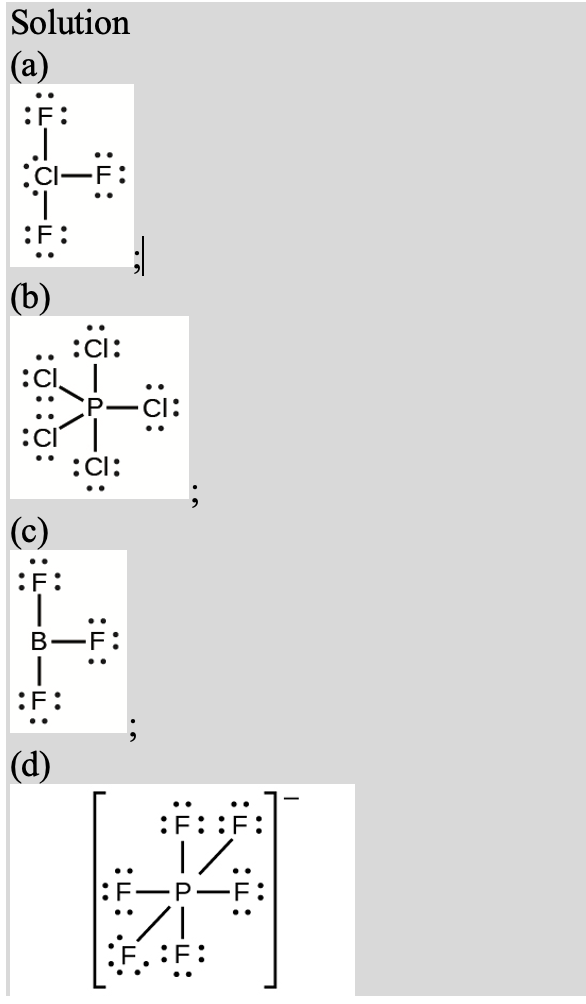
41.Write Lewis structures for the following:
(a) ClF3
(b) PCl5
(c) BF3
(d) PF6−
Two arrangements of atoms are possible for a compound with a molar mass of about 45 g/mol that contains 52.2% C, 13.1% H, and 34.7% O by mass. Write the Lewis structures for the two molecules.
65.Calculate the formal charge of each element in the following compounds and ions:
(a) F2CO
(b) NO–
(c) BF4−
(d) SnCl3−
(e) H2CCH2
(f) ClF3
(g) SeF6
(h) PO43−
find solution
73.Which of the following structures would we expect for nitrous acid? Determine the formal charges:
find solution
There are at least 14 elements categorized as “essential trace elements” for the human body. They are called “essential” because they are required for healthy bodily functions, “trace” because they are required only in small amounts, and “elements” in spite of the fact that they are really ions. Two of these essential trace elements, chromium and zinc, are required as Cr3+ and Zn2+. Write the electron configurations of these cations.
First, write the electron configuration for the neutral atoms:
Zn: [Ar]3d104s2
Cr: [Ar]3d54s1
Next, remove electrons from the highest energy orbital. For the transition metals, electrons are removed from the s orbital first and then from the d orbital. For the p-block elements, electrons are removed from the p orbitals and then from the s orbital. Zinc is a member of group 12, so it should have a charge of 2+, and thus loses only the two electrons in its s orbital. Chromium is a transition element and should lose its s electrons and then its d electrons when forming a cation. Thus, we find the following electron configurations of the ions:
Zn2+: [Ar]3d10
Cr3+: [Ar]3d3
Potassium and magnesium are required in our diet. Write the electron configurations of the ions expected from these elements.
K+: [Ar], Mg2+: [Ne]
Selenium and iodine are two essential trace elements that form anions. Write the electron configurations of the anions.
Se2–: [Ar]3d104s24p6
I–: [Kr]4d105s25p6
Write the electron configurations of a phosphorus atom and its negative ion. Give the charge on the anion.
P: [Ne]3s23p3; P3–: [Ne]3s23p6
Bond polarities play an important role in determining the structure of proteins. Using the electronegativity values in Figure 4.6, arrange the following covalent bonds—all commonly found in amino acids—in order of increasing polarity. Then designate the positive and negative atoms using the symbols δ+ and δ–:
C–H, C–N, C–O, N–H, O–H, S–H
The polarity of these bonds increases as the absolute value of the electronegativity difference increases. The atom with the δ– designation is the more electronegative of the two. Table 4.1 shows these bonds in order of increasing polarity.
Bond | ΔEN | Polarity |
|---|---|---|
C–H | 0.4 | 𝛿−C−𝛿+H |
S–H | 0.4 | 𝛿−S−𝛿+H |
C–N | 0.5 | 𝛿+C−𝛿−N |
N–H | 0.9 | 𝛿−N−𝛿+H |
C–O | 1.0 | 𝛿+C−𝛿−O |
O–H | 1.4 | 𝛿−O−𝛿+H |
Silicones are polymeric compounds containing, among others, the following types of covalent bonds: Si–O, Si–C, C–H, and C–C. Using the electronegativity values in Figure 4.6, arrange the bonds in order of increasing polarity and designate the positive and negative atoms using the symbols δ+ and δ–.
Bond | Electronegativity Difference | Polarity |
|---|---|---|
C–C | 0.0 | nonpolar |
C–H | 0.4 | 𝛿−C−𝛿+H |
Si–C | 0.7 | 𝛿+Si−𝛿−C |
Si–O | 1.7 | 𝛿+Si−𝛿−O |
Name the following ionic compounds:
(a) Fe2S3
(b) CuSe
(c) GaN
(d) MgSO4∙7H2O
(e) Ti2(SO4)3
The anions in these compounds have a fixed negative charge (S2−, Se2− , N3−, and SO42−), and the compounds must be neutral. Because the total number of positive charges in each compound must equal the total number of negative charges, the positive ions must be Fe3+, Cu2+, Ga3+, Mg2+, and Ti3+. These charges are used in the names of the metal ions:
(a) iron(III) sulfide
(b) copper(II) selenide
(c) gallium(III) nitride
(d) magnesium sulfate heptahydrate
(e) titanium(III) sulfate
Write the formulas of the following ionic compounds:
(a) chromium(III) phosphide
(b) mercury(II) sulfide
(c) manganese(II) phosphate
(d) copper(I) oxide
(e) iron(III) chloride dihydrate
(a) CrP; (b) HgS; (c) Mn3(PO4)2; (d) Cu2O; (e) FeCl3∙2H2O
Name the following covalent compounds:
(a) SF6
(b) N2O3
(c) Cl2O7
(d) P4O6
Because these compounds consist solely of nonmetals, we use prefixes to designate the number of atoms of each element:
(a) sulfur hexafluoride
(b) dinitrogen trioxide
(c) dichlorine heptoxide
(d) tetraphosphorus hexoxide
Write the formulas for the following compounds:
(a) phosphorus pentachloride
(b) dinitrogen monoxide
(c) iodine heptafluoride
(d) carbon tetrachloride
(a) PCl5; (b) N2O; (c) IF7; (d) CCl4
NASA’s Cassini-Huygens mission detected a large cloud of toxic hydrogen cyanide (HCN) on Titan, one of Saturn’s moons. Titan also contains ethane (H3CCH3), acetylene (HCCH), and ammonia (NH3). What are the Lewis structures of these molecules?
Step 1. Calculate the number of valence electrons.
HCN: (1 × 1) + (4 × 1) + (5 × 1) = 10
H3CCH3: (1 × 3) + (2 × 4) + (1 × 3) = 14
HCCH: (1 × 1) + (2 × 4) + (1 × 1) = 10
NH3: (5 × 1) + (3 × 1) = 8Step 2. Draw a skeleton and connect the atoms with single bonds. Remember that H is never a central atom:
Step 3. Where needed, distribute electrons to the terminal atoms:
HCN: six electrons placed on N
H3CCH3: no electrons remain
HCCH: no terminal atoms capable of accepting electrons
NH3: no terminal atoms capable of accepting electronsStep 4. Where needed, place remaining electrons on the central atom:
HCN: no electrons remain
H3CCH3: no electrons remain
HCCH: four electrons placed on carbon
NH3: two electrons placed on nitrogenStep 5. Where needed, rearrange electrons to form multiple bonds in order to obtain an octet on each atom:
HCN: form two more C–N bonds
H3CCH3: all atoms have the correct number of electrons
HCCH: form a triple bond between the two carbon atoms
NH3: all atoms have the correct number of electrons
Both carbon monoxide, CO, and carbon dioxide, CO2, are products of the combustion of fossil fuels. Both of these gases also cause problems: CO is toxic and CO2 has been implicated in global climate change. What are the Lewis structures of these two molecules?
Xenon is a noble gas, but it forms a number of stable compounds. We examined XeF4 earlier. What are the Lewis structures of XeF2 and XeF6?
We can draw the Lewis structure of any covalent molecule by following the six steps discussed earlier. In this case, we can condense the last few steps, since not all of them apply.
Step 1. Calculate the number of valence electrons:
XeF2: 8 + (2 × 7) = 22
XeF6: 8 + (6 × 7) = 50Step 2. Draw a skeleton joining the atoms by single bonds. Xenon will be the central atom because fluorine cannot be a central atom:
Step 3. Distribute the remaining electrons.
XeF2: We place three lone pairs of electrons around each F atom, accounting for 12 electrons and giving each F atom 8 electrons. Thus, six electrons (three lone pairs) remain. These lone pairs must be placed on the Xe atom. This is acceptable because Xe atoms have empty valence shell d orbitals and can accommodate more than eight electrons. The Lewis structure of XeF2 shows two bonding pairs and three lone pairs of electrons around the Xe atom:
XeF6: We place three lone pairs of electrons around each F atom, accounting for 36 electrons. Two electrons remain, and this lone pair is placed on the Xe atom:
The halogens form a class of compounds called the interhalogens, in which halogen atoms covalently bond to each other. Write the Lewis structures for the interhalogens BrCl3 and ICl4−.
Assign formal charges to each atom in the interhalogen ion
Step 1. We divide the bonding electron pairs equally for all I–Cl bonds:
Step 2. We assign lone pairs of electrons to their atoms. Each Cl atom now has seven electrons assigned to it, and the I atom has eight.
Step 3. Subtract this number from the number of valence electrons for the neutral atom:
I: 7 – 8 = –1
Cl: 7 – 7 = 0
The sum of the formal charges of all the atoms equals –1, which is identical to the charge of the ion (–1).
Calculate the formal charge for each atom in the carbon monoxide molecule:
C −1, O +1
Assign formal charges to each atom in the interhalogen molecule BrCl3.
Step 1. Assign one of the electrons in each Br–Cl bond to the Br atom and one to the Cl atom in that bond:
Step 2. Assign the lone pairs to their atom. Now each Cl atom has seven electrons and the Br atom has seven electrons.
Step 3. Subtract this number from the number of valence electrons for the neutral atom. This gives the formal charge:
Br: 7 – 7 = 0
Cl: 7 – 7 = 0
All atoms in BrCl3 have a formal charge of zero, and the sum of the formal charges totals zero, as it must in a neutral molecule.
Determine the formal charge for each atom in NCl3.
N: 0; all three Cl atoms: 0
Nitrous oxide, N2O, commonly known as laughing gas, is used as an anesthetic in minor surgeries, such as the routine extraction of wisdom teeth. Which is the more likely structure for nitrous oxide?
Determining formal charge yields the following:
The structure with a terminal oxygen atom best satisfies the criteria for the most stable distribution of formal charge:
The number of atoms with formal charges are minimized (Guideline 2), there is no formal charge with a magnitude greater than one (Guideline 2), the negative formal charge is on the more electronegative element (Guideline 4), and the less electronegative atom is in the center position.
Which is the most likely molecular structure for the nitrite (NO2−) ion?
ONO–
Predict the electron-pair geometry and molecular structure for each of the following:
(a) carbon dioxide, CO2, a molecule produced by the combustion of fossil fuels
(b) boron trichloride, BCl3, an important industrial chemical
(a) We write the Lewis structure of CO2 as:
This shows us two regions of high electron density around the carbon atom—each double bond counts as one region, and there are no lone pairs on the carbon atom. Using VSEPR theory, we predict that the two regions of electron density arrange themselves on opposite sides of the central atom with a bond angle of 180°. The electron-pair geometry and molecular structure are identical, and CO2 molecules are linear.
(b) We write the Lewis structure of BCl3 as:
Thus we see that BCl3 contains three bonds, and there are no lone pairs of electrons on boron. The arrangement of three regions of high electron density gives a trigonal planar electron-pair geometry. The B–Cl bonds lie in a plane with 120° angles between them. BCl3 also has a trigonal planar molecular structure (Figure 4.21).
Figure 4.21
The electron-pair geometry and molecular structure of BCl3 are both trigonal planar. Note that the VSEPR geometry indicates the correct bond angles (120°), unlike the Lewis structure shown above.
Carbonate, CO32−, is a common polyatomic ion found in various materials from eggshells to antacids. What are the electron-pair geometry and molecular structure of this polyatomic ion?
The electron-pair geometry is trigonal planar and the molecular structure is trigonal planar. Due to resonance, all three C–O bonds are identical. Whether they are single, double, or an average of the two, each bond counts as one region of electron density.
Two of the top 50 chemicals produced in the United States, ammonium nitrate and ammonium sulfate, both used as fertilizers, contain the ammonium ion. Predict the electron-pair geometry and molecular structure of the NH4+ cation.
We write the Lewis structure of NH4+ as:
We can see that NH4+ contains four bonds from the nitrogen atom to hydrogen atoms and no lone pairs. We expect the four regions of high electron density to arrange themselves so that they point to the corners of a tetrahedron with the central nitrogen atom in the middle (Figure 4.19). Therefore, the electron pair geometry of NH4+ is tetrahedral, and the molecular structure is also tetrahedral (Figure 4.22).
Figure 4.22 The ammonium ion displays a tetrahedral electron-pair geometry as well as a tetrahedral molecular structure.
Identify a molecule with trigonal bipyramidal molecular structure.
Any molecule with five electron pairs around the central atoms including no lone pairs will be trigonal bipyramidal. PF5 is a common example.
Predict the electron-pair geometry and molecular structure of a water molecule.
The Lewis structure of H2O indicates that there are four regions of high electron density around the oxygen atom: two lone pairs and two chemical bonds:
We predict that these four regions are arranged in a tetrahedral fashion (Figure 4.23), as indicated in Figure 4.19. Thus, the electron-pair geometry is tetrahedral and the molecular structure is bent with an angle slightly less than 109.5°. In fact, the bond angle is 104.5°.
Figure 4.23 (a) H2O has four regions of electron density around the central atom, so it has a tetrahedral electron-pair geometry. (b) Two of the electron regions are lone pairs, so the molecular structure is bent.
The hydronium ion, H3O+, forms when acids are dissolved in water. Predict the electron-pair geometry and molecular structure of this cation.
electron pair geometry: tetrahedral; molecular structure: trigonal pyramidal
Sulfur tetrafluoride, SF4, is extremely valuable for the preparation of fluorine-containing compounds used as herbicides (i.e., SF4 is used as a fluorinating agent). Predict the electron-pair geometry and molecular structure of a SF4 molecule.
The Lewis structure of SF4 indicates five regions of electron density around the sulfur atom: one lone pair and four bonding pairs:
We expect these five regions to adopt a trigonal bipyramidal electron-pair geometry. To minimize lone pair repulsions, the lone pair occupies one of the equatorial positions. The molecular structure (Figure 4.24) is that of a seesaw (Figure 4.19).
Figure 4.24 (a) SF4 has a trigonal bipyramidal arrangement of the five regions of electron density. (b) One of the regions is a lone pair, which results in a seesaw-shaped molecular structure.
Predict the electron pair geometry and molecular structure for molecules of XeF2.
The electron-pair geometry is trigonal bipyramidal. The molecular structure is linear.
Of all the noble gases, xenon is the most reactive, frequently reacting with elements such as oxygen and fluorine. Predict the electron-pair geometry and molecular structure of the XeF4 molecule.
The Lewis structure of XeF4 indicates six regions of high electron density around the xenon atom: two lone pairs and four bonds:
These six regions adopt an octahedral arrangement (Figure 4.19), which is the electron-pair geometry. To minimize repulsions, the lone pairs should be on opposite sides of the central atom (Figure 4.25). The five atoms are all in the same plane and have a square planar molecular structure.
Figure 4.25 (a) XeF4 adopts an octahedral arrangement with two lone pairs (red lines) and four bonds in the electron-pair geometry. (b) The molecular structure is square planar with the lone pairs directly across from one another.
In a certain molecule, the central atom has three lone pairs and two bonds. What will the electron pair geometry and molecular structure be?
electron pair geometry: trigonal bipyramidal; molecular structure: linear
The Lewis structure for the simplest amino acid, glycine, H2NCH2CO2H, is shown here. Predict the local geometry for the nitrogen atom, the two carbon atoms, and the oxygen atom with a hydrogen atom attached:
Consider each central atom independently. The electron-pair geometries:
nitrogen––four regions of electron density; tetrahedral
carbon (CH2)––four regions of electron density; tetrahedral
carbon (CO2)—three regions of electron density; trigonal planar
oxygen (OH)—four regions of electron density; tetrahedral
The local structures:
nitrogen––three bonds, one lone pair; trigonal pyramidal
carbon (CH2)—four bonds, no lone pairs; tetrahedral
carbon (CO2)—three bonds (double bond counts as one bond), no lone pairs; trigonal planar
oxygen (OH)—two bonds, two lone pairs; bent (109°)
Another amino acid is alanine, which has the Lewis structure shown here. Predict the electron-pair geometry and local structure of the nitrogen atom, the three carbon atoms, and the oxygen atom with hydrogen attached:
electron-pair geometries: nitrogen––tetrahedral; carbon (CH)—tetrahedral; carbon (CH3)—tetrahedral; carbon (CO2)—trigonal planar; oxygen (OH)—tetrahedral; local structures: nitrogen—trigonal pyramidal; carbon (CH)—tetrahedral; carbon (CH3)—tetrahedral; carbon (CO2)—trigonal planar; oxygen (OH)—bent (109°)
Using molecular shape simulator allows us to control whether bond angles and/or lone pairs are displayed by checking or unchecking the boxes under “Options” on the right. We can also use the “Name” checkboxes at bottom-left to display or hide the electron pair geometry (called “electron geometry” in the simulator) and/or molecular structure (called “molecular shape” in the simulator).
Build the molecule HCN in the simulator based on the following Lewis structure:
H–C≡N
Click on each bond type or lone pair at right to add that group to the central atom. Once you have the complete molecule, rotate it to examine the predicted molecular structure. What molecular structure is this?
The molecular structure is linear.
Build a more complex molecule in the simulator. Identify the electron-group geometry, molecular structure, and bond angles. Then try to find a chemical formula that would match the structure you have drawn.
Answers will vary. For example, an atom with four single bonds, a double bond, and a lone pair has an octahedral electron-group geometry and a square pyramidal molecular structure. XeOF4 is a molecule that adopts this structure.
What is the total mass (amu) of carbon in each of the following molecules?
(a) CH4
(b) CHCl3
(c) C12H10O6
(d) CH3CH2CH2CH2CH3
(a) 12.01 amu; (b) 12.01 amu; (c) 144.12 amu; (d) 60.05 amu
Determine the molecular mass of the following compounds:(a)
(b)
(c)
(d)
(a) 56.107 amu;
(b) 54.091 amu;
(c) 199.9976 amu;
(d) 97.9950 amu
7
What information is needed to determine the molecular formula of a compound from the empirical formula?
fnd solution
14 A compound of carbon and hydrogen contains 92.3% C and has a molar mass of 78.1 g/mol. What is its molecular formula?
find solution
20 What information is needed to calculate the molarity of a sulfuric acid solution?
find solutio
26 Calculate the number of moles and the mass of the solute in each of the following solutions:
(a) 2.00 L of 18.5 M H2SO4, concentrated sulfuric acid
(b) 100.0 mL of 3.8 × 10⁻⁶ M NaCN, the minimum lethal concentration of sodium cyanide in blood serum
(c) 5.50 L of 13.3 M H2CO, the formaldehyde used to “fix” tissue samples
(d) 325 mL of 1.8 × 10⁻⁶ M FeSO4, the minimum concentration of iron sulfate detectable by taste in drinking water
fund solution
30 Calculate the molarity of each of the following solutions:
(a) 0.195 g of cholesterol, C27H46O, in 0.100 L of serum, the average concentration of cholesterol in human serum
(b) 4.25 g of NH3 in 0.500 L of solution, the concentration of NH3 in household ammonia
(c) 1.49 kg of isopropyl alcohol, C3H7OH, in 2.50 L of solution, the concentration of isopropyl alcohol in rubbing alcohol
(d) 0.029 g of I2 in 0.100 L of solution, the solubility of I2 in water at 20 °C
solution
38 What is the molarity of the diluted solution when each of the following solutions is diluted to the given final volume?
(a) 1.00 L of a 0.250-M solution of Fe(NO3)3 is diluted to a final volume of 2.00 L
(b) 0.5000 L of a 0.1222-M solution of C3H7OH is diluted to a final volume of 1.250 L
(c) 2.35 L of a 0.350-M solution of H3PO4 is diluted to a final volume of 4.00 L
(d) 22.50 mL of a 0.025-M solution of C12H22O11 is diluted to 100.0 mL
solution
What volume of a 0.20-M K2SO4 solution contains 57 g of K2SO4?
solution
46 What mass of solid NaOH (97.0% NaOH by mass) is required to prepare 1.00 L of a 10.0% solution of NaOH by mass? The density of the 10.0% solution is 1.109 g/mL.
solution
52 Copper(I) iodide (CuI) is often added to table salt as a dietary source of iodine. How many moles of CuI are contained in 1.00 lb (454 g) of table salt containing 0.0100% CuI by mass?
solution
Ibuprofen, C13H18O2, is a covalent compound and the active ingredient in several popular nonprescription pain medications, such as Advil and Motrin. What is the molecular mass (amu) for this compound?
Molecules of this compound are comprised of 13 carbon atoms, 18 hydrogen atoms, and 2 oxygen atoms. Following the approach described above, the average molecular mass for this compound is therefore:
Acetaminophen, C8H9NO2, is a covalent compound and the active ingredient in several popular nonprescription pain medications, such as Tylenol. What is the molecular mass (amu) for this compound?
151.16 amu
Aluminum sulfate, Al2(SO4)3, is an ionic compound that is used in the manufacture of paper and in various water purification processes. What is the formula mass (amu) of this compound?
The formula for this compound indicates it contains Al3+ and SO42− ions combined in a 2:3 ratio. For purposes of computing a formula mass, it is helpful to rewrite the formula in the simpler format, Al2S3O12. Following the approach outlined above, the formula mass for this compound is calculated as follows:
Calcium phosphate, Ca3(PO4)2, is an ionic compound and a common anti-caking agent added to food products. What is the formula mass (amu) of calcium phosphate?
310.18 amu
Analysis of a 12.04-g sample of a liquid compound composed of carbon, hydrogen, and nitrogen showed it to contain 7.34 g C, 1.85 g H, and 2.85 g N. What is the percent composition of this compound?
To calculate percent composition, divide the experimentally derived mass of each element by the overall mass of the compound, and then convert to a percentage:
%C=7.34gC12.04gcompound×100%=61.0%
%H=1.85gH12.04gcompound×100%=15.4%
%N=2.85gN12.04gcompound×100%=23.7%
The analysis results indicate that the compound is 61.0% C, 15.4% H, and 23.7% N by mass.
A 24.81-g sample of a gaseous compound containing only carbon, oxygen, and chlorine is determined to contain 3.01 g C, 4.00 g O, and 17.81 g Cl. What is this compound’s percent composition?
12.1% C, 16.1% O, 71.79% Cl
Aspirin is a compound with the molecular formula C9H8O4. What is its percent composition?
To calculate the percent composition, the masses of C, H, and O in a known mass of C9H8O4 are needed. It is convenient to consider 1 mol of C9H8O4 and use its molar mass (180.159 g/mole, determined from the chemical formula) to calculate the percentages of each of its elements:
%C=9molC×molarmassCmolarmassC9H8O4×100=9×12.01g/mol180.159g/mol×100=108.09g/mol180.159g/mol×100%C=60.00%C
%H=8molH×molarmassHmolarmassC9H8O4×100=8×1.008g/mol180.159g/mol×100=8.064g/mol180.159g/mol×100%H=4.476%H
%O=4molO×molarmassOmolarmassC9H8O4×100=4×16.00g/mol180.159g/mol×100=64.00g/mol180.159g/mol×100%O=35.52%
Note that these percentages sum to equal 100.00% when appropriately rounded.
To three significant digits, what is the mass percentage of iron in the compound Fe2O3?
69.9% Fe
A sample of the black mineral hematite (Figure 6.6), an oxide of iron found in many iron ores, contains 34.97 g of iron and 15.03 g of oxygen. What is the empirical formula of hematite?
This problem provides the mass in grams of each element. Begin by finding the moles of each:
34.97gFe(molFe55.85g)=0.6261molFe15.03gO(molO16.00g)=0.9394molO
Next, derive the iron-to-oxygen molar ratio by dividing by the lesser number of moles:
0.62610.6261=1.000molFe0.93940.6261=1.500molO
The ratio is 1.000 mol of iron to 1.500 mol of oxygen (Fe1O1.5). Finally, multiply the ratio by two to get the smallest possible whole number subscripts while still maintaining the correct iron-to-oxygen ratio:
2(Fe1O1.5)=Fe2O3
The empirical formula is Fe2O3.
What is the empirical formula of a compound if a sample contains 0.130 g of nitrogen and 0.370 g of oxygen?
N2O5
The bacterial fermentation of grain to produce ethanol forms a gas with a percent composition of 27.29% C and 72.71% O (Figure 6.7). What is the empirical formula for this gas?
Since the scale for percentages is 100, it is most convenient to calculate the mass of elements present in a sample weighing 100 g. The calculation is “most convenient” because, per the definition for percent composition, the mass of a given element in grams is numerically equivalent to the element’s mass percentage. This numerical equivalence results from the definition of the “percentage” unit, whose name is derived from the Latin phrase per centum meaning “by the hundred.” Considering this definition, the mass percentages provided may be more conveniently expressed as fractions:
27.29%C=27.29gC100gcompound72.71
%O=72.71gO100gcompound
The molar amounts of carbon and oxygen in a 100-g sample are calculated by dividing each element’s mass by its molar mass:
27.29gC(molC12.01g)=2.272molC72.71gO(molO16.00g)=4.544molO
Coefficients for the tentative empirical formula are derived by dividing each molar amount by the lesser of the two:
2.272molC2.272=14.544molO2.272=2
Since the resulting ratio is one carbon to two oxygen atoms, the empirical formula is CO2.