Trigonometry
 Call Kai
 Learn
 Practice Test
 Spaced Repetition
 Match
 Flashcards
 Knowt Play
1/76

There's no tags or description
Looks like no tags are added yet.
77 Terms

What happens when you split an equilateral triangle in half?
You create a 30-60-90 triangle

Descrive the 30-60-90 triangle theorem


What happens when you cut a square in half?

What is the 45-45-90 triangle theorem?

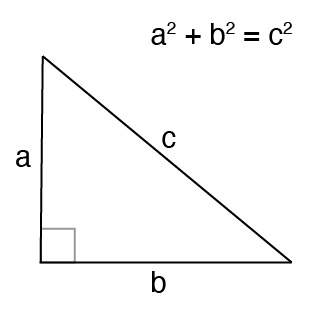
What is the Pythagorean theorem?
Only works on right triangles
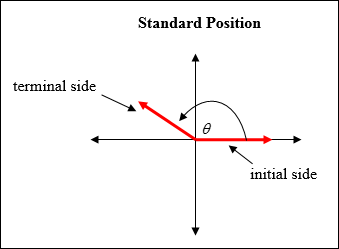
What is the initial side of an angle?
What is the terminal side of an angle?
What is the standard position of an angle?
What is the reference angle of an angle?
Acute angle closest to x-axis formed by a certain angle

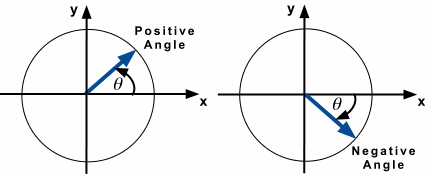
What is a negative angle?
Represents DIRECTION
Clockwise rotation of an angle

What is a positive angle?
Counter clockwise rotation
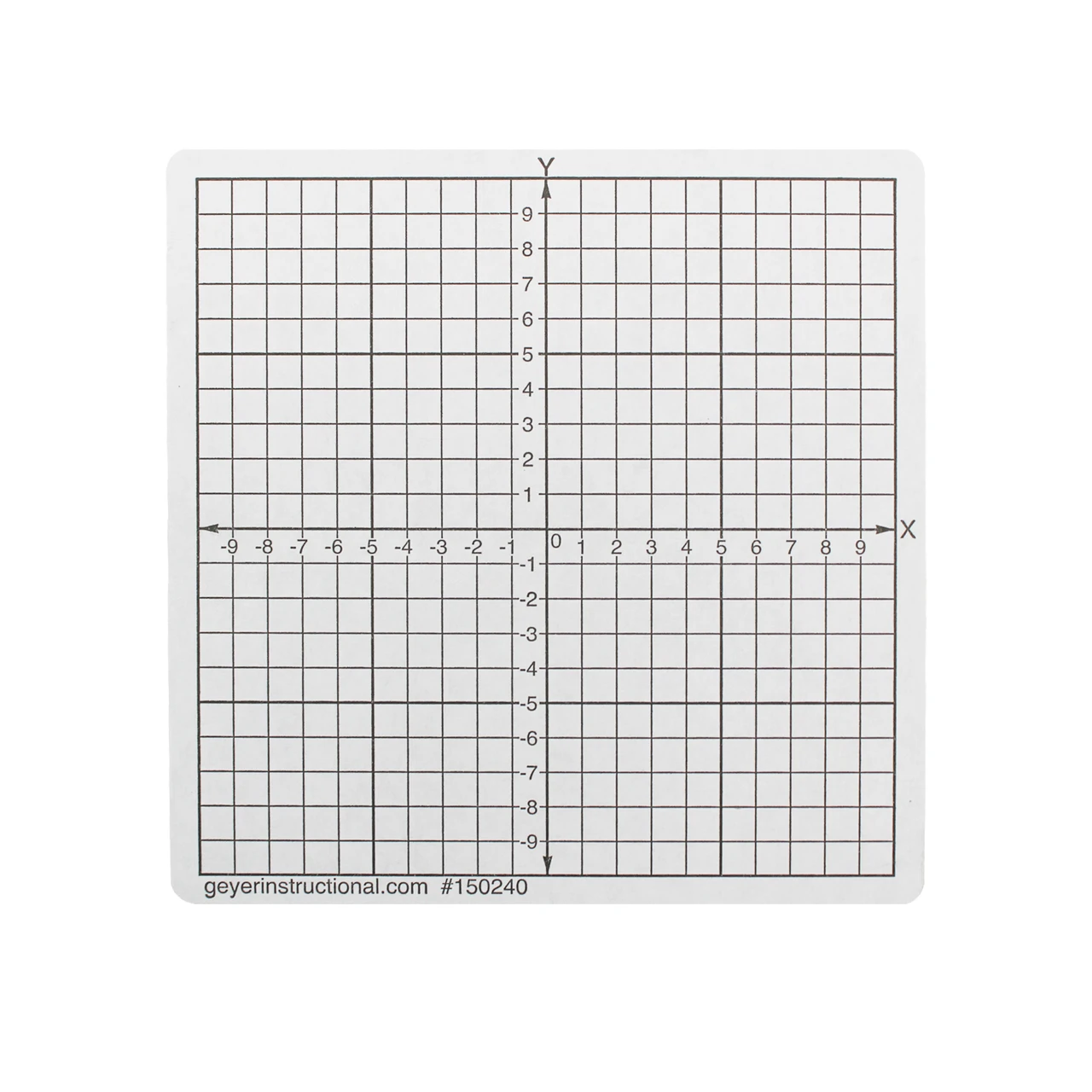
List the four quadrants.
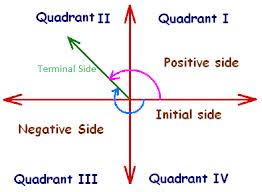
Define standard position
When the initial side of the angle is on the positive x-axis
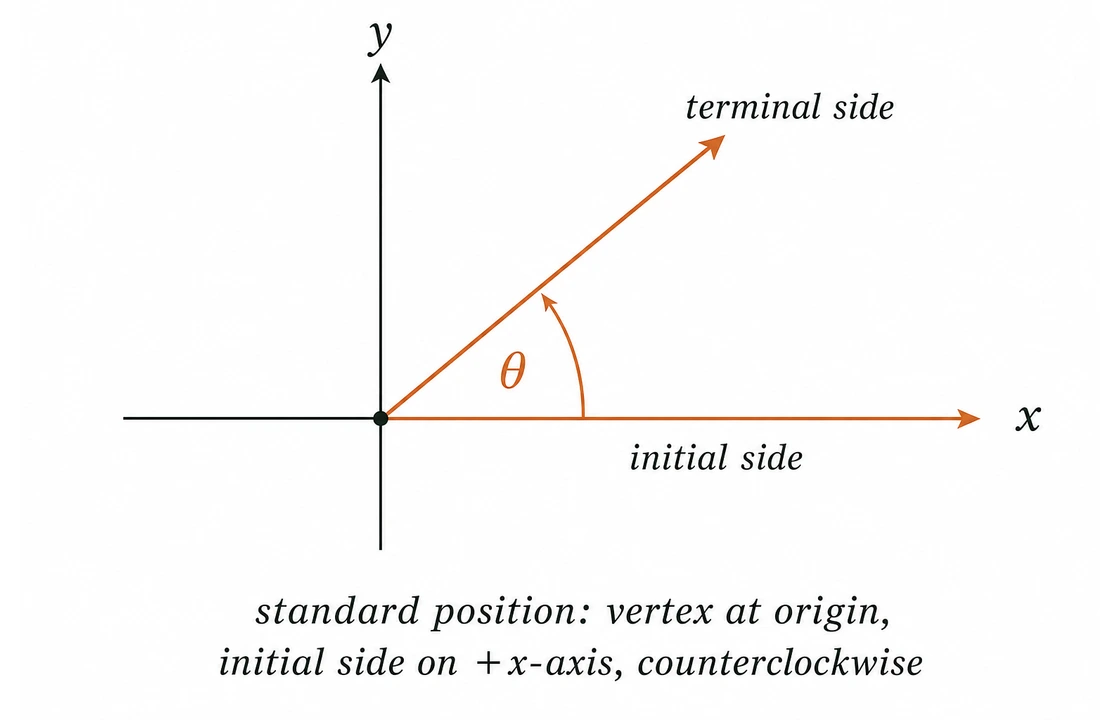
A reference angle is the angle created by the ________side and the ___-axis
Terminal side
X-axis

Give the definition of:
Sine
o/h
y/1
Give the definition of:
Cosine
a/h
x/1
Give the definition of:
Tangent
o/a
y/x
Tell me about the unit circle.
Sine = y-axis (+ or -)
Cosine = x-axis (+ or -)
Hypotenuse is always positive 1

What is a quadrantal angle?
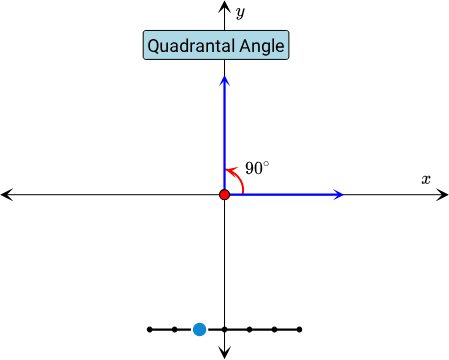
I have an angle of -450º. How do I find the reference angle?
Coterminal angles.

On the unit circle, the hypotenuse will always be ________
Positive (1)

Notice:
sin (beta) is the exact same thing as the _________axis
cosine (beta) is the exact same thing as the _________axis
Y
X
What is a radian?
Radian is essentially a measure of an angle

On a circle graph, describe where the radian numbers land


Arc length is a fraction of the circumference of the circle.
Circumference of circle = _____
A full rotation in radians is
2 (pi) (r)
2 (pi)
What are key conversions for degrees to radians and vice versa?

Cosecant (csc) = _________ = _____ = ________
Inverse of sin (beta)
1/ sin
1/y
h/o
Secant (sec) = _________ = _____ = ________
Inverse of cos (beta)
1/ cos
1/x
h/a
Cotangent (cot) = _________ = _____ = ________
Inverse of tan (beta)
1/ tan
x/y
a/o

Reminder
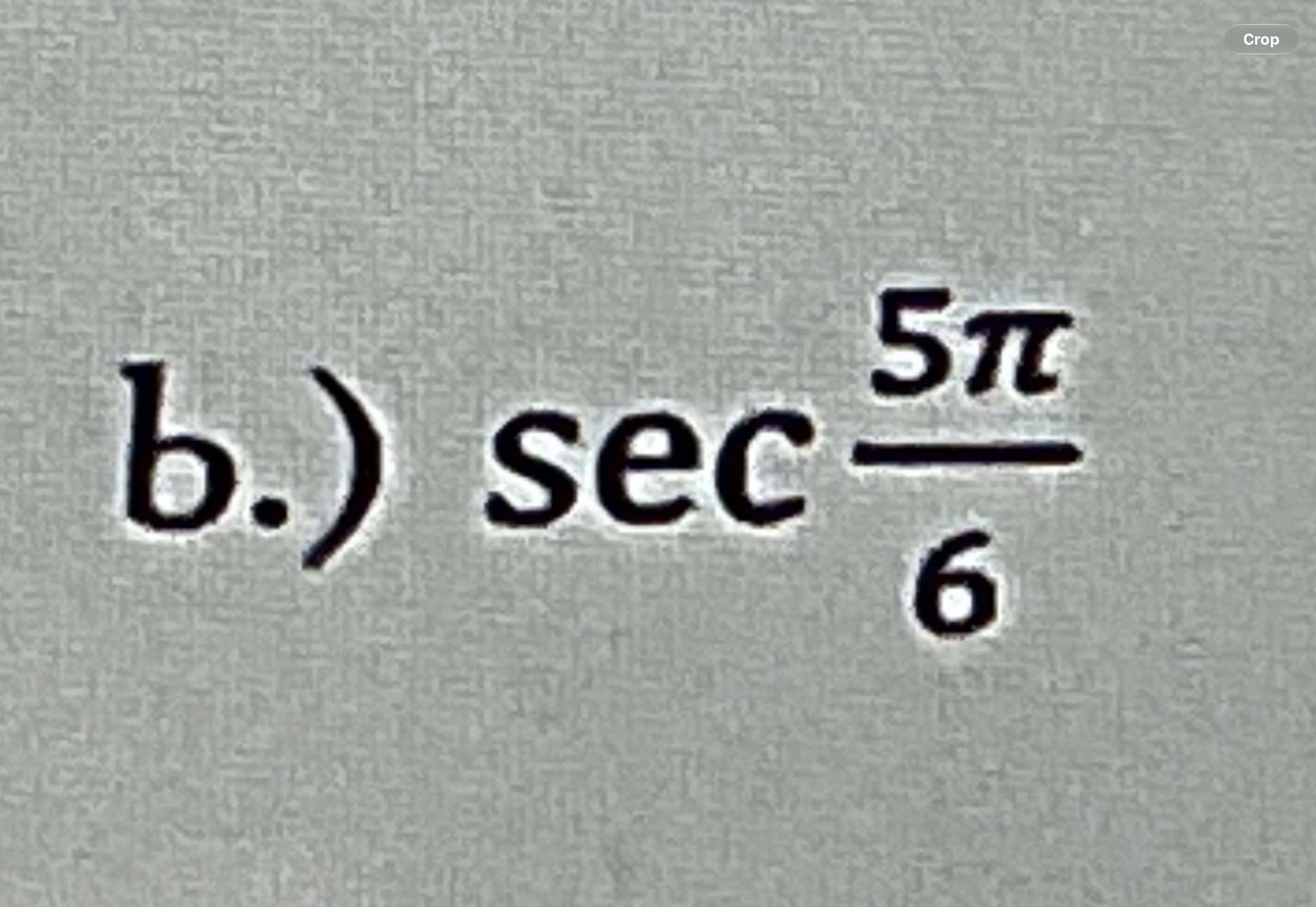
Here, is angles or radians given?
Radians given
may want to convert to degrees
150º
Radian Trick!!!
#/4 = _______º
#/6 = _______º
#/2 = _______º
#/3 = _______º
→ # represents any number, positive or negative
→ Explain your thinking
#/4 = ___45__º
#/6 = __30___º
#/2 = ___90__º
#/3 = ___60__º

Solve: cosine 90º
Top or bottom will always be zero in this scenario (answer = 0 or undefined, depends)
Describe the four quadrants.
In the corresponding quadrant, ONLY Tangent and Cotangent are positive, for example.

If you’re given radians, your answer should be in radians (same idea for degrees) unless converting.
On the unit circle, what is sin pi/6?

On the unit circle, what is sin (-5pi/4)?
reference angle is 45º, quadrant II
-√2 /2


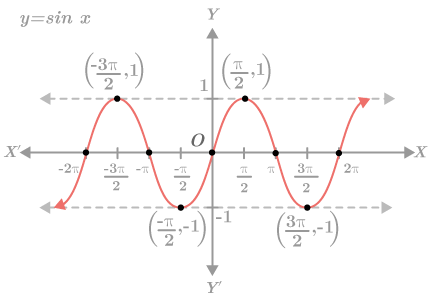
What is the graph of y= sin x ?

What is the graph of y= cos x ?

What is the… of the graph y= sin x ?
Domain
Range
Amplitude
Period
Domain = (-∞, ∞)
Range = [-1, 1]
Amplitude = 1
Period = 2 pi
What is the… of the graph y= cos x ?
Domain
Range
Amplitude
Period
Domain = (-∞, ∞)
Range = [-1, 1]
Amplitude = 1
Period = 2 pi

Reference Angles are always _________ and _____
Positive and acute

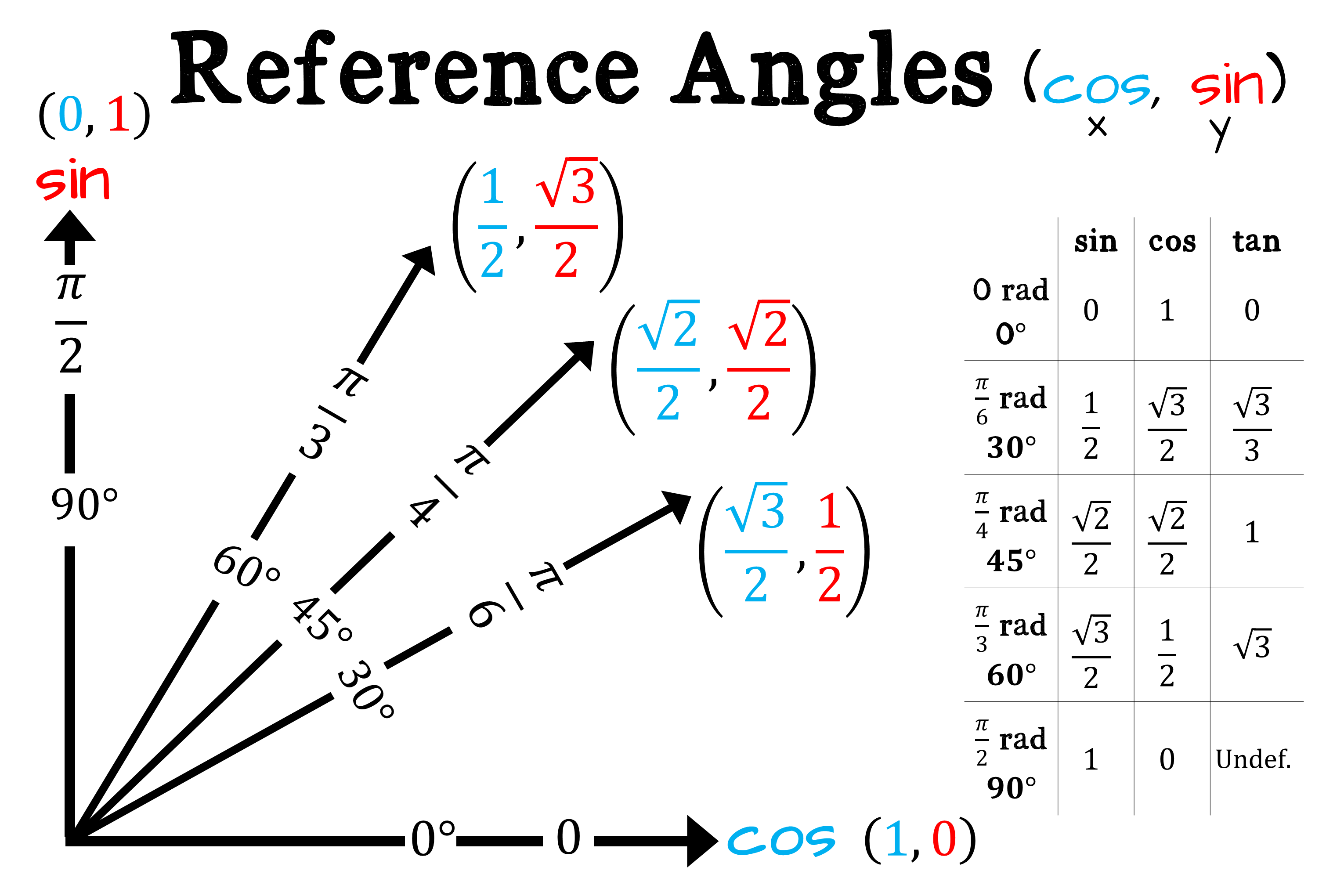

Beware that corresponding sides may be negative.
(A/S/T/C)
What are the 5 key points of a PARENT sine graph?

What are the 5 key points of a PARENT cosine graph?


“I have zero idea why sine goes up”

“Getting a C brings your grade down”
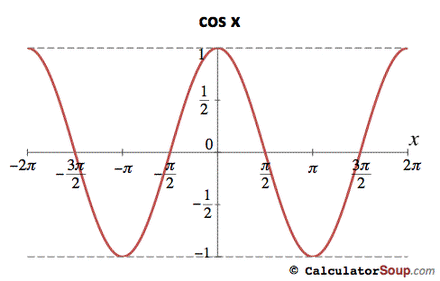
There is definitely symmetry on sine, tangent and cosine functions!
Once you get the “3-5 key points down,” you can easily follow the pattern and jot the rest of the points!
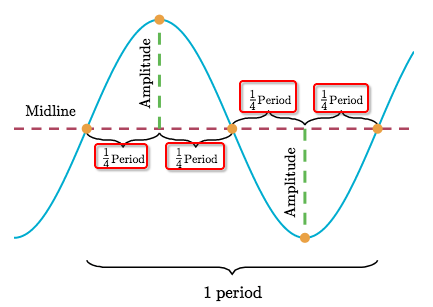
Define amplitude
Midline to peak or trough

Does tangent have an amplitude?
Nope

What is a period?
How long a section takes to “restart”

What is a midline?
The horizontal line halfway between its maximum and minimum values
What are the three KEY PARENT points of tangent, and where are the parent vertical asymptotes?
Key points:
( -π/4 , -1 )
( 0, 0 )
( π/4, 1 )
Vertical asymptotes = period
-π/2 and π/2

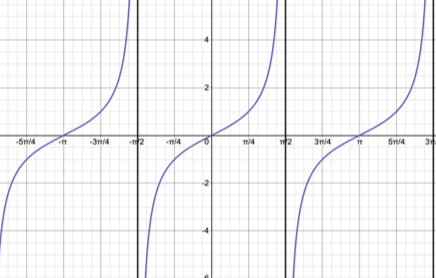
What os the domain, range, period and amplitude of a tangent graph?
Period: π
Amplitude: n/a (tangent does not have an amplitude)
Range: (-∞,∞) or all real numbers
Domain: all real numbers except x= -π/2 + πk, keZ


Explain the tangent parent domain:
Domain: All real numbers except x= -π/2 + πk, keZ
All real numbers (every possible value of x)
Except
Any value π away from (+ or - π) from -π/2, an asymptote (this is subject to change)
Π in this case is the period (this is subject to change)
For any integer of k
K is constrained in the set of all integers

How do you know what a period on the tangent function is?
A period is the distance between two vertical asymptotes on a tangent function

How do you find your asymptotes given you have already found your period?
Do period / 2.
Then, add period /2 from each side of your middle-most key point on each side!

What are two translations that could occur to your sin/cos/tangent graphs?
Phase shift (left or right)
Vertical shift (up or down)

FYI:
√3 ~_____
√3/3 ~_____
√2/2 ~____
√3/2~____
1.73
0.58
0.71
0.87
What is the phase or vertical shift?
Y= sin (x-π/4) +2
Up 2 = vertical shift
Right π/4 =0.785 horizontal shift
** X ALWAYS LIES

X—always lies!!!

Yay

When finding your domain, you can pick any vertical asymptote your heart desires.
What is the “CORRECT” firm if scaling a sine/ cosine/tangent graph?
y = A sin* (B( x + c )) + D
*sin could be sin, cos, or tan
y = A sin* (B( x + c )) + D
What effects your amplitude?
A
Literally multiply your parent y-values by the A value in order to figure out your new
Also, A is literally your amplitude answer (as your parent’s amplitude is 1)

y = A sin* (B( x + c )) + D
If A>1, then your graph will ______
If A<1, then your graph will _____
Stretch
Compress

y = A sin* (B( x + c )) + D
What affects your period?
B
X ALWAYS LIES!!!!
Multiply the x values from your parent by the reciprocal of B
→ To find your period…
Cosine/sine: 2π / B value
Tangent: π/ B value
What is your amplitude?
y = ½ sinx
Amplitude = 1/2
What is the period?
y= cos (2x)
X always lies. Because 2* x is given, you need to do x/2
→ period = 2π / 2 = π
What is the period?
y= tan (2x)
X always lies. Because 2* x is given, you need to do x/2
→ period = π / 2 = π/2
What is the period?
y = 2tan (1/3x)
Π / 1/3 → π (3/1) → 3π
3π in this context is the distance between two vertical asymptotes (the period of a tangent)
Given…
y = 2tan (1/3x)
My period is 3π with a vertical asymptote at (3π)/2. What is my domain?
Domain:
All real numbers except x= (3π)/2 +3πk + keZ
Period is now 3π
A vertical asymptote is at 3π/2
For tangent, if I have this, I do not have an amplitude…
y = 2tan (1/3x)
Instead, I have a Vertical Scale Change or VSC!
What is the VSC?
2

Same
READ DIRECTIONS!!!!!!!
y = A sin* (B( x + c )) + D