CORONARY ARTERY: ANATOMY AND PHYSIOLOGY U2 L2
 Call Kai
 Learn
 Practice Test
 Spaced Repetition
 Match
 Flashcards
 Knowt Play
1/49

There's no tags or description
Looks like no tags are added yet.
50 Terms
List the 4 areas the coronary arteries perfuse with oxygen-rich blood.
Ventricular myocardium
Atria
SA node
AV node
Where do the coronary arteries arise?
From the aortic root at the level of the sinuses.
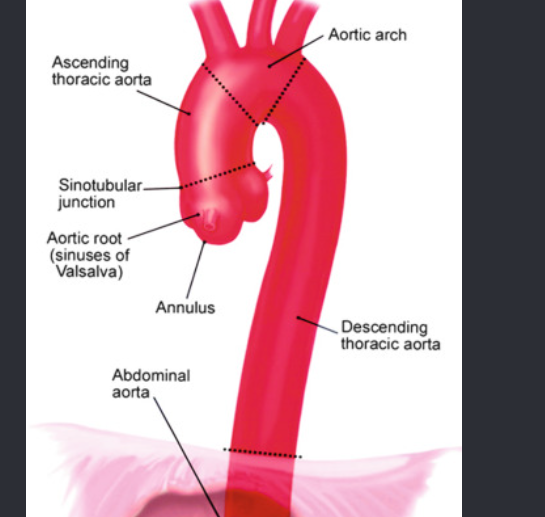
When does myocardial perfusion occur (in what cardiac cycle), and list the 2 reasons given?
During diastole because of:
Lower resistance
Aortic recoil
Aortic recoil = the aorta springs back during diastole, helping push blood into the coronary arteries to perfuse the heart muscle.
ARTERIAL WALLS
List the 3 features of the intima.
Innermost layer
Single layer of endothelial cells that acts as a barrier
Lines the lumen
List the 3 features of the media.
Middle smooth-muscle cell layer
Bordered by the internal and external elastic laminae
Contains openings through which cells can pass
It means the media, which is the middle layer of the artery wall, is sandwiched between two stretchy elastic layers.
Internal elastic lamina = elastic layer on the inside of the media
External elastic lamina = elastic layer on the outside of the media
So simply:
Media = smooth muscle layer between two elastic sheets.
List the 2 features of the adventitia.
Outermost layer
Houses blood vessels, nerves, and lymphatics that nourish the vessel
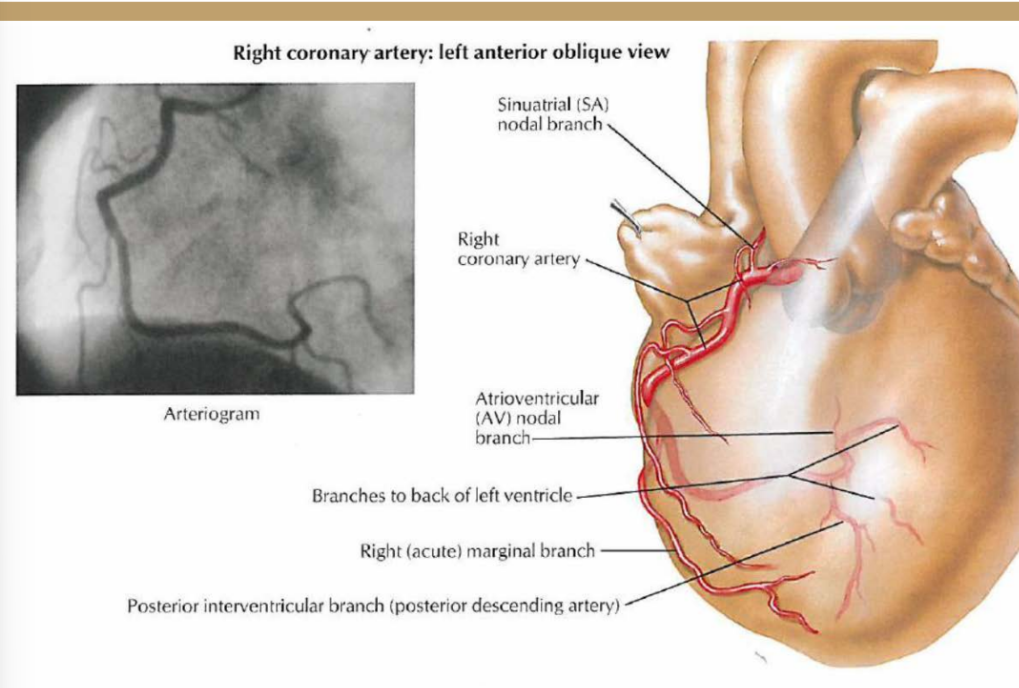
Where does the RCA Arises from?
From the right coronary ostium.
What is the course of the RCA? & Mid RCA courses?
It courses:
Superiorly and rightward posterior to the pulmonary trunk
Underneath the RAA
Mid RCA then courses inferiorly and posteriorly along the AV
groove

Into which 2 branches does the RCA eventually bifurcate?
Posterior LV branch
posterior descending artery (PDA)
List the 5 RCA branches and what they supply. WHICH ONE IS THE 1 ST BRANCH
• 1st branch, Conus branch — RVOT
SA node branch
AV node branch
RV marginal branches — RV free wall
PDA — RV inferior wall and 1/3 of the IVS
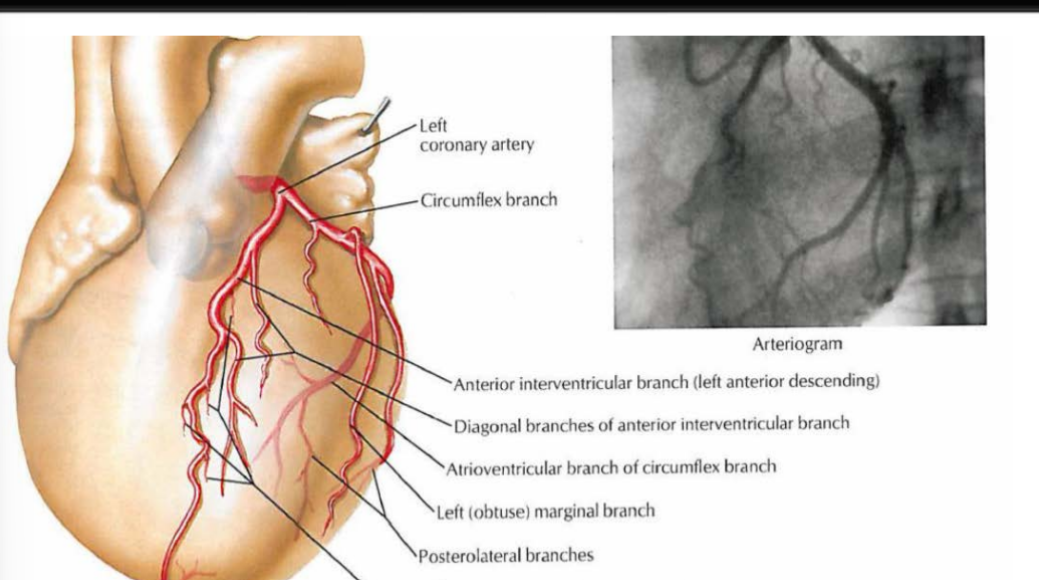
Where does the LAD arise? & traveling along where?
From the left main coronary artery after the left coronary ostia descending along the AV groove

List the 2 main branches of the LAD.
Septal perforators
Diagonal branches
What areas does the LAD supply? List 2 and what does the Septal perforators supply?
Anterolateral myocardium
Apex
Septal perforators supplying the anterior 2/3 of the IVS
Where does the circumflex artery arise, and what is its course?
It arises from the bifurcation of the left main coronary artery and travels left and posteriorly toward the lateral aspect of the left ventricle
List the 2 branches of the circumflex artery.
Obtuse marginal
Left posterolateral branch
What LV walls does the circumflex artery supply? List 2
Lateral wall
Posterolateral wall
What is right coronary dominance, and how common is it?
The PDA branches from the RCA.
Occurs in 70% of hearts…. right coronary dominance Is THE MOST COMMON
What is co-dominant coronary circulation, and how common is it?
The PDA arises from both the RCA and circumflex.
Occurs in 20%
What is left coronary dominance, and how common is it?
The PDA arises from the circumflex artery.
Occurs in 10%
Into what 3 levels is the LV divided for ventricular wall-segment assessment?
(Divided heart into three sections perpendicularly)
Basal
Mid
Apex
Where does the basal level extend?
From the mitral valve annulus to the tip of the papillary muscle.
Where is the mid level?
Along the entire length of the papillary muscle.
Where is the apical level?
From the area beyond the papillary muscle to the most inferior aspect of the LV apex
List the 5 wall-motion scores and what each represents.
Normal/hyperkinesis — systolic increase in thickening >50%
Hypokinesis
Akinesis or severe hypokinesis — <10% systolic thickening
Dyskinesis — paradoxical systolic motion
Aneurysmal — diastolic deformation
List the 2 main categories of coronary artery disease.
Atherosclerotic coronary artery disease
Non-atherosclerotic coronary artery disease
What is atherosclerotic CAD?
A condition where atherosclerotic plaque forms within the vessel lumen.
What can atherosclerotic plaque eventually cause? List 2
Vessel-lumen narrowing
Ischemia
What plaque-related event is the major cause of WHAT?
Thrombosis related atherosclerotic plaques is the major cause for Acute MI
How much must the coronary artery lumen cross-sectional area be reduced before there is a significant reduction in what?
CSA of the coronary artery lumen must be reduced 75% before there is significant
reduction in myocardial perfusion
What is non-atherosclerotic coronary heart disease?
Myocardial ischemia or infarction caused by:
Reduced or disrupted coronary artery flow, or
Increased myocardial metabolic demand
Increased metabolic demand → heart needs more oxygen → coronary blood supply cannot keep up → ischemia → possible MI.
List the 3 non-atherosclerotic causes of myocardial ischemia or infarction shown in the table.
Coronary artery emboli
Coronary artery dissection
Coronary spasm
What is ischemia?
A condition in which blood flow to a specific tissue is restricted.
What is ischemic heart disease?
Blood flow to the heart muscle is restricted
ETIOLOGY
Why does ischemia occur?
A supply-and-demand mismatch
What Is the most common cause for Ischemia?
Atherosclerosis: 90%
List the 3 non-atherosclerotic examples of ischemia given. (happens 10%)
spontaneous coronary artery dissection (SCAD)
Vasospasms
Myocardial bridging
SCAD = spontaneous coronary artery dissection → a tear in the coronary artery wall can reduce blood flow
Vasospasm = the coronary artery suddenly tightens/narrows, reducing blood flow
Myocardial bridging = part of a coronary artery travels through the heart muscle, so the muscle can squeeze/compress the artery
Atherosclerotic CAD = plaque blocks the artery
Non-atherosclerotic CAD = something other than plaque reduces coronary blood flow.
How does spontaneous coronary artery dissection (SCAD) compare between women and men in What events?
• SCAD is 5x more common in acute events in women than men
What happens in Acute Coronary Syndrome?
Blood flow to the heart muscle is suddenly reduced or blocked, depriving the myocardium of oxygen.
What can ACS lead to? List 2
Heart-muscle damage or death.
List the 3 conditions included under ACS.
(Symptoms and 2 EKG findings)
Unstable angina / chest pain
NSTEMI
STEMI
Acute coronary events , MOST COMMON ****65-75% are cause by? 25-30% are caused by? and 5% are caused by?
Plaque rupture — 65–75% -MOST COMMON CAUSE OF ACS
Plaque erosion — 25–30%
Calcified nodules — 5%
Plaque rupture = the plaque cracks open
The inside of the plaque gets exposed to the blood
The body thinks there is an injury
A blood clot forms
That clot can suddenly block the artery
Plaque erosion = the plaque does not necessarily crack open
Instead, the thin surface lining over it gets damaged or worn away
Blood touches the damaged area
A clot can form there too
Calcified nodule = the plaque has become hard with calcium
A hard calcium piece can stick up into the artery
It can injure the lining
That can trigger a blood clot
How long can native coronary atherosclerosis develop before a clinical event occurs?
Native coronary atherosclerosis develops over decades before clinical events occur (Before ACS)
List the 7 modifiable risk factors for CAD.
Smoking
Diabetes
Obesity
Lipid levels
Hypertension
Diet
Sedentary lifestyle
List the 6 non-modifiable risk factors for CAD.
Social determinants of health
Sex
Age
Race
Family history
Genetics
Social determinants of health means the conditions in a person’s everyday life that can affect their health.
For example, your slide lists things like:
Air pollution
Not being able to afford medications
No transportation to appointments
Living in a food desert, where healthy food is hard to get U2 L2 Coronary Artery Anat and …
So think of it like this:
Where you live, what you can afford, and what resources you have can affect your chance of developing heart disease.
Simple example:
If someone can’t afford blood pressure medicine or can’t get to doctor appointments, their heart disease risk may be harder to control.
What percentage of prognostic performance do the non-modifiable risk factors contribute to?
63–80%
Contribute to 63%–80% of prognostic performance” means these non-modifiable risk factors help a lot when predicting a person’s future risk of CAD or cardiovascular problems.
Prognostic performance means how well risk factors help predict a person's future health outcomes, such as developing coronary artery disease (CAD), having an MI, or dying from heart disease.
List the 3 epidemiology facts about CAD given.
Epidemiology means the study of how common a disease is in a population and who it affects, Epidemiology = how common a disease is and how it affects groups of people.
It is listed as the single leading cause of death in America.
15.5 million Americans have CAD.
CAD is listed as the foremost single cause of mortality
What is the SA node and where is it Located?
Natural Pacermaker of the heart
Located in groove where the SVC joins the RA
What is the AV node and where is it Located?
Responsible for normal delay between atrial and ventricular activation (depolarization)
(2nd fire if the SA node fails this will fire first)
Located in RA endocardium above TV
What is the Bundle of HIS and where is it located
Located in the IVS
Splits into the LBB and the RBB
Where is the Purkinje system located
Located in subendocardium layers of the ventricular myocardium
Coordinated depolarization and contraction of the ventricle so they can contract at the same time