Week 3: Pre 1: Introduction to Metabolism
 Call Kai
 Learn
 Practice Test
 Spaced Repetition
 Match
 Flashcards
 Knowt Play
1/40

There's no tags or description
Looks like no tags are added yet.
41 Terms
Catabolic reactions vs. anabolic reactions
Catabolic: Metabolic pathways that break down complex molecules into simpler molecules, releasing energy.
Example: Cellular respiration.
Generally exergonic (ΔG < 0).
Anabolic: Metabolic pathways that build complex molecules from simpler molecules, requiring energy.
Example: Protein synthesis.
Generally endergonic (ΔG > 0).
Metabolism
Metabolism is the sum of all chemical reactions that occur in a cell or organism to maintain life.
Each metabolic pathway is catalyzed by an _____
enzyme
Kinetic energy:
relative motion of objects
Thermal energy:
Thermal energy is the energy associated with the random movement of atoms and molecules in a substance.
More molecular movement → Higher temperature.
Less molecular movement → Lower temperature.
Thermal energy can be transferred between objects as heat.
Potential energy:
energy stored in an object due to its relative position
Chemical energy:
Chemical energy is potential energy stored in the chemical structure of molecules, which can be released or used during chemical reactions.available energy to do work
Thermodynamics
The study of energy and its transformation
First law of thermodynamics:
Energy can be transferred and transformed, but it cannot be created or destroyed
Second law of thermodynamics:
Every energy transfer or transformation increases the entropy (i.e., measure of disorder) of the universe
What is entropy?
Entropy is a measure of how dispersed/disordered (spread out) energy is within a system.

Enthalpy
Enthalpy is the total heat content of a system at constant pressure.
Change in enthalpy (ΔH) tells us whether a reaction absorbs or releases heat.
Gibbs free energy refers to what
energy available in a system to do useful work
formula for change in free energy
∆G = ∆H - T∆S OR ∆G = Gfinal – Ginitial
Symbol | Meaning | Simple Explanation |
|---|---|---|
ΔG | Change in free energy | Determines whether a reaction is spontaneous |
ΔH | Change in enthalpy | Heat energy released or absorbed |
T | Temperature | Temperature in Kelvin (K) |
ΔS | Change in entropy | Change in disorder or energy dispersal |
Endothermic reaction
An endothermic reaction is a chemical reaction that absorbs heat energy from its surroundings.
ΔH > 0 (positive) → Heat is absorbed.
Surroundings become cooler because heat is taken in.
Products have higher enthalpy than reactants.

Exothermic reactions
An exothermic reaction is a chemical reaction that releases heat energy into its surroundings.
ΔH < 0 (negative) → Heat is released.
Surroundings become warmer because heat is released.
Products have lower enthalpy than reactants.

Activation Energy (Ea)
The energy required to start a chemical reaction, determines rate of reaction. (amount of energy required for the reactants to reach the transition state)
do enzymes have an impact on enthalpy
no they only effect how much activation energy is required
What is the difference between exergonic and endergonic reactions?
Exergonic: Releases free energy (ΔG < 0). Spontaneous. - reactants have higher energy
Endergonic: Requires energy input (ΔG > 0). Nonspontaneous. - Products have higher energy

Gibbs free energy (G) is positive
products have more free energy therefore energy is absorbed/needed; endergonic
Transition state
The transition state is the highest-energy, unstable point during a chemical reaction, when bonds are breaking and forming.
Catalysts:
molecules that speed up reactions but aren't consumed in them by decreasing activation energy without impacting ΔG (Delta G) = Change in Gibbs Free Energy
Enzymes:
macromolecules that act as biological catalysts
Substrate:
substrate is the molecule that an enzyme binds to and acts on during a chemical reaction.
Enzyme substrate specificity:
An enzyme only works with specific substrates because its active site has a matching shape and charge.
what is needed for the entropy of a system to decrease
It means you can't lower a system's entropy for free. You have to put in energy or dump heat out.
Order in a system costs energy; entropy can go down only if the surroundings take on more entropy.
Induced fit:
Induced fit occurs when an enzyme slightly changes shape as a substrate binds to its active site, allowing a better fit and helping the reaction occur.
Enzymes lower activation energy by:
Orienting substrates correctly.
Straining or weakening bonds.
Providing a suitable chemical environment.
Temporarily bonding with substrates.
Gibbs free energy is negative
products have less energy than reactants therefore energy is released; exergonic and spontaneous
Where does endergonic reactions get their ATP
from exergonic reactions
Enzyme activity is influenced by _______ and ___
temperature & pH
Cofactor vs. coenzyme
Feature | Cofactor | Coenzyme |
|---|---|---|
Definition | Non-protein substance that helps an enzyme function | Organic molecule that helps an enzyme function |
Type | Can be inorganic or organic | Always organic |
Example | Mg²⁺, Zn²⁺, Fe²⁺ | NAD⁺, FAD, Coenzyme A |
How does enzyme localization help regulate chemical reactions?
Enzymes are located in specific areas of the cell, allowing reactions to occur efficiently and controlling where enzymes interact with substrates.

Competitive inhibitors:
changes shape of active site that decreases enzyme activity

Noncompetitive inhibitors:
An inhibitor binds somewhere other than the active site, decreasing enzyme activity.
Allosteric regulation
Allosteric activation:
Allosteric inhibition:
Allosteric regulation occurs when a molecule binds to an enzyme at a site other than the active site, changing the enzyme's shape and activity.
Allosteric activation: Increases enzyme activity.
Allosteric inhibition: Decreases enzyme activity.
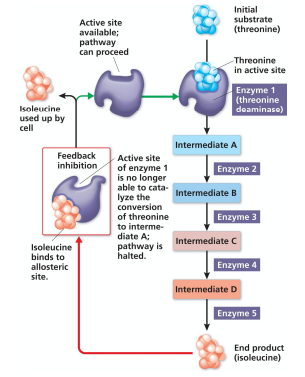
Feedback inhibition:
Feedback Inhibition: The final product of a metabolic pathway binds to an enzyme earlier in the pathway, stopping further production.
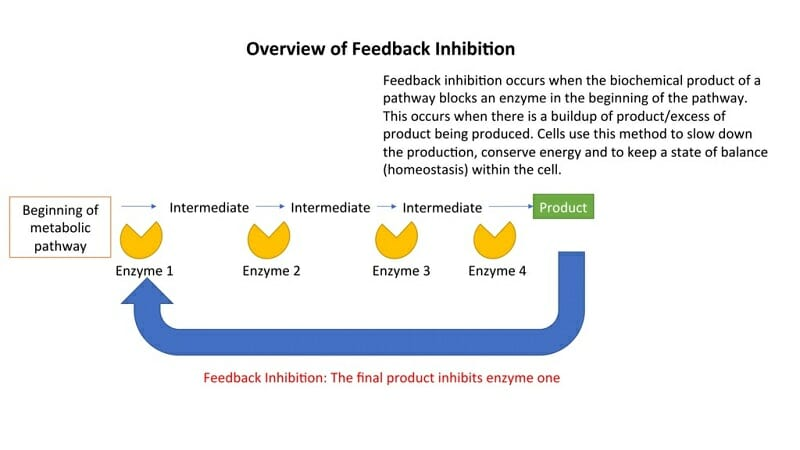
What are the three types of work cells perform using ATP?
Chemical: Building molecules.
Transport: Moving substances against their concentration gradient.
Mechanical: Producing movement.
What is energy coupling?
Energy coupling is when energy released from an exergonic (catabolic)(ΔG < 0) reaction (like ATP hydrolysis) is used to drive an endergonic (anabolic) reaction (ΔG > 0).
How are bond breaking/forming, catabolism, anabolism, exergonic/endergonic reactions, and energy coupling related?
Bond breaking: Requires energy.
Bond forming: Releases energy.
Catabolism: Breaks down molecules, generally releasing free energy (exergonic, ΔG < 0).
Anabolism: Builds molecules, generally requiring free energy (endergonic, ΔG > 0).
Energy coupling: Uses energy from exergonic reactions (often through ATP) to power endergonic reactions.
Catabolism releases energy → ATP transfers energy → Anabolism uses energy.
How does ATP hydrolysis provide energy for cellular work?
ATP is hydrolyzed into ADP + Pi, releasing free energy (exergonic) that is coupled to energy-requiring (endergonic) cellular processes..