biochemistry quiz on saccharides 10/30/23
 Call Kai
 Learn
 Practice Test
 Spaced Repetition
 Match
 Flashcards
 Knowt Play
1/41

There's no tags or description
Looks like no tags are added yet.
42 Terms
aldose vs ketose
Aldose (aldehyde)
Ketose (ketone)

monosaccharide carbon count:
3 or more.
D and L notation

Epimer:
different configuration at a single chiral center
epimer at C-4

D-Glyceraldehyde
aldotriose
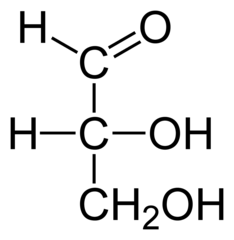
D-Erythrose
aldotetrose
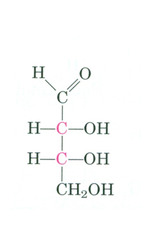
D-Ribose
Aldopentose

D-Arabinose
Aldopentose

D-Xylose
aldopentose
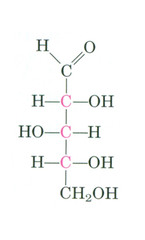
D-Glucose
Aldohexose

D-Mannose
Aldohexose

D-Galactose
Aldohexose

dihydroxyacetone
ketotriose

D-Erythrulose
ketotetrose

D-Ribulose
ketopentose

D-Xylulose
ketopentose
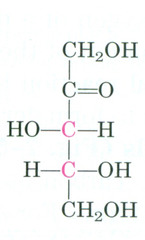
D-Fructose
ketohexose

Cyclization naming of aldohexoses:
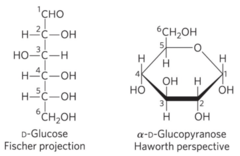
a-D-Glucopyranose
the aldehyde forms the anomeric carbon! (C1)

cyclization of ketohexose:
B-D-Fructofuranose
C2 becomes the anomeric carbon

B-D-Glucosamine

N-Acetyl-B-D-glucosamine

B-D-Glucuronate

D-Gluconate

anomer
epimer at the hemiacetal/hemiketal carbon

Converting Fischer projection to Haworth perspective:
1. Draw pyranose or furanose ring and # carbons
2. CH2OH pointed up for D isomer
3. OH on left in Fischer is pointed up in Haworth
4. OH on right in Fischer is pointed down in Haworth
5. Assign anomeric carbon
Reducing sugar:
open-chain form with aldehyde group (aldose) or ring form with free hemiacetal group.

Formation of acetal or ketal what kind of bond?
glycosidic bond

Disaccharides are linked by ?
Glycosidic bond, forming an acetal at C1
Naming Disaccharides: Maltose
1. Identify nonreducing and reducing end
2.Name nonreducing sugar ("syl" suffix)
3.Two carbons involved in glycosidic linkage
4.Name reducing sugar ("ose" suffix)
Contains two glucoses
a-D-Glucopyranosyl (1-4) B- D-Glucopyranose

Lactose
Contains Gal and Glc (B-1,4-linkage)

Sucrose
Glucose and Fructose (a,B-(1-2)) linkage

Trehalose
two Glucoses:
a linked

Starch is made up of ?
Amylose and Amylopectin
Amylopectin
Branched
a-D-glucose
a-1, 4-linkages
a-1, 6-linkages (branch points)
every 8-10 glucoses there is a branch point
Amylose:
unbranched
a-D-glucose
a-1,4-linkages

Glycogen
More extensively branched than starch. Basically the same as amylopectin
branches every 5-7 glucoses

significance of branching:
Branching increases the non-reducing ends.
Cellulose
Glucose residues linked by B-1,4-linkages
unbranched
B-D-glucose
B-1,4-linkages
amylose but B linkages

Chitin
N-acetyl-B-D-Glucose
Unbranched
B-1, 4-linkages
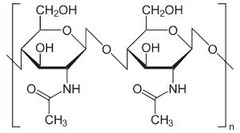
Cellulose and chitin make:
sheets/sandwiches
Starch and glycogen form :
helix/tightly coiled helix
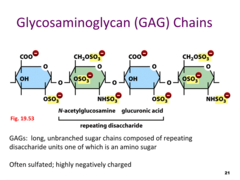
What is a GAG?:
Glycosaminoglycans
Uronic acid (carboxyl)
N-acetylglucosamine or N-acetylgalactoseamine (amide)
repeating units...
They are negatively charged
Unbranched
Some contain sulfate esters