Patho Chp 28
 Call Kai
 Learn
 Practice Test
 Spaced Repetition
 Match
 Flashcards
 Knowt Play
1/20

There's no tags or description
Looks like no tags are added yet.
21 Terms
What are the 2 types of disorders of the cardiac conduction system
disorders of rhythm
disorders of impulse conduction
What are the 4 causes
congenital defects or degenerative changes in the conduction system
myocardial ischemia and infarction
fluid and electrolyte imbalances
effects of drug ingestion

This photo is an example of what type of sinus node arrhythmias
Sinus bradycardia
This type of sinus node arrhythmias has fewer than 60 beats per minute
Sinus bradycardia

This photo is an example of what type of sinus node arrhythmias
Sinus tachycardia
This type of sinus node arrhythmias has more than 100 beats per minute
Sinus tachycardia

This photo is an example of what type of sinus node arrhythmias
Sinus arrest

This photo is an example of what type of arrhythmias
Atrial fibrillation
This type of arrhythmias is the most common
Atrial fibrillation
Twisting of points
torsade de pointes
This refers to a large bizarre polymorphic QRS complex that vary in amplitude and direction
torsade de pointes
How can you get torsade de pointes (2)
congenital: membrane ion channel
acquired: cocaine (MI, electrolyte imbalance, HIV)

This photo is an example of
torsade de pointes
This is an absence of P waves
ventricular tachycardia

This photo is an example of
ventricular tachycardia
This represents severe derangements of cardiac rhythm that terminate fatally within minutes
ventricular flutter
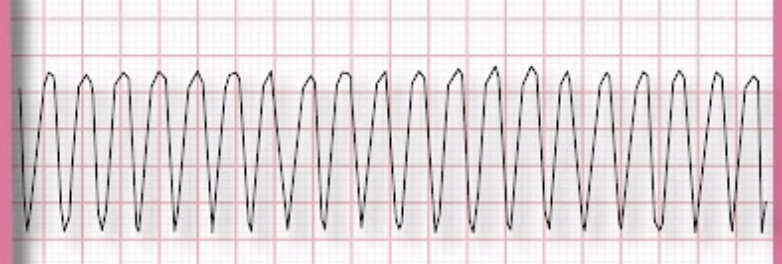
This photo is an example of
ventricular flutter
This ventricles quivers but does not contract
ventricular fibrillation

This photo is an example of
ventricular fibrillation
What are the 3 disorders of atrioventricular conduction?
First degree AV block
Second degree AV block
Third degree AV block
What are the 2 types of second degree of AV block
Type I (Wenckebach or Mobitz)
Type II (Mobitz type 2)