Scaly stuff: Anatomy & husbandry of fish and reptiles SDL (AHW)
 Call Kai
 Learn
 Practice Test
 Spaced Repetition
 Match
 Flashcards
 Knowt Play
1/79

There's no tags or description
Looks like no tags are added yet.
80 Terms
how many species of fish are there
over 32000
how long ago do fossil records go for fish
500 million years
why are fish called fish even though its such a broad term for their huge variey?
t’s ecologically and culturally useful.
It works for fisheries, teaching, and everyday conversation.
So, scientists don’t mean fish aren’t real animals, only that ‘Fish’ is not a scientifically coherent evolutionary category.
what do whalesharks eat?
tiny fish, squid, plankton
how do whale sharks give birth?
to live young - not eggs
what are chondrichthyes? what are their features?
cartilaginous fish
features:
hyaline cartilage skeleton
over 700 species of shark, skate, ray
what are the bony fish characteristics?
skeleton made of bone
over 24000 species
(teleosti + osteichthyes)
term for jawless fish? how many species?
agnatha
under 100 species
how many lungfish species are there
less than 10
list 6 cartilagenous fish species
goblin shark
common skate
common stingray
great white shark
spiny dogfish
lesser spotted dogfish
list 6 bony fish species
blue tang
haddock
discus
clownfish
stickleback
neon tetra
list 3 jawless + lungfish species
spotted lungfish
sea lamprey
black hagfish
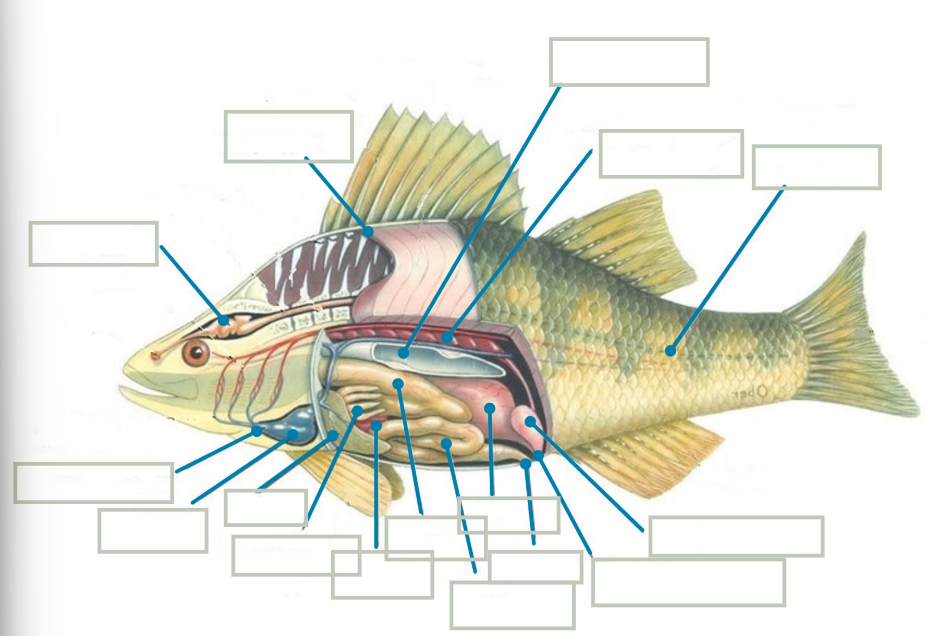
label the:
kidney, liver, spleen, ovary, stomach, anus, brain, swim bladder, lateral line, pyloric caeca, skin, ventricle, intestines, urogenital opening, bulbus arteriosis, urinary bladder
???????????????????????????????????????
what is the system called in the gills regarding direction of flow?
counter-current system
most difficult biological process for fish?
maintain water balance
25%-50% total energy→ osmoregulation
fresh water fish osmoregulation
hypotonic environment compared to the body
water enters passively
fish produce and excrete high urine volume with low salt conc
they extract as much salt as possible from food
marine fish for osmoregulatoin
hypertonic environment vs body
water passively leaves fish’s body
drink large salt water quantities - salt actively excrete through urine + gills + digestive tract
kidney must produce highly conc. urine with as much water reabsorption as possible
why cant a freshwater tropical fish in a tropical marine aquarium?
marine environment is hypertonic compared to the fish's body fluids, water will rapidly leave the fish’s body by osmosis, particularly across the gills.
Freshwater fish deal with excess water, not water loss. specialised kidneys → large volumes of dilute urine - not effective at conserving water.
In seawater - leads to dehydration as fish loses water cant reduce urine output/ concentrate its urine.
Freshwater fish: lack mechanisms to actively excrete large amounts of salt.
In seawater, salts diffuse into the body, freshwater fish gills are adapted for salt uptake rather than salt secretion -causes salts to accumulate in the body fluids, impacts normal cellular function.
unable to maintain internal balance → severe physiological stress and death.

label: wavemaker, hood + light, heater + thermostat, substrate + decor, protein skimmer, filter, thermometer, UV steriliser, air stones, chillers + fans
??????????????????????????
how do you chose what species to buy to be in the same tank?
appropriate temperament
chart to help identify good species to group
social needs vs solitary
territorial behaviour: aggression and predation
how do you chose tank size + stocking density?
stocking density calculators = guideline
deduct 10% tank for decor + substrate
allow amount of space per fish depending on the breed
what cm of space should be allowed for: tropical freshwater, coldwater, marine fish?
coldwater: 0.89
tropical freshwater: 1.8
marine: 2.4

how to chose correct habitat and water parameters? (what? aims? risks?)
species must share same water requirements:
pH, salt, substrate levels, sedate/ fast flow water
aim:
different water level parameters = less competition
risks:
disease/ chronic stress

feeding fish
formulated diets:
(tablets, flakes, granules, pellets) - float, sink slowly/rapidly
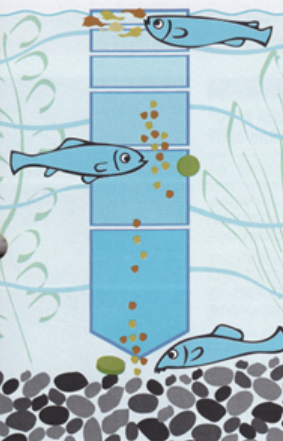
how do you know where a fish will feed in water?
look for mouth position
what diet is best for omnivores?
varied diet of:
formulated feeds (pellets, flakes, granules),
fresh food ,
live food,
frozen food
what diet is best for carnivores?
live prey or frozen cubes or freeze-dried invertebrates
what diet is best for herbivores?
graze aquarium plants
algae/ seaweed tablets
aquarium plants + fresh veg
what can phosphorus deficiency cause?
screamer jaw
risk of wet fish diet?
pathogen/ parasite transfer

reptiles: label the heat sources

what are incandescent bulbs for? pros/ cons
heat + visible light
benefits:
Provide basking areas
Provide a consistent environmental temperature
Can be used alongside a UVA/UVB light so a full spectrum of heat, visible light and UVA/UVB is provided
risks:
Risk of burns - must be fitted with a protective guard to prevent injury, epsecially for snake species
ceramic bulbs use + pros/ cons
heat not light
benefits:
Provide basking area
Cheap
Do not need changing regularly
Long lasting
Useful when supplemental heat is needed over night when a light source would disrupt circadian rhythms.
Can be used with halogen bulbs and UVA/UVB lights so a full spectrum of heat, visible light and UVA/UVB is provided
risks:
Significantly dries the air - may be an issue with species requiring high humidity
No visual indication if they are working or not, must monitoring vivarium temperature closely
heat mat: uses + pros/ cons?
out of enclosure - maintain background temp (no more than 0.5 of floor)
benefits:
Provide heat without light - does not disturb circadian rhythms
Preserve humidity
risks:
Significant risk of burns, even if the mat is placed outside the vivarium
Designed to warm surfaces not heat air - would not be a suitable choice for providing a temperature gradient
Not suitable for providing basking areas
heat rocks: pros/ cons?
risks:
Not advised due to significant burns risk and difficulty maintaining a consistent temperature
Do not provide a temperature gradient - poor heat distribution
substrate requirements for reptiles
Non-irritant, non-toxic
Easy to clean, obtain and replace
Suitable for species
Provide enrichment
risk of inappropriate substrate
microbe + parasite build up
high humidity species substrates reptiles:
mulch + husk substrate
retain moisture + no mould
low humidity species substrates reptiles:
shavings
absorbent + can dig
what shavings are not good?
pine + cedar → contain irritating oils to skin, mucous membranes + resp. tract
wood shavings → toxicity, impaction, mould growth, dust + splinters
what substrate is good for desert reptiles? examples of reptiles?
sand
leopard geckos
collared lizards
sand boas
inappropriate ingestion
anecdotal tissue - reason why reptiles are fed in separate feeding containers
large amounts = impaction (blockage)
(sand, bark, wood chips)
what does current research recommend regarding substrates?
mix of types - mimics natural habitat
What is a disadvantage of peat moss as a substrate? reptiles
organic waste hard to detect
What is a major clinical risk associated with sand as a substrate? reptiles
gut impaction
Which substrate is associated with lead exposure risk from ink? reptiles
newspaper
Which general principle best explains why multiple substrates may be used in vivaria? reptiles
provide humidity gradient
Which substrate is particularly associated with harbouring mites and chiggers and is NOT recommended? reptiles
corn cobs
Why are wood shavings generally not recommended? reptiles
They retain humdity and promote mould
Why is Astroturf unsuitable for some reptile species?
It is unsuitable for burrowing species
Cat litter is not recommended for reptiles primarily because:
Its dust is a respiratory irritant
carnivore diet needs - reptiles
whole defrosted prey - live prey = illegal
Prey should be no larger than the widest part of the snake as a general rule.
regurgitation if handled within 24-48 hrs of feeding
juvenile snakes: 5-7 days
adult snakes: 1-3 weeks
herbivore and omnivore reptile diets
leafy weeds + vegetables
chopped = reduce selective feeding
hay - added for some species
herbivore and omnivore reptile diets - what to avoid
fruit and image
omnivore reptile species diets
appropriate meat source - range of insects (mealworms + crickets)
range = reduced nutritional imbalance
what insects are advised for omnivore reptile species
Insects that are gut loaded are advised → the insects have been given nutrient rich food - passed on to the reptile.
issues with gut loaded insects
Insects may not consume enough of the nutrients to pass them on
Rapid nutrient loss: Insects cannot retain nutrients for long and often "off-load" them rapidly, meaning the benefits may be lost if not fed to the reptile quickly
Incorrect diets: Feeding insects high-fat/protein items rather than high-nutrient greens (e.g., leafy greens) causes dietary imbalances
method of feeding reptiles
live prey → separate handling box = best
(monitor feeding)
(less ingested substrate)
live insects should be removed after 30 mins if uneaten
vegetables and plant material:
the wheel method → content is systematically rotated to ensure a balanced intake of nutrients, mimic natural browsing and reduce unwanted feeding behaviours - e.g. selective feeding
how should snakes be fed?
use tongs when feeding snakes → creates distance between your fingers and a snake in full feeding response.
snakes have poor vision - rely on other senses (smell and heat) to locate prey
the risk of bites increases if we offer food via our hands.
can present the prey at a natural angle and create movement to encourage interest
supplementation
Ca deficiency - supplement 2:1 (Ca:P)
Vit D3 to obtain Ca from food/ UVB for basking animals
methods:
dust over food or gut loading
based on life stage: reptoboost dissolved in drinking water = glucose + electrolytes + vitamins + probiotics → for debilitated reptiles/ tortoises post hibernation
what does a bearded dragon eat
live insects and veg
what does leopard gecko eat?
live insects only
what does corn snake eat?
frozen mice
what does hermanns tortoise eat?
leafy greens and weeds
sexing bearded dragons
hemipene bulges+ phemoral pores = male
s3xing snakes
probing the cloaca (further in males as entering inverted hemipene spaces)
s3xing tortoises
tail length + shape + cloaca positions
longer tail with spur + cloaca (more slit shaped) further to tail tip = male

what s3x?
male

what s3x?
female

which is male?
right
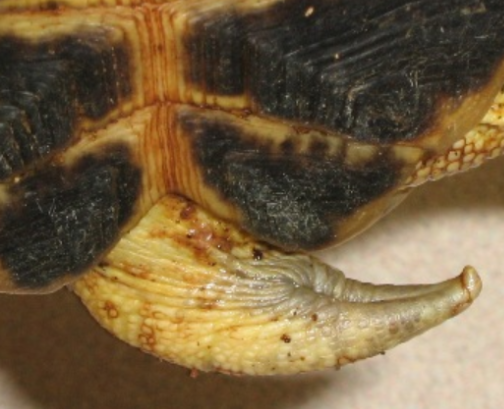
what s3x?
male

what s3x?
female
In freshwater fish, what is the main osmoregulatory challenge?
Losing too much salt
Losing too much water
Producing highly concentrated urine
Gaining excess water
gaining excess water
Why should heat mats not cover more than half of a reptile enclosure floor?
They reduce availiable UVB
The inhibit temperature gradients
They decrease humidity
They interact with water
inhibit temp gradients
Why is stocking density guidance used when setting up an aquarium?
To prevent aggression between big and small fish
To maximise the number of occupants
To reduce competition for food
To prevent overloading the biofilter
prevent overloading biofilter
Which factor is MOST important when creating a community fish tank?
Ensuring all the fish are the same size
Choosing fish which eat the same diet
Choosing fish which share water parameters
Choosing fish which swim at different levels
choose fish that share water parameters
Which of the following substrates is MOST appropriate for a high-humidity species like a ball python?
Mulch or husk
Sand
Pine shavings
Gravel
mulch/ husk
What is the main functional advantage of countercurrent exchange in fish gills?
It reduces water flow over the gills
It prevents nitrogenous waste excretion
It allows oxygen to diffuse continuously into the blood
It increases carbon dioxide excretion
allows oxygen to diffuse continuously into the blood
Why is feeding whole prey important for carnivorous reptiles?
It prevents dehydration
It prevents nutritional imbalace
It reduces feeding frequency
It improves digestive tract health
It prevents nutritional imbalace
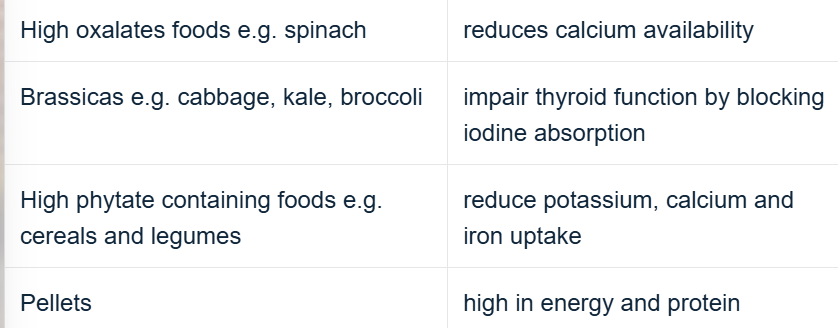
What is a key risk of feeding reptiles vegetables high in oxalates (e.g. spinach)?
Increased fat absorption
Increased protein digestion
Reduced calcium availability
Reduced thyroid secretion
reduced Ca availability