Lab 10 - Overview of Living Primates
 Call Kai
 Learn
 Practice Test
 Spaced Repetition
 Match
 Flashcards
 Knowt Play
1/17

There's no tags or description
Looks like no tags are added yet.
18 Terms
The Primate Pattern
Behavior
Most are arboreal; a few are terrestrial. Generalized diets and generalized teeth (four tooth types). Most are diurnal; a few are nocurnal. Social. Uniparous (one offspring at a time), with a slow maturation and heavy parental investment
Anatomy
Opposable thumbs and big toes for grasping. Tactile pads on the fingertips, and nails instead of claws. Forward-facing eyes for depth perception, more bone around the eyes, and color vision. Shorter snouts and reduced smell. Vision and touch are emphasized over smell and hearing. Larger brains for body size, but smaller olfactory bulbs.
Strepsirhines
Lemurs and Lorises
Postorbital bar: a bar of bone beside the eye, but the orbit is still open.
Longer snout, rhinarium (wet nose), stronger smell
Dental Comb: long, slender, forward projecting lower incisors and canines, used for feeding (scraping bark, extracting gums) and grooming
Unfused Mandible: two halves joined by cartilage at the mandibular symphysis
Mix of nails and claws; claws used for grooming
Dental Formula 2.1.3.3 (the aye-aye is an exception)
Haplorhines
Tarsiers and Anthropoids
More enclosed orbits (tarsiers) or full bony enclosure (anthropoids)
Short Snout, dry noise
No Dental Comb
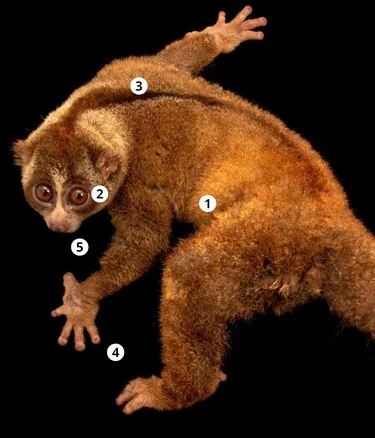
Lorises
Found in Africa and Southeast Asia. Small and Nocturnal, with large eyes and more rods. They eat many insects, usually feed alone, and come together to socialize and sleep.
Order Primates > Suborder STREPSIRHINES > Infraorder Lorisiformes > Common Species Loris
Lemurs
Found only on Madagascar, and very diverse. Some are nocturnal and insect-eating; others are diurnal and eat leaves and fruit. Ring-Tailed lemurs aare very social and fairly terrrestrial.
Order Primates > Suborder STREPSIRHINES > Infraorder Lemuriformes > Common Species Lemur

Tarsiers
Found in Southeast Asia
Like Strepsirhines: small, insect-eating, nocturnal, leaper, with a mix of claws and nails
Like Anthropoids: more enclosed orbits, no dental comb, short snout, dry noise, anthropoid-like inner ear, and greater genetic similarity.
Unique: Dental formula 2.1.3.3 on top and 1.1.3.3 on the bottom. Each eye is larger than the brain. They can turn their heads almost 180 degrees each way. They have very long legs and tarsal (foot) bones, and a fused tibia and fibula.
Order Primates > Suborder HAPLORRHINI > Infraorder Tarsiiformes > Common Species Tarsier

Anthropoids
In general, they have larger bodies and bigger brains for their size. Almost all are diurnal. They rely more on vision than smell, usually have color vision, they have full bony orbits and their eyes sit close together.
Order Primates > Suborder HAPLORRHINI > Infraorder Simiformes (Anthropoids or Simians)

Platyrrhines
New World Monkey
Central and South America
Broad Nose, nostrils face out to the sides, wide septum (“broad nosed”)
3 premolars per quadrant: 2.1.3.3 or 2.1.3.2
Some have prehensile tails that work as a fifth limb
Examples: Capuchins, howler monkeys, owl monkeys, (Aotus), the only nocutrnal genus; tamarins and marmosets, the smallest, which eat gums and insects and usually have twins
Order Primates > Suborder HAPLORRHINI > Infraorder Simiformes (Anthropoids or Simians) > Parvorder Platyrrhini

Catarrhines
Old World Monkeys and Apes
Africa and Asia
Narrow nose, nostrils face down, narrow septum (“hook-nosed”)
2 Premolars: 2.1.2.3
No Old World monkey has a prehensile tail
Order Primates > Suborder HAPLORRHINI > Infraorder Simiformes (Anthropoids or Simians) > Parvorder Catarrhines
Old World Monkeys (Cercopithecoids)
General Traits: Diurnal, usually in large groups, move on all fours
Bilophodont molars: four cusps arranged in two parallel ridges
Ischial Callosities: rough patches of skin on the buttocks
Colobines: mostly in Asia (a few in Africa, such as the black-and-white colobus). Long tails. Arboreal, leaf-eaters with complex stomachs. Examples: langurs, colobus, proboscis monkeys
Often larger and often terrestrial with short tails. More fruit in the diet, and cheek pouches. Examples: baboons, macaques
Order Primates > Suborder HAPLORRHINI > Infraorder Simiformes (Anthropoids or Simians) > Parvorder Catarrhines > Superfamily Cercopithecoidea

Monkeys vs. Apes
Apes share the Catarrhine nose and the 2.1.2.3 dental formula with Old World Monkeys. Traits that set the apes apart:
No tail. This is a shared derived trait of all apes
Y-5 lower molars: five cusps and no Y
Flatter (orthognathic) faces, while other primates have projecting (prognathic) faces.
Larger brains for the body size
Long arms and long, curved fingers, kept from there adaptation and swinging.
Nocturnal
Large eyes to take in light, more rods, and less reliance on vision. Lorises also have stronger sense of smell
Examples: lorises, some lemurs, tarsiers, owl monkeys.
Diurnal
Most primates, almost all anthropoids
Rely on vision and usually have color vision
Hylobatidae “the lesser apes”
Gibbons and Siamangs
Found in Southeast Asia. Smaller bodies and brains than other apes.
Diurnal, eat a lot of fruit, live in small groups, defend territory with “songs.”
Swing through trees more than any other primate
Smaller, Gracile bodies, even longer arms, longer more curved fingers, and very short thumbs that don’t interfere with swinging. Strong, highly mobile shoulders.
Order Primates > Suborder HAPLORRHINI > Infraorder Simiformes (Anthropoids or Simians) > Parvorder Catarrhines > Superfamily Hominoidea > Family Hylobatid > Species Gibbons and Siamangs

Teeth, in summary
Lorises and most lemurs: 2.1.3.3 The Aye-Aye has 1.0.1.3 on top and 1.0.0.3 on the bottom
Tarsiers: 2.1.3.3 on top, 1.1.3.3 on the bottom
New World Monkeys: 2.1.3.3 or 2.1.3.2
Old World Monkeys and apes: 2.1.2.3
Old World Monkey Molars are bilophodont; ape lower molars are Y-5
Orangutans have lateral incisors much smaller than their medial incisors
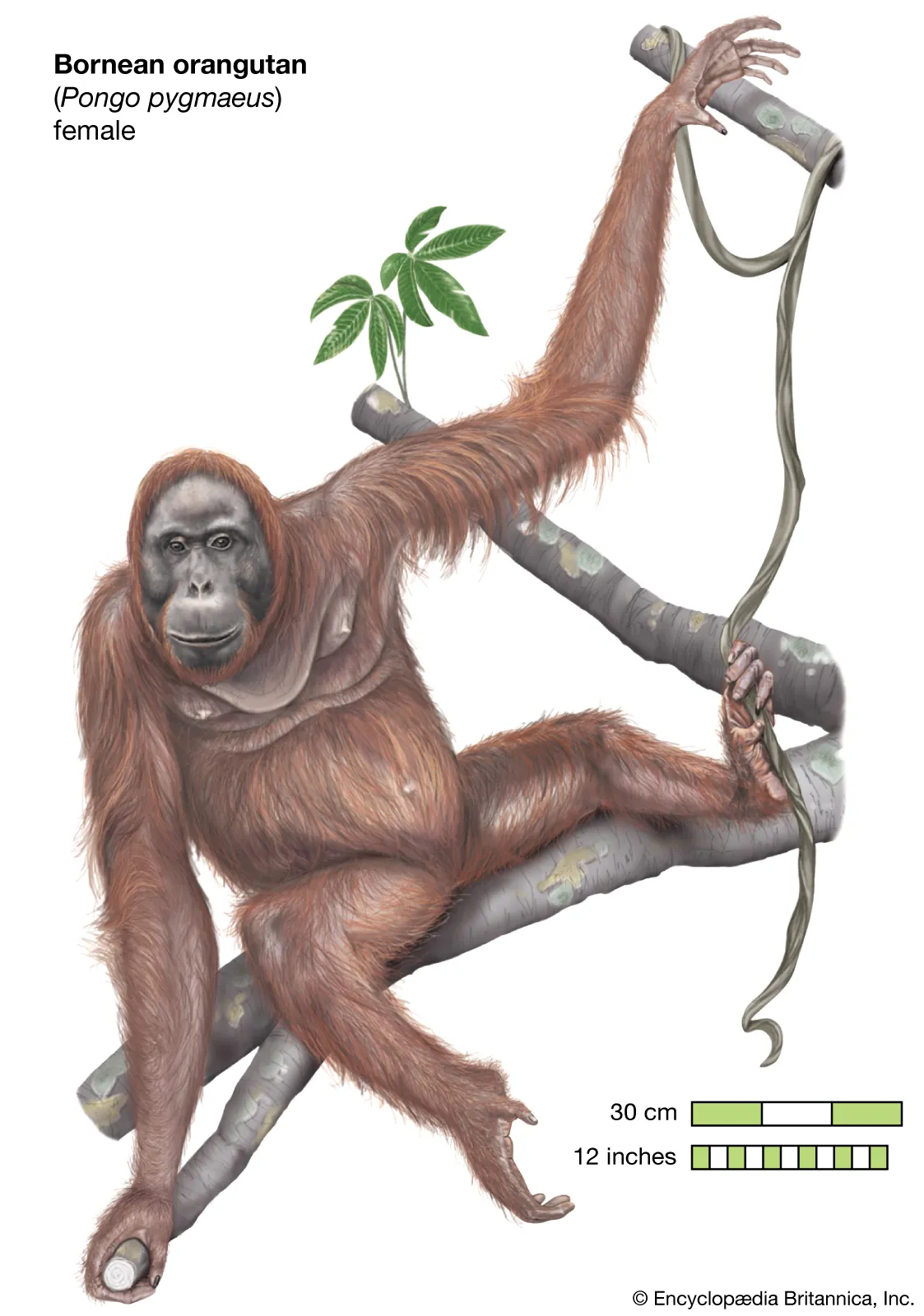
Orangutans
Borneo and Sumatra, now three species.
Dish-shaped face. Mostly Solitary
Order Primates > Suborder HAPLORRHINI > Infraorder Simiformes (Anthropoids or Simians) > Parvorder Catarrhines > Superfamily Hominoidea > Family Hominidae > Subfamily Ponginae > Common Species Orangutans
Gorillas
Equatorial Africa.
The largest primate, the most leaves in the diet, and a very robust skull.
Order Primates > Suborder HAPLORRHINI > Infraorder Simiformes (Anthropoids or Simians) > Parvorder Catarrhines > Superfamily Hominoidea > Family Hominidae > Subfamily Gorillinae > Common Species Gorillas

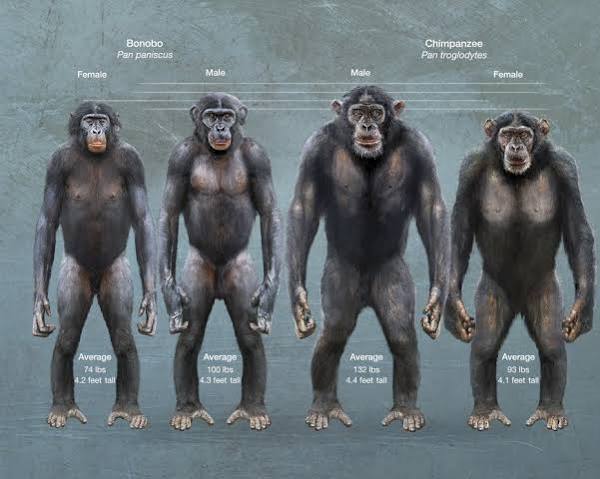
Chimpanzees and Bonobos
Separated by the Congo River
Bonobos are leaner, more arboreal, less violent and more sexual