Anti-Arrythmics
 Call Kai
 Learn
 Practice Test
 Spaced Repetition
 Match
 Flashcards
 Knowt Play
1/105

There's no tags or description
Looks like no tags are added yet.
106 Terms
Quinidine class
Class IA Na+ Channel Blocker
Procainamide class
Class IA Na+ Channel Blocker
Disopyramide class
Class IA Na+ Channel Blocker
Lidocaine class
Class IB Na+ Channel Blocker
Mexiletine class
Class IB Na+ Channel Blocker
Flecainide class
Class IC Na+ Channel Blocker
Propafenone class
Class IC Na+ Channel Blocker
Propranolol class
Class II Beta Blocker
Metoprolol class
Class II Beta Blocker
Amiodarone class
Class III K+ Channel Blocker
Dronedarone class
Class III K+ Channel Blocker
Sotalol class
Class III K+ Channel Blocker
Dofetilide class
Class III K+ Channel Blocker
Ibutilide class
Class III K+ Channel Blocker
Diltiazem class
Class IV Non-DHP Ca++ Channel Blockers
Verapamil class
Class IV Non-DHP Ca++ Channel Blockers
Digoxin class
Class V Na+/K+ ATPase inhibitor (and increases parasympathetic output to heart)
Adenosine class
Class V, A1 receptor agonist (and A2 receptor agonist)
Magnesium class
Class V (TdP treatment)
SAN and AVN are ___ fibers
slow
atria, his-purkinje, and ventricles are ___ fibers
fast
slow/funny Na+ channels affect phase ___ of slow fibers
4
LTCCs affect phase ___ of slow fibers
0
K+ channels affect phase ___ of slow fibers
3
fast/voltage gated Na+ channels affect phase ___ of fast fibers
0
LTCCs affect phase ___ of fast fibers
2
K+ channels affect phase ___ of fast fibers
3
Na+ channel blockers effect
decreased conduction velocity and decreased firing rate of myocytes
beta blockers effect
SAN: decreased firing rate
AVN: decreased conduction velocity, increased refractoriness
myocytes: decreased contractility
K+ channel blockers effect
increased refractoriness of myocytes
Ca++ channel blockers effect
SAN: decreased firing rate
AVN: decreased conduction velocity, increased refractoriness
myocytes: decreased contractility
type of arrhythmia and location of sinus bradycardia
supra-ventricular bradyarrhythmias
type of arrhythmia and location of AV blocks
supra-ventricular bradyarrhythmia
type of arrhythmia and location of bundle branch blocks
ventricular bradyarrhythmia
type of arrhythmia and location of sinus tachycardia
supra-ventricular tachyarrhythmia
type of arrhythmia and location of AF (atrial fib) and AFL (atrial flutter)
supra-ventricular tachyarrhythmia
type of arrhythmia and location of PSVT (Paroxysmal supraventricular tachycardia)
supra-ventricular tachyarrhythmia
type of arrhythmia and location of VT
ventricular tachyarrhythmia
type of arrhythmia and location of TdP
ventricular tachyarrhythmia
type of arrhythmia and location of VF (ventricular fib)
ventricular tachyarrhythmia
K+ channel blockers effect on QT, RR, and QTc
increases QT, RR stays the same, QTc increased
(QTc = QT / sqr (RR))
K+ channel blockers directly increase QT without affecting HR
beta blockers effect on QT, RR, QTc
QT increased, RR decreased, QTc stays the same
(QTc = QT / sqr (RR))
beta blockers indirectly increase QT by slowing HR
Ca++ channel blockers effect on QT, RR, QTc
QT increased, RR decreased, QTc stays the same
(QTc = QT / sqr (RR))
Ca++ channel blockers indirectly increase QT by slowing HR
MOA of Class IA drugs
moderate binding to Na+ channels → increases QRS
also block K+ channels → increases APD
also block ACh → anti-cholinergic effects
uses of Class IA drugs
rarely used because of toxicity (old school drugs)
formerly used for Afib, atrial flutter, PSVT, VT (almost everything)
what drug is a Class IA Na+ channel blocker that is rarely used due to multiple toxicities, can cause cinchonism (headache, dizziness, tinnitus), GI effects (N/V/D), has severe AEs of thombocytopenia, hepatitis, and autoimmune reactions
Quinidine
Quinidine is available as ___
PO or IV
what drug is a Class IA Na+ channel blocker that has autoimmune reactions and NAPA (an active metabolite, K+ blocker), can cause QTc prolongation
Procainamide
Procainamide is available as ___
IV only
what drug is a Class IA Na+ channel blocker that is highly anticholinergic
Disopyramide
Disopyramide is available as ___
PO only
Which is preferred out of the Class IA Na+ Channel Blockers?
Disopyramide
MOA of Class IB drugs
weak binding to Na+ channels which has no effect on QRS and decreases APD
Class IB drugs are used only for ___
ventricular arrhythmias
which class IB drug has a short half-life (IV bolus followed by infusion), levels can be monitored, and has neurological AEs (dizziness, tremor, confusion)
lidocaine
lidocaine is available as __
IV only
which class IB drug is orally absorbable and has gastric AEs (nausea, heartburn)?
Mexiletine
Mexiletine is available as ___
PO only
which of the class IB drugs could you use for AF?
none (ventricular arrhythmias only)
MOA of class IC drugs
strong binding to Na+ channels → INCREASES QRS interval
unchanged APD
may increase PR interval, decrease contractility
Class IC drug uses
ventricular and supraventricular arryhthmias
most commonly: Afib, atrial flutter
__ drugs have increased mortality in patients with CHF and CAD
Class IC (due to structural damage to heart)
which class IC drug is first line for AF in patients without structural heart disease (CHF, CAD) and has GI and CNS AEs of headache, dizziness, fatigure
Flecainide
Flecainide is available as ___
PO only
which class IC drug has beta blocker properties, is contraindicated in bronchospastic disease (asthma, COPD), and can have metallic taste
Propafenone
Propafenone is available as ___
PO only

this action potential graph represents Class ___ drugs due to ___
IA (moderate block)
increased QRS, increased APD

this action potential graph represents Class ___ drugs due to ___
IB (weak block)
unchanged QRS, decreased APD
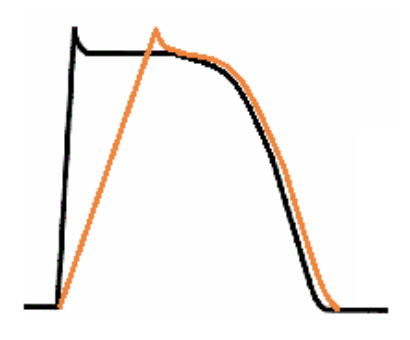
this action potential graph represents Class ___ drugs due to ___
IC (strong block)
INCREASED QRS, unchanged APD
MOA of K+ channel blockers
increases APD, increases refractoriness

this graph represents effects of class ___ drugs
III (K+ channel blockers)
what is important to consider about K+ channel blockers?
QTc prolongation (increases QTc) → increased risk of Torsades de Pointes
which class III drug has properties of all four VW classes, serious AEs (pulm fibrosis, thyrotoxicity, neurotoxicity, hepatotoxicity), lots of DDIs, and long half-life
Amiodarone
Amiodarone is available as __
PO or IV
which class III drug increases QTc and requires inpatient initiation?
Dofetilide
Dofetilide is available as ___
PO only
which class III drug has beta blocker properties; contraindicated in decompensated CHF, asthma, and COPD; and increases QTc (requires inpatient initiation)?
Sotalol
Sotalol is available as ___
PO or IV
which class III drug is contraindicated in CHF, CAD, and permanent AF; and is FDA approved for AF/AFL only?
Dronedaone
Dronedarone is available as ___
PO only
which class III drug is inpatient use only and is not a maintenance treatment?
Ibutilide
Ibutilide is available as ___
IV only
For patients with h/o CAD and CHF, what drugs can be used for rhythm control?
K+ channel blockers (not Na+ channel blockers due to increased mortality)
a 60 y/o F with h/o CAD and CHF wants long-term reduction of AF, which is the least toxic option?
Dofetilide
what to use for rate control if BP is stable?
beta blockers
Ca+ channel blockers
what to use for rate control if BP is too low?
Amiodarone
Digoxin
which med/s is/are used for rate control of supraventricular arrhythmias in unstable patients?
Amiodarone, Digoxin
MOA of Amiodarone
has properties of all four VW classes, beta blockade is responsible for rate control properties
effect of Amiodarone on BP
doesn’t significantly lower BP if dosed by slow IV infusion
MOA of Digoxin
inhibits Na+/K+ ATPase
Increases intracellular Ca++
increases contractility
baroreceptor reflex (increases parasympathetic output to heart)
effect of Digoxin on SAN and AVN
SAN: decreases firing rate
AVN: decreases conduction velocity
which IV drug(s) can decrease ventricular rate without significantly lowering BP?
Amiodarone, Digoxin
paroxysmal supraventricular tachycardia is caused by
reentry circuits within AVN, or between atria and ventricles
Adenosine is used for
acute treatment of PSVT (also as coronary vasodilator)
Adenosine is available as __
IV only
MOA of Adenosine
binds adenosine A1 receptors in SAN and AVN
A1 receptors → Gi coupled → decreases cAMP → increases K+ channels, decreases Ca++ channels
SAN: decreases firing rate
AVN: DECREASES conduction velocity
also binds A2 receptors in vascular SM
A2 receptors → Gs coupled → increases cAMP → increases vasodilation
when Adenosine given as fast IV bolus, it ___
halts AVN conduction (~ 5 seconds)
Adenosine rapidly eliminated from circulation by cellular uptake (T1/2 = seconds)
Torsades de Pointes is ___
early after depolarizations (EADs) due to increased QTc interval (K+ channel blockade, decreased K+, decreased HR) → ventricular tachyarrhythmia
often drug induced
__ is used as a treatment for TdP
Magnesium
antiarrhythmic drugs have a ___-dependent binding
state