chapter 7. 10 chem
0.0(0)
Studied by 1 person Call Kai
 Learn
 Practice Test
 Spaced Repetition
 Match
 Flashcards
 Knowt Play
Card Sorting
1/19

Earn XP
Description and Tags
20 Terms
1
New cards
kinetic molecular theory
In this theory, a gas is modeled as a collection of particles (either molecules or atoms, depending on the gas) in constant motion.
2
New cards
kinetic molecular theory explains what
s explains the gas laws and some properties of liquids and solids.
3
New cards
gas laws explain what
the gas laws state mathematical relationships describing the behavior of gases.
4
New cards
Random motion
n means that gas particles travel in straight lines in any direction until they hit something.
5
New cards
perfectly elastic collision
means the particles bounce off one another without any loss of energy.
6
New cards
Five Postulates of the Kinetic Molecular Theory
1. Gases are composed of small molecules that are in constant, random motion.
2. The volume that is taken up by the molecules themselves is insignificant compared with the overall volume occupied by the gas.
3. Forces between the molecules are negligible, except when the molecules collide with one another.
4. Molecular collisions are perfectly elastic; that is, no energy is lost when the molecules collide.
5. The average kinetic energy of the gas molecules is directly proportional to the absolute temperature of the gas.
7
New cards
inelastic collision
do not bounce off each other, crash into each other, think car wreck
8
New cards
explain how gas pressure works
Postulates 1 and 3 state that gas particles are in constant motion and are colliding with each other.
The particles must also be colliding with the walls of their containers. The force of those collisions is source of gas pressure.
The particles must also be colliding with the walls of their containers. The force of those collisions is source of gas pressure.
9
New cards
explain boyle’s law,
When the volume of this gas sample decreases, the rate of collisions of those particles with the container walls must increase.
The higher rate of collisions means higher pressure, so as volume decreases, pressure must increase
**Pressure and volume have an inverse relationship**
The higher rate of collisions means higher pressure, so as volume decreases, pressure must increase
**Pressure and volume have an inverse relationship**
10
New cards
explain charles’s law
a gas sample is at a fixed pressure and number of particles, but in an expandable container at a certain temperature.
According to postulate 5 of kinetic molecular theory, an increase in temperature causes gas particles to have more energy and move at higher speeds.
• As these faster moving particles strike the walls of the container, they cause the container to expand, maintaining a constant pressure.
**Gas expands when heated**
11
New cards
explain Avogardo’s Law
• a gas sample is at a fixed pressure and temperature, but in an expandable container that allows you to add more moles of gas.
When the number of moles of gas are increased, the rate of collisions of those particles with the walls of the container increases.
As this greater number of particles strike the walls of the container, they cause the container to expand, maintaining a constant pressure.
\
**the volume of any gas is proportional to the number of molecules of gas**
12
New cards
kinetic molecular theory formula
PV=nRT
13
New cards
• The pressure on a wall of a container occupied by particles in constant motion is the
e total force on the wall (due to the collisions) divided by the area of the wall.
14
New cards
average kinetic energy of the gas molecules depends on
average mass and velocity
15
New cards
Average kinetic energy of the gas formula
KEavg = ½NAmv^2
NA= avogardo’s number
m= mass
v= volume
NA= avogardo’s number
m= mass
v= volume
16
New cards
gases in the same container have the same _______________t__herefore they have the same___________________ _____________ ___________
temperature;
same average kinetic energy
same average kinetic energy
17
New cards
• If they have different masses, the only way for them to have the same kinetic energy is to have
different average velocities.
* –Lighter particles will have a faster average velocity than more massive particles
* –Lighter particles will have a faster average velocity than more massive particles
18
New cards
ideal gas law formula
KEavg = (3/2)RT
R= gas constant in energy units, 8.314 J/mol•K
1 J = 1 kg ∙ m2/s2
R= gas constant in energy units, 8.314 J/mol•K
1 J = 1 kg ∙ m2/s2
19
New cards
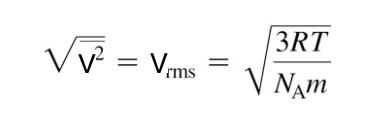
some formula idk
20
New cards
temperature vs. Molecular speed