5/6 photon interaction w matter
 Call Kai
 Learn
 Practice Test
 Spaced Repetition
 Match
 Flashcards
 Knowt Play
1/35

There's no tags or description
Looks like no tags are added yet.
36 Terms
electron beams treat… what depth of target
superficial
high energy photon treat (gamma/xray)… what depth of target
deep tagets (used for imaging)
protons treat… what depth of target
deep — minimal entrance/exit dose to healthy
describe coherent scatter

thompson vs rayleigh scatter

what energy does coherent scatter happen
LOW photon energy !!
relationship btw Z and E in coherent scatter
coherent is more probable in high-Z and low E
describe photoelectric effect

when is photoelectric effect more likely to occur (energy)
<100kev (diagnositc energy range)
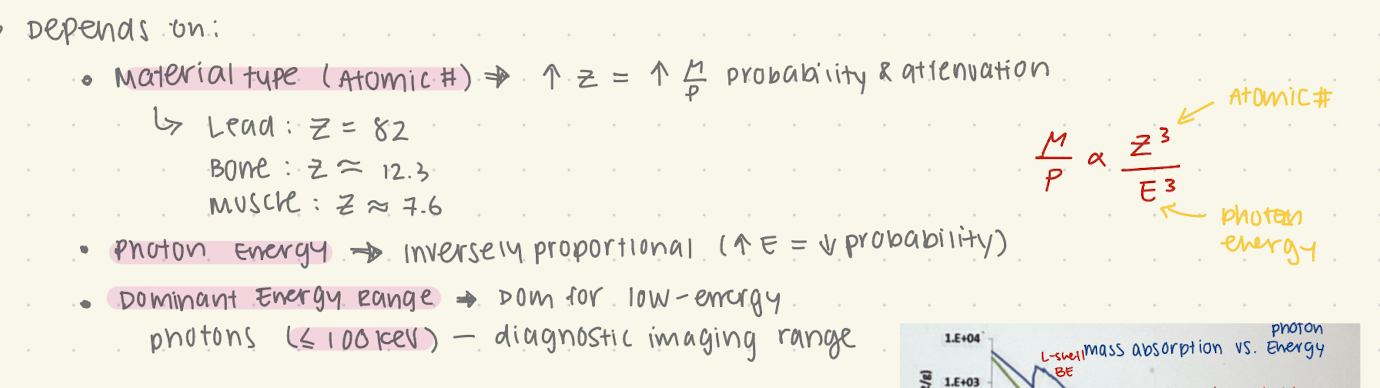
mass absorption coeff depends on…
material type (Z)
↑ Z = ↑ MAC
photon energy (↑ E = ↓ probability)
dominant energy range (<= 100kev range)
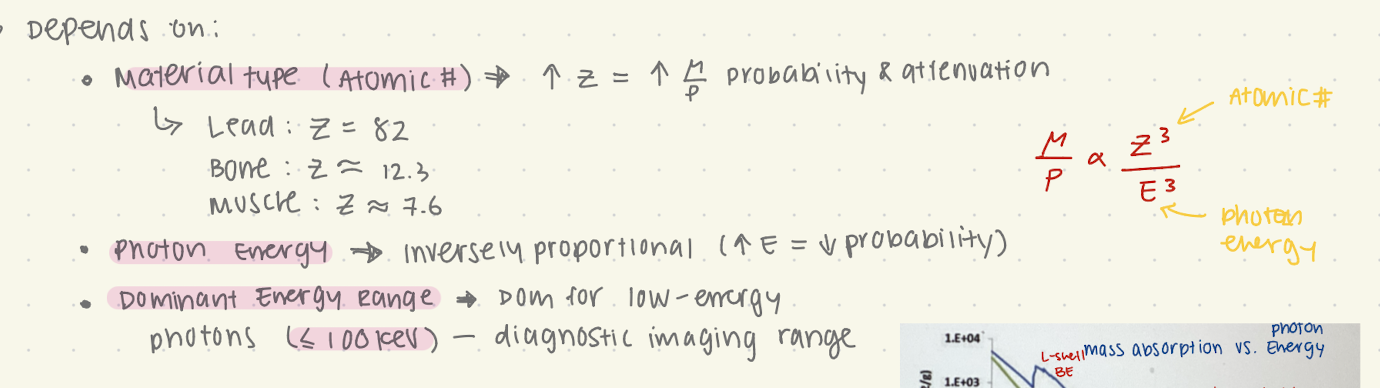
mass absorption coeff
proability of photoelectric interaction occuring
absorption edges
when incoming photon energy reaches/just exceeds exact BE of specific shell
before thres = not enough liberate e
at/after threshold = whole new shell available for e- to absorb photons (∴ ↑ mass absorption coeff)

describe compton scatter

when does compton scatter dominate
100kev-10Mev
3 sscatter scenerios of compton scatter (explain)
backscatter, side scatter, forward scatter of photon

probability of compton scatter
low Z = ↑ #e/nucleon = ↑ compton (plastic, water, tissue)
high Z = ↓ #e/nucleon = ↓ compton (bone, metal)
dominant in highish energy (100kev-10mev)
probability of direction of scatter in compton
↑ high energy = ↑ likihood of forward scatter

pair production describe

pair production probability
↑ photon energy (>1.022mev) = ↑ likihood of pp
↑ High-Z materials = ↑ probability
photonuclear reaction/photodisintegration
extremely high energy photons (>10mev) interact with atomic nucleus and cause nucleus to eject neutrons
threshold of >10Mev
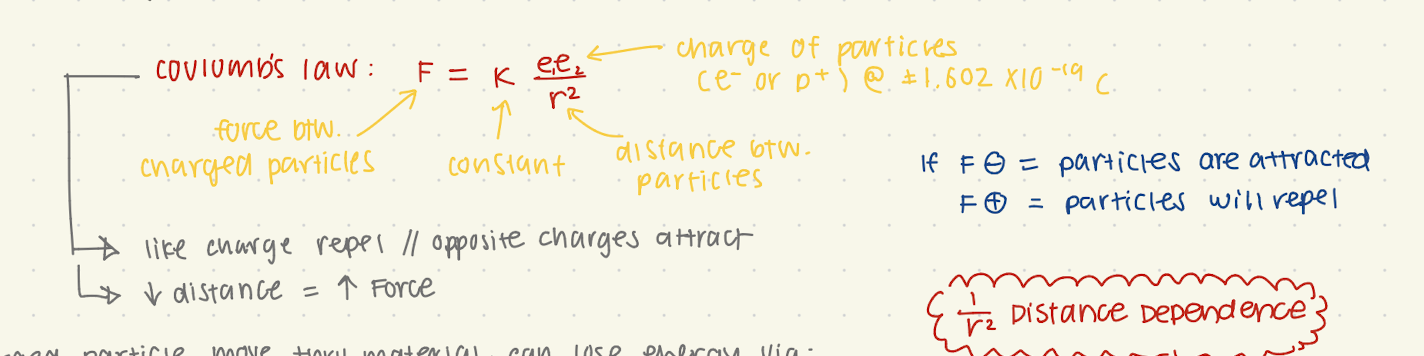
coulombs law formula
as charged particle move thru material = lose energy via..
colliosnal energy loss
radiative stopping power
describe Scoll
charge particle loses energy bc it gets transferred to orbiting e- via coulomb

describe Srad
lose energy bc of acceleration and curve and radiation as bremsstrahlung photons (

impact parameters vs canonical size
impact parameters (b) = distance from charged particle to center of atom
canonical size (a) = radius of atom
radiative loss (b<a)
‘soft’ collision (b>a)
too far, too weak to even ionize)
‘hard’ collision (b~a)
incident particle pass close to e- oribital
will transfer large energy that ejects e- from atom w high energy (delta ray)
proportional eqn for radiative stopping power
and ↑ acceleration = ↑ energy = ↑ bremsstranglung = ↑ Srad

proportionality eqn of collisional stopping power
mainly depends on electron density (#e/gram)
↑ #e/gram = ↑ frequency of coulomb interaction = ↑ energy transfer = ↑ Scollision
slight Z dependence
↑ Z-material = ↓ #e/gram = ↓ less frequent = ↓ energy transfer = ↓ Scoll
NOT strong energy dependance (radiiative stopping power only overtakes for very high energy e’s (>10mev) in high Z-matierals

is collisional or radiative energy loss applicable to energy loss in protons/heavy particles
radiative energy loss = NA
key dependencies of stopping power in heavy charged particles
NOT depend on mass
DOES depend on speed (energy)
does depend on Z/A of material
higher stopping power in proton/heavy than e-s

do photons or electrons deposit dose
only electrons (photons indirectly do..)
CSDA
continuous slowing down approximation (CSDA): avg total path length travelled by charged particle
CSDA in water (in cm) = E (in Mev)/2 cm

how does energy change neutron behaviour
low energy (thermal) neutrons
energy <0.025eV
interact via neutron capture
1) 1H ⟹ 2H + gamma photon + KE
2) 14N ⟹ 14C + free photon
3) 10B ⟹ 7Li + alpha-particle → most effective neutron sheilding*
high energy (fast) neutrons
energy >100ev
fast neutrons undergo elastic scatter

LET + unit
linear energy transfer: amt of enegry that ionizing particle transfers to material per unit distance (locally)
controlls biological damage
unit = keV/µm
low LET vs high-LET
low-LET: few keV/µm (xray, gamma, electrons)
high-LET (up to >100keV/µm) (p+, heavy ions, C, alpha-particles -
driven by Z2 of collisional stopping power ?? (high z = ↓ #e/gram = ↓ Scoll)
proportionality of LET
charge — 1/velocity — # of LET

which particles have highest RBE as LET
photons/electrons
proton
neutrons fast
carbon (heavy ion)
alpha