Week 4 - Serial Dilutions & Unknown 1
 Call Kai
 Learn
Learn Practice Test
 Spaced Repetition
 Match
Match Flashcards
 Knowt Play
1/38

There's no tags or description
Looks like no tags are added yet.
Name | Mastery | Learn | Test | Matching | Spaced | Call with Kai | Chat |
|---|
No analytics yet
Send a link to your students to track their progress
39 Terms
Serial Dilutions =
A method of diluting an unknown concentration of bacteria in a series of known volumes for the purpose of calculating the unknown concentration.
IDF:
Individual dilution factor
Volume Transferred / (Volume Transferred + Volume Present)

What does this image show?
sample serial dilution - IDF
TDF =
total dilution factor
TDF will inc as you continue diluting
IDF1 x IDF2 x IDF3 . . .

What does this image show?
sample serial dilution — TDF
CFU =
colony forming unit
unit commonly used to estimate the concentration of microorganisms in a test sample
It is an isolated group of bacteria that is theorized to have originated from a single bacterium.
The number of visible colonies (CFU) present on an agar plate can be multiplied by the dilution factor to provide a CFU/ml result.
To find the concentration of the stock solution:
CFU / (TDF x Volume)
The units will be CFU/ml
Range of viable colonies 30-300
If a plate has more than this, it is called too numerous to count (TNTC). If a plate has less than this, it is called too few to count (TFTC)

What is on this slide?
calculation example

What method is this?
pour plate

What method is this?
spread plate
Selective media:
inhibits growth of some organisms while encouraging the growth of others
Differential media:
contains indicators to expose differences between organisms
Undefined media:
contains one or more components with unknown composition
Defined media:
all components are known
Phenol Red Fermentation Test =
Used to differentiate organisms based on their ability to ferment various carbohydrates
Phenol red is a pH indicator which turns yellow below a pH of 6.8 and fuchsia above a pH of 7.4
If the organism is able to utilize the carbohydrate:
an acid by-product is created, turning the media yellow
When the organism is able to use the carbohydrate:
a gas by-product may be produced — If it is, an air bubble will be trapped inside the Durham tube — If the organism is unable to utilize the carbohydrate, gas will not be produced, and no air bubble will be formed

What does this show?
phenol red results
Bile Esculin Agar =
Bile esculin agar is a selective and differential medium which is used to identify organisms based on their ability to hydrolyze (break down) esculin.
BEA: Gram-positive bacteria other than some streptococci and enterococci are =
inhibited by the bile salts in this medium
If an organism can hydrolyze esculin:
the media will turn dark brown or black
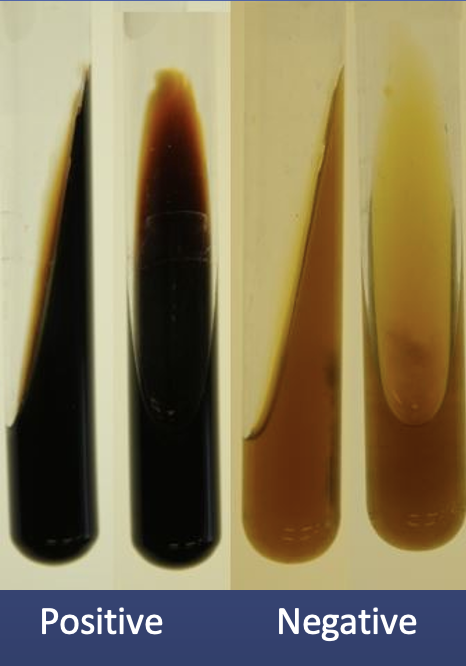
What does this show?
bile esculine agar results
Catalase Test =
Catalase is an enzyme produced by some species of bacteria
This enzyme protects bacteria from hydrogen peroxide (H2O2) that can damage and kill them
Catalase will convert hydrogen peroxide into liquid water (H2O) and oxygen gas (O2)
Testing for the presence or absence of catalase can help identify bacteria
A simple test to determine if bacteria produce catalase is to add hydrogen peroxide to bacteria

What does this show?
catalase test results
How to perform the catalase test:
Use a sterilized loop to smear a small amount of bacteria onto a glass slide.
IMPORTANT: do not use colonies from blood agar to run this test! Blood contains catalase and will give false positives.
Place a drop of hydrogen peroxide (H2O2) onto the smear.
Look for bubbles
Aerobic Bacteria =
microorganisms that grow in the prescence of oxygen
can only survive with oxygen
live in soil, water, and on different surfaces
Aerobic Bacteria =
microorganisms that grow in the absence of oxygen
live in oxygen depleted areas such as the digestive system
Obligate Aerobes =
microbes that require oxygen for growth
They cannot survive without oxygen and are typically found growing at the top of a liquid media
Facultative Anaerobes =
can grow in the presence or absence of oxygen — does not use oxygen in any metabolic processes
Microaerophiles =
survive in environments with low concentrations of oxygen.
They need some oxygen to survive, but cannot tolerate large quantities of it
Aerotolerant Anaerobes =
do not require oxygen, but they are capable of growing in the presence of oxygen
Obligate Anaerobes =
grow strictly in the absence of oxygen — Oxygen is toxic to their survival
Thioglycolate is a medium designed to test:
aerotolerance in bacteria
4 main components of Thioglycolate Medium:
Yeast Extract
Sodium Thioglycolate
Methylene Blue
Agar
Yeast extract =
nutrient source for the bacteria
Sodium Thioglycolate =
reduces O2 to water in the media
O2 + H+ → H2O (Oxygen Reduction Reaction)
Methylene Blue =
color indicator in the presence of O2
Agar =
slows oxygen diffusion through the media

What does this show?
what growth of different aerobes/anaerobes look like