Week 4: Reinforced concrete + Elasticity
 Call Kai
 Learn
 Practice Test
 Spaced Repetition
 Match
 Flashcards
 Knowt Play
1/13

There's no tags or description
Looks like no tags are added yet.
14 Terms
What are the 5 components that make up concrete, and what does each one do?
Cement: A powder substance that sets, hardens, and binds other materials together like holding concrete together
- Portland cement is the most common type of cement in general use
Water: Combining water with Cementous material forms a cement paste by the process of hydration
- Lower water to cement ratio create a stronger and more durable concrete
- Higher water gives more fluid, easier to flow concrete, but generally less durable
Aggregates: Sand, natural gravels, crushed stones are used in concrete mixture. It occupies about ¾ of concrete volume
Steel reinforcement: Concrete is strong in compression but weak in tension as the cement holding the aggregate in place can crack. That’s why reinforcing bars, steel fibers, glass fibers, or plastic fibers are used to carry tensile loads
Chemical admixture: Powder or fluids that are added to concrete to give it a certain characteristic not obtainable with plain concrete mixes. For example, modifying properties such as accelerator, pigments, bonding agents
What is slump
Slump is the decrease in vertical height of fresh concrete after slump cone is removed.
High slump: concrete is more fluid, easier workability, easier to flow and place
Low slump: Concrete stiffer, lower workability, harder to flow and place
- Adding more water can increase slump, but adding too much can decrease concrete’s durability and strength


What is compressive strength
Compressive strength tells us the maximum compressive stress that concrete can withstand before failure under compression
- compressive strength [MPa]= max compressive force [N] / cross sectional area [mm²]
Higher strength concrete can withstand greater compressive strength, after reaching its max compressive stress, concrete may lose load-bearing capacity as crushing develops
Tensile strength in concrete
Concrete tensile strength is approximately 8-15% of its compressive strength → so concrete has very low tensile strength because it’s a brittle material, containing microscopic cracks and pores that can easily open and spread when tensile force acts on it
Which is why steel reinforcements are add to concrete to resist in tensile force because steel has high tensile strength and ductility

Concrete hydration
Hydration is the chemical reaction between water and cement, allowing the concrete to harden and develop strength over time. Concrete continues to gain strength overtime at a slower rate → 28 days is used as the standard reference point for specifying and testing concrete.
Different mixes develop strength at different rates
Curing and its methods
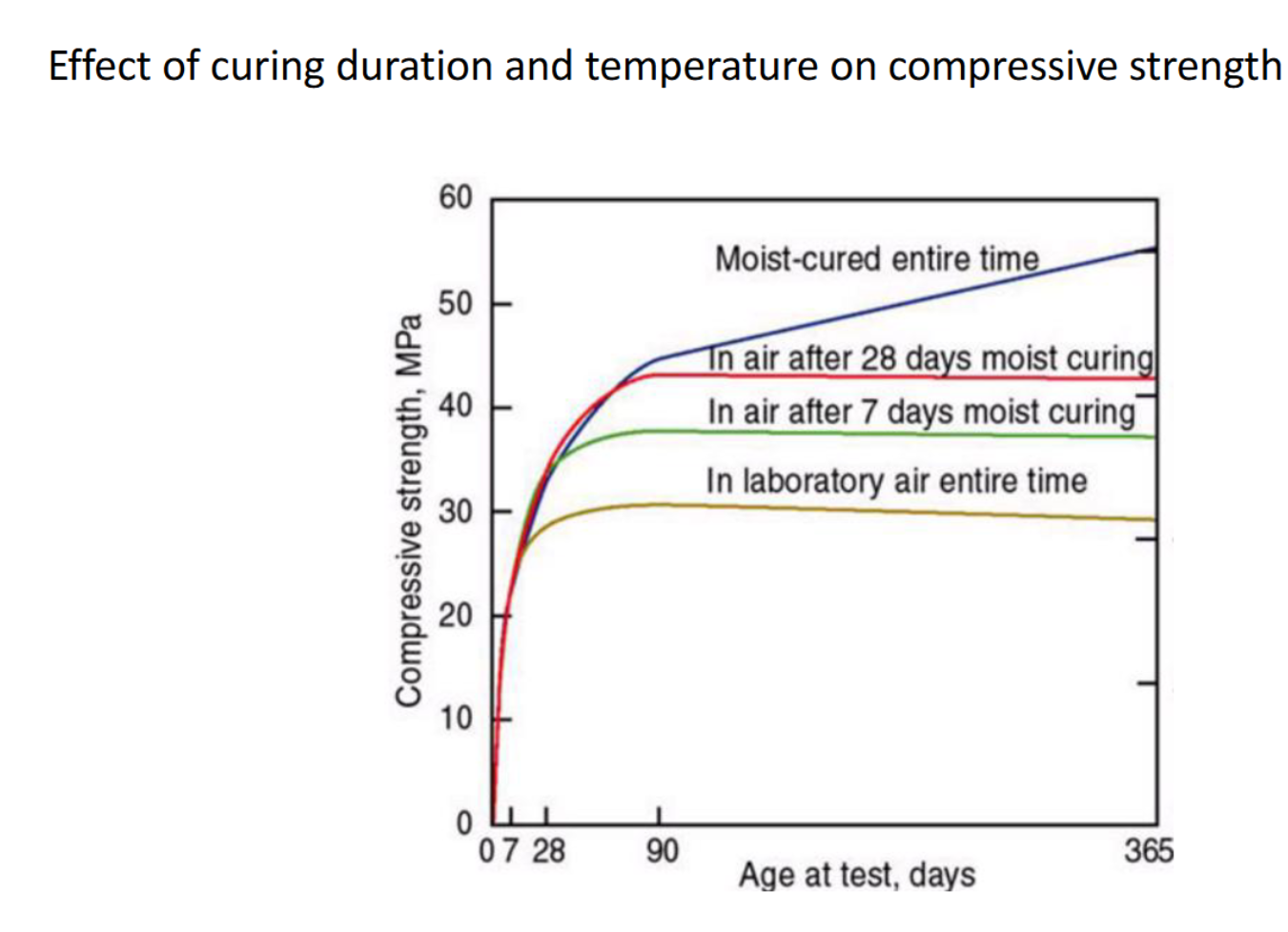
Take place immediately after concrete placing and finishing → It involves maintaining suitable moisture and temperature conditions, so that hydration can continue effectively. This process helps to increase concrete strength and durability.
1) Maintain moisture by mixing water in concrete during early hardening process
- Ponding: Keeping shallow layer of water on the concrete surface
- Immersion: Completely submerging concrete in a tank or pool of water
- Spraying or fogging
- Wet covering
2) Preventing water loss by reducing the loss of mixing water from the surface of the concrete
- Covering concrete with plastic sheets
- Applying membrane-forming curing compound
3) Accelerating strength gain using heat and additional moisture
- Heating coils
- Concrete blankets
- Electrical heated forms or pads
The graph shows that concrete that receives enough curing generally develops greater compressive strength than concrete that allowed to dry too early
Why does concrete shrink and crack
When mixing concrete and aiming for easy workability, water is used (around twice as much) than necessary for the cement and water to react (hydration). So, when the concrete has been cured and begin to dry, the excess water comes to the surface and evaporate, leading to shrinkage and cracks
Creep of concrete
Creep is the gradual increase in deformation of concrete under a sustained load overtime. Initially, the the structural member (e.g. concrete columns) would shorten a bit due to the load applied. Over months or year, when the column continues to shorten even with no additional load, eventually total deformation will usually be 2 to 3 times the initial deformation
The amount of creep, is highly dependent on the amount of stress
Elasticitiy
Elasticity is the ability for a material to return back to its original shape and size after a load is removed. For a relatively small deformation of an object., the size of the deformation is directly proportional to the deforming force → so under these conditions, the object returns to its original shape and size when load is removed
Connection of Hooke’s law and stress-strain graph
Hooke’s law describes the linear elastic region of the stress-strain graph where, stress and strain are directly proportional to each other, and the slope represents the stiffness of the material (Young’s modulus E), whereas the slope of Hooke’s law graph is the spring constant K, tells the stiffness of an object.
F=kX → stress = E x strain
Explain the effect on slump and strength when more water is added to concrete
Adding more water makes the concrete more fluid, increasing slump and workability. However, too much water can decrease the concrete strength as porosity increases.
Explain the difference between hydration, setting, hardening, and curing
Hydration: chemical reaction between water and cement, responsible for setting and hardening
Setting: fresh concrete loses its plasticity and becomes rigid
Hardening: Gradual development of concrete strength overtime due to continued hydration
Curing: Maintaining moisture content and temperature to allow hydration to continue, resulting in strength development
Distinguish drying shrinkage from creep, and structural consequences of each
Drying shrinkage: volume reduction from moisture loss as water travels to surface and escape. Restrained drying shrinkage can cause cracking because concrete is prevented from contracting freely, generating tensile stress that may exceed its tensile strength
Creep: Deformation of structural element over time under sustained stress. This can lead to long term shortening or deflection of structure
Explain the design principle “design resistance must be at least as large as design demand” and identify the role of capacity reduction factor
Design demand must not exceed reduced design capacity, otherwise the structure would fail. The capacity reduction factor reduces nominal capacity to account for uncertainties