Biochem lecture 15 (exam 3)
 Call Kai
 Learn
 Practice Test
 Spaced Repetition
 Match
 Flashcards
 Knowt Play
1/80

There's no tags or description
Looks like no tags are added yet.
81 Terms
in the cytoplasm/cytosol
where does glycolysis take place?
1 6 carbon glucose
whats the original reactant of glycolysis?
2 pyruvate
whats the final product(s) of glycolysis?
oxygen
whats the final electron acceptor in our body?
alternate pathways that branch off the glycolytic pathway; they provide essential products for the body
what are shunt pathways and whats their importance?
lipids
out of the 3 biomolecules (carbohydrates, lipids, proteins) which gives the most energy?
carbohydrates
out of the 3 biomolecules (carbohydrates, lipids, proteins) which is the quickest source of energy?
most importantly the brain needs carbohydrates to function. this is why people on keto and atkins diet may feel sick because they lack carbohydrates needed by the brain (the brain can also utilize lipids, but carbohydrates are preferred)
even though the body can use other biomolecules (lipids, proteins) as a source of energy, why is carbohydrate metabolism important?
sugar usually isn't explosive/reactive on its own, but it can be when grouped together in large amounts. same in our bodies, if we eat a small amount of carbohydrates, we'll only get a small amount of energy from it. if we eat a large amount of carbohydrates, we'll get a lot of energy.
a sugar factory exploded due to an initial spark in the factory. when sugar comes into contact with fire, it'll burn and caramelize. its usually not that reactive to the point that it explodes. what made the factory explode in regards to the sugar and what does this have to do with the energy in our bodies?
glucose
_______ is the building block of our lives and we get a lot of energy from it
when in plentiful amounts, it can be stored in a polymeric form as glycogen/starch/sucrose; can be oxidized in glycolysis to make pyruvate and undergo the rest of respiration to make energy; can be used to make structural polysaccharides for ECM and cell wall of fungi, insects, bacteria; can divert from respiration and be oxidized into PPP (shunt pathway) to make nucleotides (REVIEW)
what are the 4 different fates of glucose?
enzymatic conversion of 6-carbon glucose into 3-carbon pyruvate. 1 glucose, 2 NAD+, 2 ATP go in and make 2 pyruvate, 2 NADH, 2 H+, 2 ATP, and 2 H2O.
what is glycolysis? what are the reactants and products?
conserved
glycolysis is highly ______ in essentially all organisms (same process in all organisms), the only thing that happens differently is the regulation of the pathway and the fate of pyruvate
it doesn't require oxygen
whats different between glycolysis and the rest of cellular respiration in regards to oxygen?
preparatory and payoff phase; ATP is brought in to provide energy in the preparatory phase and energy is made in the payoff phase
there are 2 phases in glycolysis. what are they and what happens in them?
it helps keep them inside the cell (phosphates don't diffuse out), the phosphate can be transferred directly to ADP (group transfer) in the payoff phase to make back ATP, and they serve as good enzymatic handles as enzymes are favored to act on phosphorylates substrates
why do we phosphorylate the intermediates in glycolysis?
glucose is converted into glucose-6-phosphate with the enzyme hexokinase. it uses ATP to group transfer a phosphate to glucose to make glucose-6-phosphate, it is irreversible, it is the first priming step of glycolysis
explain the first step of glycolysis

yes, delta G is very negative
the first step in glycolysis has a delta G of -16.7 kJ/mol. will it proceed as written?
products of different genes that catalyze the same reaction. similar to enzymes
what are isozymes?
glucokinase
in the liver, whats the enzyme that carries out the first step of glycolysis (hexokinase reaction)?
glucokinase; low
________ carries out the first step of glycolysis in the liver. it has a ____ affinity for glucose.
the liver is what supplies the brain with glucose. if glucokinase had a high affinity for glucose, it would metabolize it into 2 pyruvate and so on. since it has a low affinity, it can send glucose to the brain as it can't metabolize it in the liver.
why does glucokinase have a low affinity for glucose?
the OH at C6 of glucose attacks gamma phosphate of ATP
how is glucose phosphorylated in the first step of glycolysis?
Mg2+
what cofactor stabilizes the negative charges of the phosphate groups in an ATP molecule?
it sort of tags glucose, marking it so the rest of the cell knows it will undergo glycolysis
why is glucose phosphorylated in the first step of glycolysis?
no, we don't need anymore energy so no more glucose needs to be phosphorylated to undergo cellular respiration. it'll instead get stored as glycogen for later use when needed
if the body has high energy already, is glucose going to be phosphorylated?
isomerization of glucose-6-phosphate to fructose-6-phosphate using the enzyme phosphoglucose isomerase (also known as phosphohexose isomerase), can proceed in either direction, involves ring opening because you can only convert aldose to ketose in the linear form via an enediol intermediate, glutamate of isomerase enzyme acts as a general base and general acid to move proton from C2 to C1
explain the second step of glycolysis

it can proceed either way
the second step in glycolysis has a delta G of 1.7 kJ/mol. will it proceed as written?
fructose-6-phosphate gets converted to fructose-1,6-bisphosphate using the enzyme phosphofructokinase-1 (PFK-1), PFK uses ATP to group transfer a phosphate on fructose-6-phosphate, its irreversible, its the second priming step in glycolysis, its the first committed step in glycolysis (at this point there's no return)
explain the third step of glycolysis
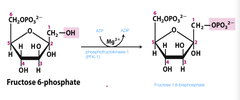
the third step of glycolysis (second priming step) is the first committed step in glycolysis, which means theres no point of return
even though the first step of glycolysis is a priming step, glucose-6-phosphate can divert from glycolysis and go into glycogenesis to make glycogen. after the second priming step, is there any chance to divert from glycolysis or is there no going back?
high amounts of ATP signal that the cell doesn't need anymore energy, so it will decrease the activity of PFK and the other glycolytic enzymes (feedback inhibition)
why does a high amount of ATP decrease the activity of PFK?
yes, delta G is very negative
the third step in glycolysis has a delta G of -14.2 kJ/mol. will it proceed as written?
fructose-1,6-bisphosphate is cleaved into dihydroxyacetone phosphate (DHAP) and glyceraldehyde 3-phosphate (G3P) using the enzyme aldolase, reversible reaction, despite the large positive delta G the reaction goes forward because the products are quickly removed by the next step, reaction requires ring opening (the DHAP ketose is removed and isomerized into G3P)
explain the fourth step of glycolysis

it lowers the Q
why does product removal of the DHAP ketose in the fourth step of glycolysis drive the reaction forward?
it can go backwards since its reversible, but since there is product removal in this step, the forward reaction is favored
the fourth step in glycolysis has a delta G of 23.8 kJ/mol. will it proceed as written?
dihydroxyacetone phosphate (DHAP) ketose is converted into glyceraldehyde 3-phosphate (G3P) aldose using the enzyme triose phosphate isomerase. this happens because an aldose is more stable than a ketose. this step is reversible. isomerization proceds via enediol intermediate
explain the fifth step of glycolysis

it can proceed either way
the fifth step in glycolysis has a delta G of 7.5 kJ/mol. will it proceed as written?
glyceraldehyde 3-phosphate gets converted into 1,3-biphosphoglycerate using the enzyme glyceraldehyde 3-phosphate dehydrogenase. glyceraldehyde 3-phosphate is phosphorylated by an inorganic phosphate (condensation reaction). this step is reversible. its the first energy-yielding step in glycolysis since the oxidation of the aldehyde with NAD+ gives NADH and phosphorylation yields a high-energy reaction product. don't forget that 2 G3P go in, so 2 products are made, and 2 NADH
explain the sixth step of glycolysis
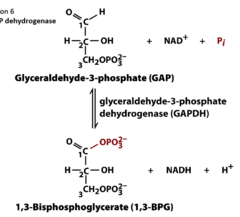
it can proceed either way, but will preferably proceed forward due to product removal of 1,3-BPG
the sixth step in glycolysis has a delta G of 6.3 kJ/mol. will it proceed as written?
1. aldehyde of G3P gets oxidized (HC=O to HO=C) which will give an electron to NAD+ to become NADH. it is a favorable reaction
2. intermediate gets phosphorylated (acyl-phosphate formation). this reaction is unfavorable
explain the 2 reactions that happen in the sixth step of glycolysis
negative
acyl-phosphate formation in sixth step of glycolysis has a highly ___ delta G'o (loaded gun), meaning it will go forward quickly
electron carrier; carries 2 electrons (as hydride ion), soluble coenzyme in many biological oxidation reactions; NAD+ is kept high in the cytoplasm/cytosol for glycolysis; and NADH is kept high in mitochondria for ETC
what is NAD+/NADH?
glycolysis will be inhibited because NADH is a high energy molecule. glycolysis also requires a molecule that can accept its electrons, hence why it needs NAD+ instead (low energy in oxidized form
if we have NADH high in the cytoplasm/cytosol instead of NAD+, what will happen?
NAD+; NADH
for glycolysis to proceed _______ needs to be kept at high amounts in the cytoplasm/cytosol, not _____
1,3-bisphosphoglycerate gets converted to 3-phosphoglycerate using the enzyme phosphoglycerate kinase. one of the phosphates on 1,3-biphosphoglycerate is added to ADP, producing ATP (2 ATP technically). this is an unfavorable reaction because adding a negatively charged phosphate to a molecule with 2 phosphates already is unfavorable. this step is reversible as it can go backwards and the phosphoglycerate kinase can add a phosphate to 3-phosphoglycerate. the formation of the products however is favorable due to its negative delta G'o. this step is a substrate level phosphorylation
explain the seventh step of glycolysis

yes, delta G is very negative. it however can also proceed backwards since PGK is a kinase
the seventh step in glycolysis has a delta G of -18.5 kJ/mol. will it proceed as written?
generation of ATP from ADP and reactive chemical intermediates using soluble enzymes
what is substrate level phosphorylation
steps 6 and 7. step 6 has a delta G'o of 6.3, so its not favorable to go forward. what helps drive it forward is quick product removal of 1,3-BPG in step 7, where the delta G'o is -18.5, so it wants to go forward
which 2 steps in glycolysis are coupled, and explain why?
3-phosphoglycerate is converted to 2-phosphoglycerate using the enzyme phosphoglycerate mutase. this enzyme shifts the phosphate from the 3 to the 2 position. this enzyme uses a phosphorylated histidine in its active site that donates a phosphate to O2 and retrieves a phosphate from O3 to regenerate itself. this basically implies that the phosphate isn't really shifted over, its swapped. this step is reversible
explain the eighth step of glycolysis

an enzyme that shifts functional groups
what is a mutase?
it can proceed either way
the eighth step in glycolysis has a delta G of 4.4 kJ/mol. will it proceed as written?
we want to get rid of one of the phosphates. when phosphates are close to each other, they repel and want to go farther. this will help one of the phosphates leave.
why do we "shift" the phosphate over in step 8 to put the phosphate closer to the other one?
it's not negative enough (delta G'o) to make ATP
we said that we "shift" the phosphate over in step 8 so they are close to each other and so that one can leave to make ATP. why is 2-phosphoglycerate not a good enough phosphate donor?
2-phosphoglycerate is converted into phosphoenolpyruvate (PEP) using the enzyme enolase, 2 water leave (dehydration reaction), this tep is reversible
explain the ninth step of glycolysis

it can proceed either way
the eighth step in glycolysis has a delta G of 7.5 kJ/mol. will it proceed as written?
phosphoenolpyruvate is converted into pyruvate using pyruvate kinase, PEP gives phosphate to ADP to make ATP (2 ATP made) (substrate level phosphorylation), reaction is irreversible, extremely energonic, will be converted into a enol form and ketol form, but ketol form is more stable and enol form will undergo product removal
explain the tenth step of glycolysis

metal cofactors (Mg2+, Mn2+)
pyruvate kinase requires _______ for activity
Mg2+
the activity of pyruvate kinase is limited by the level of _____ cofactor present
2 ATP
what is the total sum of ATP you get from glycolysis?
4 ATP
what is the amount of ATP you get from the payoff phase?
lactate and alcohol fermentation
what are the 2 anaerobic ways you can make ATP?
glycolysis runs as normal, pyruvate regenerates NAD+ with the enzyme lactate dehydrogenase to make lactate, this regeneration of NAD+ will promote more glycolysis to generate ATP. not as efficient as aerobic respiration because ETC isn't utilized.
explain lactate fermentation
its when you exercise a lot and due to that exercise your body makes lactate for energy because it has low oxygen at the moment, and protons build up and make the blood pH too acidic. This is bullshit because we're not releasing protons in the lactate fermentation pathway. We regenerate NAD+ from NADH, which is oxidized and has no proton.
what is lactic acidosis, and why is it a bullshit concept?
glycolysis runs as normal, pyruvate is decarboxylated with the enzyme pyruvate decarboxylase and cofactors TPP & Mg2+, acetaldehyde is produced, alcohol dehydrogenase makes ethanol which will regenenerate NAD+ in the process. regeneration of NAD+ will promote more glycolysis to make ATP. not as efficient as aerobic respiration because ETC isn't utilized.
explain alcohol fermenation
humans don't perform this process, only yeast and other microbes that don't/can't do lactate fermentation
humans can undergo normal cellular respiration in aerobic conditions, and lactate fermentation in anaerobic conditions. what about alcohol fermenation?
it acts as a competitive inhibitor because when it binds to G3P in the sixth step, it cannot properly generate ATP in the seventh step because theres no phosphate to perform substrate level phosphorylation. also when it hydrolyzes, it produces more free arsenate which will inhibit ATP production at a higher rate
arsenate can act as an inorganic phosphate in step 6 of glycolysis where glyceraldehyde 3-phosphate dehydrogenase converts G3P to 1,3-BPG. when arsenate is used as an inorganic phosphate in the step, it forms 1-arseno-3-phosphoglycerate, which is unstable and will quickly hydrolyze to 3-phosphoglycerate and free arsenate. why is arsenate stable?
a-amylase will hydrolyze starch and glycogen to make glucose and dextrins, dextrinate will hydrolyze dextriins to make glucose, glucose is taken up by GLUT transporters in the cell membrane (facilitated diffusion)
how can starch and glycogen be made into glucose to perform glycolysis?
phosphorylase will phosphorylate the stored starch and glycogen to make glucose-1-phosphate, phosphoglucomutase will produce glucose-6-phosphate. in this pathway we're conserving energy because we bypass the first step of glycolysis since glucose-1-phosphate is already hydrolyzed
whats another way stored starch and glycogen can be made into glucose for glycolysis?
they don't have the enzyme lactase to break down lactose, so high amounts of lactose in the body can be a problem because its now an acute product
different dietary sugars (lactose, sucrose, maltose) with the help of their respective enzymes are broken down into their respective monosaccharides (glucose, fructose, galactose) . what happens if someone is lactose intolerant?
fructose
_____ can be converted directly to fructose-6-phosphate and then fructose-1,6-bisphosphate with the help of PFK. this takes place in muscle and kidney cells with the same hexokinase that phosphorylates glucose
mannose
_____ can be converted to mannose-6-phosphate with hexokinase and then isomerized into fructose-6-phosphate with phosphomannose isomerase and the rest proceeds as expected
fructose-1,6-bisphosphate
fructose can be converted to fructose-1-phosphate via fructokinase enzyme, which will act similar to _______ and cleave into GAP (not G3P because it only has one phosphate) and DHAP via fructose-1-phosphate aldolase
It would utilize the same amount of ATP. It would utilize the same amount of ATP as well.
Mannose is going to get converted to fructose-6-phosphate with the help of hexokinase would it use
the same amount of energy as a glucose molecule? How about if I started with fructose?
no because its already phosphorylated
if starting with Fructose-1-phosphate utilize the same amount of energy as a glucose molecule starting in glycolysis?
yes
in the galactose pathway, UDP-glucose is made. is it the same as a phosphorylated compound like glucose-6-phosphate?
That glucose contains UDP which removes it from undergoing glycolysis to store it and allow the brain to use it. UDP signals that there is excess amounts of energy.
if UDP-glucose, glucose-6-phosphate, fructose-1-phosphate, etc. are phosphorylated intermediates, why would I do them differently in the cell? Is an advantage? Why use UDP to tag glucose?
galactose is taken up into cells via transporters, it then becomes phosphorylated by galactokinase, then participates in a UDP transfer reaction and generates glucose-1-phosphate, which is converted to glucose-6-phosphate by phosphoglucomutase
explain how galactose enters glycolysis
step 4 (aldolase step), step 6 (G3PDH step)
which steps in glycolysis has a large positive delta G but proceed forward because of product removal?
NAD+
_____ must be regenerated to keep glycolysis going
when you phosphorylate first (making glucose-1-phosphate) you wont have to spend energy later to convert it into glucose-6-phosphate. you'll only use a mutase to generate glucose-6-phosphate, thus energy is conserved
why is phosphorylating stored starch and glycogen more energy conserving than hydrolyzing it?
lowers
product removal drives a reaction forward because it ______ the Q