Campbell Biology Chapter 6
 Call Kai
 Learn
Learn Practice Test
 Spaced Repetition
 Match
Match Flashcards
 Knowt Play
1/62

There's no tags or description
Looks like no tags are added yet.
Name | Mastery | Learn | Test | Matching | Spaced | Call with Kai | Chat |
|---|
No analytics yet
Send a link to your students to track their progress
63 Terms
light microscopy
magnification of cellular structures up to 1000 X
scanning electron microscopy (SEM)
image of 3D surface coated with heavy metal like gold (100,000 X)
transmission electron microscopy (TEM)
image of ultra thin slice to view intracellular components (500,000 x)
cell fractionation
technique that breaks cells and separates their components
cytosol
aqueous part of cytoplasm within which particles and organelles are suspended

nucleoid
densly staining DNA region in a prokaryotic cell

chromatin
uncondensed DNA wrapped around histones (used during transcription)
chromosome
condensed chromatin (used during cell division)

nucleus
organelle that contains DNA and controls processes of cell
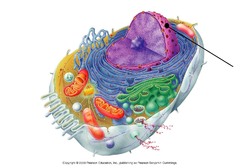
nucleolus
organelle where ribosomes are synthesized and partially assembled (within nucleus)

nuclear envelope
perforated double membrane that controls flow of materials (around nucleus)

ribosomes
organelles made of protein and rRNA that direct protein synthesis (in cytoplasm or tethered to rough ER)

nuclear lamina
netlike array of intermediate filaments that maintains shape of nucleus
endoplasmic reticulum (ER)
internal membrane system in which components of cell membrane and some proteins are constructed
rough ER
organelle continuoues with nuclear membrane, to which ribosomes are tethered and proteins are synthesized for export

smooth ER
organelle where lipids are synthesized

vesicles
small sacs surrounded by phospholipid bilayer that specialize in moving products into, out of, and within a cell

golgi apparatus
stack of membranes that modifies, sorts, and packages proteins for transport

lysosome
organelle filled with enzymes that break down chemicals

phagocytosis
when extensions of cytoplasm surround and engulf LARGE food particles

contractile vacuole
saclike organelles that expand to collect excess water and contract to squeeze it out of cell

central vacuole
membranous sac in plant cells with roles in reproduction, growth, and storage

mitochondria
organelle in all eukaryotic cells where chemical energy in glucose and fats is transformed into ATP (cellular respiration SITE)

chloroplast
organelle in plants where sunlight energy is used to synthesize glucose (photosynthesis SITE)

endosymbiont theory
states that mitochondria and chloroplasts originated as prokaryotic cells engulfed by ancestral eukaryotic cell
mitochondrial matrix
(D) internal compartment of mitochondria (Krebs cycle SITE)

cristae
(E) inner membrane infoldinfgs of mitochondria that increase surface area (Electron Transport Chain and ATP synthase SITE)

thylakoids
(C) flattened membrane sacs in chloroplast (Light Reactions SITE)

grana
(B) stacked thylakoid membranes in chloroplast

stroma
(A) innermost compartment of chloroplast (Calvin cycle SITE)

plastids
plant organelles surrounded by double membrane with their own DNA, that make and store food and pigments
peroxisomes
animal orgnalles that contain enzymes that detoxify alcohols, hydrogen peroxide, and other harmful chemicals

cytoskeleton
microscopic network of protein fibers within cytoplasm that gives shape to cell

microtubules
(bottom) thickest, hollow tubes of tubulin proteins that make up cilia, flagella, and mitotic spindle and help move organelles around cell

microfilaments
(top) thinnest, intertwined fibers of actin proteins that allow cytoplasmic streaming, ameboid movement and keep cell extensions rigid (microvilli, axons)

intermediate filaments
(middle) medium, coiled fibers of keratin that help maintain cell shape, stabilize positions of organelles

keratin
protein found in epidermis, hair, and nails
centrioles
organelles in animal cells from which mitotic spindle forms during cell division (resemble basal bodies)

mitotic spindle
microtubules that attach to centromeres through kinetochore proteins of chromosomes and pull sister chromatids apart during cell divisions

cilia
(A) short, many extensions of membrane-covered microtubules that move cell or materials past cell (ex. paramecium, trachea)

flagella
(E) long, few, whiplike tails of membrane-covered microtubules that move cells

9+2 structure
cylinder of 9 microtubule doublets around a 1 doublet (make up cilia, flagella, mitotic spindle)

basal body
star of 9 microtubules triplets that anchors cilia and flagella in membrane (resembles centrioles)

dyneins
proteins that connect microtubules in the 9+2 structure AND attach organelles to microtubules; when they contract, flagella/cilia move AND organelles "walk"
cytoplasmic streaming
circular flow of cytosol using myosin and actin filaments that speeds up distribution of materials within cells
cell wall
strong supporting layer of cellulose, chitin, or peptidoglycans around cell membrane in plants, fungi, or bacteria

middle lamina
(A) thin layer of adhesive extracellular material (pectins) between primary walls of adjacent young plant cells

primary cell wall
(B) thin, flexible and furthest out because it is secreted first

secondary cell wall
(C) strong, durable matrix added between plasma membrane and outermost structure for structure and support

extracellular matrix (ECM)
substance in which animal cells are embedded, consisting of proteins and polysaccharides

peptido/proteo-glycans
small core proteins with EXTENSIVE carbohydrate chains found in bacterial cell walls and animal ECM

glycoproteins
transmembrane proteins with SHORT carbohydrate chains that identify the cell
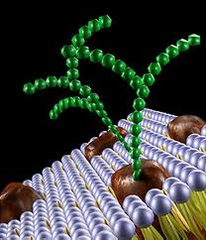
fibronectin
a glycoprotein that helps cells attach to extracellular matrix
integrins
transmembrane proteins that connect both to outside extracellular matrix and inside cytoskeleton of animal cells.

plasmodesmata
(2) openings in plant cell walls through which strands of ER and cytosol connect adjacent cells

gap junctions
(C) cytoplasmic channels between adjacent animal cells that allow movement of materials

tight junctions
(A) membrane fusions of neighboring cells that prevent leakage of fluid between them

desmosomes
(B) anchoring junctions that prevents cells subjected to mechanical stress from being pulled apart

microvilli
finger-like extensions of cells that increase surface area to increase absorption (ex. small intestine)

prokaryote
unicellular organism without nucleus and membrane bound organelles (archea and bacteria)

eukaryote
cells with nucleus and membrane bound organelles

psuedopodia
temporary projections of eukaryotic cell membranes or unicellular protists in direction of movement
collagen
fibrous protein found in connective tissues and ECM