RAD 350 EXAM 3 Study Guide
 Call Kai
 Learn
 Practice Test
 Spaced Repetition
 Match
 Flashcards
 Knowt Play
1/77

There's no tags or description
Looks like no tags are added yet.
78 Terms
What is Attentuation
Reduction in the total number of x-ray photons (intensity) remaining in the beam after going through tissue
Are X-rays reduced fully or by a percentage for each given thickness they pass through?
X-Rays are reduced by a PERCENTAGE for each given thickness they pass through
If the patient is thicker, does the attenuation increase or decrease?
Increases attenuation
How does atomic number affect attenuation?
Higher-atomic-number materials attenuate a greater percentage (such as lead and barium)
Lower-atomic-number materials attenuate a lower percentage (such as hydrogen, carbon and oxygen)
Describe differential absorption
The difference between the X-Ray photons that are absorbed PE and those that penetrate the body
What does differential absorption help to control?
- contrast (variations in the shades of gray) of the image
- the process of image formation
How is differential absorption affected when kVp is reduced?
Differential absorption increases as the kVp is reduced
What factors do Differential absorption and attenuation of the X-ray beam depend on?
- The atomic number of the atoms in tissue
- The mass density of tissue
- The X-ray energy
Describe Direct Transmission
The incoming X-Ray photon passes through the anatomic part without any interaction with the atomic structures
What occurs in Compton Scattering?
1. Ionization occurs (unstable)
- incident photon interacts w/ OUTERSHELL electron and ejects it
2. Secondary characteristic cascade may occur creating secondary photons
3. Compton e- can have interactions (photoelectric interaction)
4. Compton scatter photon can have interactions

At what energy range does Compton scattering occur?
20-40 keV (Moderate Energy)
How is Compton scattering affected by kVp?
Increases @ high kVp
Decreases @ Low kVp
What is the primary interaction in diagnostic imaging
Compton Scattering
How does Compton scattering affect the image
Reduces image contrast (grayscale), adds noise, and provides no useful information
What interaction results in the occupational workers' greatest hazard?
Compton Scattering
How is PE affected by kVp?
- Decreases with higher energy x-rays (high kVp)
- Increases with lower energy x-rays (low kVp)
When does the Photoelectric Effect occur?
when the energy of the incident photon is slightly greater than the binding energy in the inner shell (K or L)
What occurs in the Photoelectric Effect?
- X-ray is totally absorbed when an incident x-ray removes an electron
- The inner shell gives all of it's energy to the electron and the atom responds by ejecting a photoelectron (from K or L)
- Photoelectrons have a negative charge and ionize atoms in their path, have a low energy
- Characteristic x-rays are produced after the interaction (low energy and are locally absorbed)

What energy range does PE occur at?
20-120 kVp
What causes the probability that an X-ray will undergo PE interactions?
Atomic # of the irradiated tissues
What interaction is the greatest hazard to the patient
Photoelectric Effect
What occurs in classical interactions?
(Classical, Thomson, Coherent)
X-Ray photon interacts with an orbital electron and changes direction (but doesn't lose energy)

Can classical interactions cause patient dose?
- can lead to a small amount of patient dose
- Little importance to diagnostic imaging
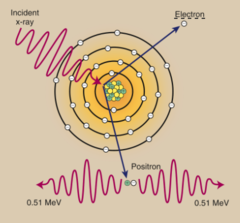
What occurs in Pair Production?
Incoming x-ray photon interacts with the nucleus and converts into a negatron and positron
The energy of the photon is transformed into
a negatron (ordinary electron)
- loses its kinetic energy by exciting and ionizing atoms in its path
a positron (positively charged electron)
- Positron is antimatter that acts destructively with a nearby free electron
What occurs in photodisintegration?
High energy photon collides with the nucleus of an atom, which absorbs all the energy & ejects a nuclear particle
- Creates an instability that is alleviated by the emission of a neutron or another nuclear fragment by the nucleus
- Made the nucleus radioactive

Describe Entrance Skin Exposure
The skin dose of radiation as the beam enters the patient
What is ESE's relationship to dose?
Which exams are given the highest ESE?
L-spine, pelvis and hip and abdomen have highest ESE
- Special attention should be given to positioning and technical factors so repeats can be reduced
Why is it important to understand ESE?
- to approximate patient exposure because it is safer to assume a maximum effect when attempting to minimize exposure to ionizing radiation
- Diagnostic radiography is the greatest source of ionizing radiation exposure for the public
What are Prime Factors?
Factors that directly affect x-ray quantity and/or quality of x-ray emission
Under the direct control of the
Radiographer
mAs, kVp, & Distance
What is X-ray quantity?
Measurement of the # of X-ray Photons in the useful beam
How is X-ray quantity measured?
- Measured in milligray in air (mGya) or milliroentgen (mR)
- Number of ion pairs produced in air by a quantity of X-rays
What is X-Ray Quantity also called?
Aka - X-ray Output, Intensity, Exposure
What influenced X-Ray Quantity?
mAs
kVp
Distance
Filtration
What is the relationship between x-ray quantity and mAs?
X-Ray quantity is directly proportional to mAs
- When mAs is doubled, the quantity is doubled
What is x-ray quality?
Measurement of the penetrating ability of the x-ray beam
- Penetrability is the distance an x-ray beam travels in matter (high energy x-rays travel farther)
How is X-ray quality measured?
half value layer (HVL)
- The HVL of an x-ray beam is the thickness of absorbing material necessary to reduce the x-ray intensity to half of its original value
- HVL of diagnostic x-ray is 3-6 cm of soft tissue
What is X-ray quality also called?
Penetrability
What is X-ray quality affected by?
kilovoltage (kV) and filtration
What is X-ray quality's relationship to kVp?
Higher kVp (kilovoltage peak) increases X-ray beam quality by producing higher-energy photons
- improves penetration and exposure but decreases contrast
Describe the Half Value Layer
The thickness of absorbing
material necessary to reduce the x-ray intensity to half of
its original value
- HVL of diagnostic x-ray is 3-6 cm of soft tissue
Describe the 15% rule
An increase in kVp by 15% will cause a doubling in exposure
- The same as doubling the mA or doubling the exposure time
- Inversely, a reduction in kVp by 15% exposure by one-half
- Decreasing the kVp by 15% should be accompanied by doubling themAs
What is subject contrast resolution?
Visibility of detail from clear white through various shades of gray to black
What is needed for appropriate penetration so that enough gray tones exist on an image?
Sufficient kVp
kVp - Saturation
What is the Law of Reciprocity? (mAs)
Numerous possible settings can all yield the same exposure
ex.
50mA x 0.2=10 mAs
100mA x 0.1= 10 mAs
200mA x 0.05= 10 mAs
What is the primary controller of image receptor exposure?
mAs is the primary controller
Why is image receptor exposure important?
If the image falls above or below these values, the image is under- or over-exposed and needs to be repeated
How does mAs affect image receptor exposure?
- Insufficient mAs will result in an underexposed image(grainy)
- Excessive mAs will result in an overexposed image
mAs - Quantum mottle /Grainy image
Increase in mAs - Decreases Quantum Mottle (less grainy)
Decrease in mAs - Increases Quantum Mottle (more grainy)
What does the Exposure Maintenance Formula state?
- As the distance increases, intensity decreases, and there is a decrease in IR exposure
- The formula can be used to compensate for the effect that
changes in distance will have on the image receptor exposure of
the radiographic image
What's the relationship between distance and mAs & kVp
As distance increases, intensity & IR exposure decrease
mAs can be adjusted to compensate for changes in distance
Increasing SID requires a higher mAs, and increasing kVp allows for a lower mAs to be used, which can reduce patient dose.
Describe the relationship between distance and the inverse square law
As distance increases, the intensity decreases rapidly
if you double the distance, the intensity becomes one-fourth
as strong
Describe the Exposure Latitude
The range of exposure values to the receptor that produce an acceptable range of densities for diagnostic purposes and are consistent with exposure rates ALARA
Review Attenuation
a. Photoelectric Effect & Compton Scatter
Understand Differential Absorption
a. Photoelectric Effect + Direct Transmission
Describe how air in the body Attenuates
Lowest attenuation.
- Air has a very low density and atomic #
- X-ray photons pass through it with very little interaction.
Shows up Black.
- Areas with air, such as the lungs, appear black on an X-ray image because IR received a high number of unattenuated X-ray photons.
Describe how Fat in the body Attenuates
Low attenuation.
- Denser than air but less dense than muscle and water,
- elements have low atomic #. This results in relatively low X-ray attenuation.
Shows up Dark gray
- darker shade of gray compared to muscle tissue.
Describe how Muscle in the body Attenuates
Moderate attenuation.
- Muscle is primarily composed of water and has a higher density and effective atomic # than fat.
- Attenuate X-rays more than fat.
Shows up Medium gray.
- denser than fat, muscle appears as a lighter shade of gray on an image.
Describe how Bone in the body Attenuates
Highest attenuation.
- Has the greatest density and highest effective atomic #
- As a result, it absorbs a much greater percentage of X-rays than soft tissues.
Shows up White.
- The high attenuation causes very few X-ray photons to reach the detector.
What are the factors that contribute to scatter production
• Increased kVp
• Increased x-ray field size
• Increased body part thickness (irradiated material)
What is Scatter Radiation?
X-Rays scattered back in the direction of the incident x-ray beam
- result in ionization and loss of energy
- produced during a Compton interaction
How does scatter affect an image
Produces noise, reduces image contrast resolution, and makes the image less visible
What is remnant radiation (exit radiation, remnant beam, exit beam)?
When the attenuated X-Ray beam leaves the patient, the remaining X-Ray beam
- Composed of transmitted and scatter radiation
- varying amount of transmitted and absorbed radiation (differential absorption) create an image
What are additive conditions?
A disease that causes the affected body tissue to increase in thickness, effective atomic number, and/or density
With an additive condition, what occurs to the X-ray beam?
Will be a greater attenuation of the x-ray beam
- More photons are absorbed, less reach the IR
- Additive conditions make it harder to penetrate because they require increasing technical factors to achieve proper exposure
- As diseases worsens (increases) IR exposure decreases
How would you modify your technique to compensate for additive conditions?
- An increase in 5-15% kVp will compensate for most pathological changes
-AEC systems will accommodate by changing mAs automatically
What are Destructive Conditions?
A disease that causes the affected body tissue to decrease in thickness, effective atomic number, and/or density
How does destructive conditions affect imaging?
- There will be less attenuation of the x-ray beam
- More photons pass through the body tissues, more photons reach the IR
- Easier to penetrate
- Require a decrease in exposure factors
- As disease process worsens (increases) IR exposure increases
What specific diseases are additive and which are destructive?
What is the equation to Find the kinetic energy of a photoelectron?
Ei = Eb + Eke
Ei - Energy of incident
Eb - Binding energy
Eke - KE of photoelectron
What is the equation to find the energy of a scattered photon?
Ei = Es + (Eb + Eke)
Ei - Energy of incident
Es - Energy of Scattered X-Ray
Eb - Binding energy (Orbital)
Eke - KE of Compton e-
What is the equation to calculate Entrance Skin Exposure (ESE)?
Dosimeter reading / ESE = SSD^2 / SID^2
or
ESE = DOSI x (SID/SSD)^2
How do you calculate HVL
...
How do you calculate the Law of reciprocity
mA x s = mAs
15% RULE
If mAs 2x - Decrease kVp by 15%
If mAs 1/2 - Increase kVp by 15 %
What is the equation for inverse square law?
I1/I2=D2^2/D1^2
or
I2 = I1 x (D1/D2)^2
What is the exposure maintenance formula?
mAs1/mAs2 = D1^2/D2^2
or
mAs2 = mAs1 x (D2/D1)^2