Foundations II Exam #1
 Call Kai
 Learn
Learn Practice Test
 Spaced Repetition
 Match
Match Flashcards
 Knowt Play
1/101

There's no tags or description
Looks like no tags are added yet.
Name | Mastery | Learn | Test | Matching | Spaced | Call with Kai | Chat |
|---|
No analytics yet
Send a link to your students to track their progress
102 Terms
What are the 6 parts of the Patient/Client Management Model (P/CMM)?
examination
evaluation
diagnosis
prognosis
intervention
outcomes
What are the important parts of the examination section of the P/CMM?
history
systems review
tests & measures
What are some of examples of the specific information recorded in the examination section of the P/CMM?
HPI (hx of present illness) / CC (chief complaint)
pain assessment (if relevant)
medical/surgical hx
social hx (family/roommates, home setup)
current functional status (home, work, recreation)
pt goals
What information would you want to know when doing a pain assessment?
onset (length of sxs, precipitating factors)
location (initially vs. now, does it travel?)
aggs & eases (positions, activities, etc.)
intensity (pain scales… VAS, NPRS)
descriptors (sharp, burning, aching, etc.)
associated sxs (neurological signs)
What are some examples of things that could be recorded during your tests & measures?

What are the different parts of a physical therapy diagnosis?
participation restriction (work, social event, athletics, role)
activity limitation (actual activities… running, jumping, walking)
impairment (msk related… bones, lig., sensations)

What is an example framework for a physical therapy diagnosis?
Patient presents with [relevant impairments] that limit/restrict the patient’s ability to [functional limitations/activities] and participate in [participation restrictions]. {Signs and symptoms consistent with [suspected pathology/medical diagnosis].}
![<p>Patient presents with <strong><em>[relevant impairments]</em></strong> that limit/restrict the patient’s ability to <strong><em>[functional limitations/activities]</em></strong> and participate in <strong><em>[participation restrictions]</em></strong>. <em>{Signs and symptoms consistent with [suspected pathology/medical diagnosis].}</em></p>](https://assets.knowt.com/user-attachments/43084bc1-2dbf-4d01-801e-0af4a8ad5a85.png)
What is a prognosis?
predicts the potential for, & optimal level of, improvement & the timeframe needed to get there
categories: excellent, good, fair, poor
What is the difference between anticipated goals and expected outcomes?
anticipated goals: short-term goals, stepping stones to reach expected outcomes, can involve impairments but should be linked to function
expected outcomes: long-term goals, what the pt will do by the end of POC, must be functional, should include pt’s own goals
What is the purpose of setting goals?
provides a target for the pt
help measure progress & plan interventions
establishes timeframe & communication w/ others
justify the need for “skilled” care
What are SMART goals?
specific - what function you what to see
measurable - a way to quantify results
achievable - is the goal even possible
realistic - will pt factors allow result to occur
timely - a time frame to see results
What is the purpose of a screening?
recognize the need for a medical referral/consultation to another healthcare professional
determine if sxs are mechanical in nature → if hx, MOI and/or findings c/w msk or neuromuscular dysfunction
What’s the difference between a PT diagnosis and a medical diagnosis?
medical: identification of disease, pathology, or injury
PT: identification of movement impairments or limitations of function/QoL
What are the different categories of a PT diagnosis?
musculoskeletal
neuromuscular
cardiopulmonary
integumentary
What are the different levels of arousal?
alert - awake, eyes open, attentive
lethargic - sleepy, slow response, inc. arousal from stimuli
obtunded - difficult to awaken, max. stimuli to inc. arousal
stupor - strong (noxious) stimuli to maintain consciousness
coma - unable to arouse/actively participate
What questions would you ask to examine a patient’s orientation?
person - what’s your name
place - where are you
time - what’s today date
event - why are you here
What sensation are superficial exteroceptors responsible for?
superficial sensation from cutaneous/subcutaneous tissue
pain, light touch, temperature, pressure
What receptor is responsible for light touch, temperature, and pressure?
superficial exteroceptors
What sensation are deep interoceptors responsible for?
deep sensation from viscera & blood vessels
What sensation are proprioceptors responsible for?
external stimuli from muscles, tendons, ligaments, joints, fascia
position sense, awareness of joints at rest, kinesthesia (proprioception)
What receptor is responsible for proprioception and positional awareness?
proprioceptors
What are some examples of combined cortical sensations?
stereognosis
two-point discrimination
tactile localization
What are some examples of proprioceptors?
free nerve endings
ruffini endings
pacinian corpuscles
golgi tendon organs

What sensation are free nerve endings responsible for?
mechanical changes in joints (movement, compression)
What sensation are free Ruffini endings responsible for?
encapsulated nerve endings → respond to joint position & slow, sustained stretching
What sensation are Pacinian corpuscles responsible for?
rapidly adapting → detect high-frequency vibrations & joint pressure changes
What sensation are Golgi tendon organs responsible for?
alterations in joint tension & force
What is stereognosis?
the ability to recognize the 3D shape of an object by touch alone
What is two point discrimination?
the ability to distinguish between two separate points of stimulation on the skin
What is tactile localization?
the ability to identify the precise location on the body where a touch, pressure, or pain stimulus is applied (superficial exteroceptors)
What is a reflex arc?
neural pathway that controls a reflex, bypassing the brain for faster processing
What are the different levels of reflexes?
0 absent
1+ diminished response
2+ normal
3+ brisk/more reflexive than normal
4+ very brisk/hyperreflexive
What is Babinski’s sign?
a plantar reflex elicited by a light stroke applied to the plantar side of the foot
normal → great toe flex.
abnormal → great toe ext./fanning of toes

What are the components of a UQS/LQS?
postural assessment
AROM
dermatomes
myotomes
reflexes
What are movements are tested for AROM in an UQS?
cervical flex./ext.
cervical side bending
cervical rotation
What are movements are tested for AROM in an LQS?
lumbar flex./ext.
lumbar side bending
lumbar rotation
What dermatomes are tested for an UQS?
C4 - T2

What is the dermatome for C4?
over trapezius - ridge of the shoulder

What is the dermatome for C5?
lat. brachium to elbow

What is the dermatome for C6?
lat. forearm/elbow to lat. ½ of hand (1st & 2nd digits)

What is the dermatome for C7?
lat. arm - 3rd digit

What is the dermatome for C8?
med. ½ of hand (4th & 5th digits) to med. elbow

What is the dermatome for T1?
med. elbow to brachium

What is the dermatome for T2?
med. side of upper arm to axilla region

What dermatomes are tested for a LQS?
L2 - S1

What is the dermatome for L2?
ant. mid thigh

What is the dermatome for L3?
ant. med. distal thigh

What is the dermatome for L4?
med. 1st digit, anteromed. calf

What is the dermatome for L5?
lat. calf (big toe web-space)

What is the dermatome for S1?
lat. foot

What is the myotome for C1/2?
cervical flex. & ext.

What is the myotome for C3?
cervical lat. flex.

What is the myotome for C4?
shoulder elevation

What is the myotome for C5?
shoulder abd.

What is the myotome for C6?
elbow flex. & wrist ext.

What is the myotome for C7?
elbow ext. & wrist flex.

What is the myotome for C8?
digit flexion & thumb ext.

What is the myotome for T1?
finger abd.
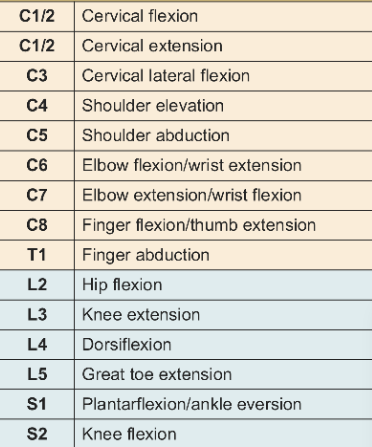
What is the myotome for L2?
hip flex.

What is the myotome for L3?
knee ext.

What is the myotome for L4?
dorsiflex.

What is the myotome for L5?
great toe ext.

What is the myotome for S1?
plantflex. & ankle eversion

What is the myotome for S2?
knee flex.

What tendons are tested for reflexes during an UQS?
biceps (C5 - C6) → elbow flex.
brachioradialis (C6) → elbow flex.
triceps (C7) → elbow ext.
What tendons are tested for reflexes during a LQS?
patellar (L3 - L4) → knee ext.
achilles (S1 - S2) → plantarflex.
What are some coordination assessments?
point-to-point: alternate nose → examiner’s finger
rapid alternating movements: rapidly alternate pronation & supination on thighs as fast as possible (heel-to-shin for LE)
What are different levels of abnormal tone?
flaccidity: dec. resistance, limp
spasticity: velocity-dependent inc. resistance, non-newtonian
dystonia: erratic volitional movements, spasms
rigidity: resistance throughout ROM, stiff
What are the three components of pain?
discriminative: ability to detect & define pain
affective: emotions associative w/ pain
cognitive: how the brain processes pain
What are the different neurophysiological pain mechanisms?
nociceptive
peripheral neuropathic
nociplastic
What is the pain pattern of nociceptive pain?
localized to area of injury/dysfunction
mechanical/anatomic in nature
pain w/ movement, dull/throbbing at rest
What treatments does nociceptive pain respond well to?
posture education
muscle stretching & joint mobilization
muscle strengthening & motor control exercises
What is the pain pattern of peripheral neuropathic pain?
dermatomal/cutaneous distribution
associated w/ hx of n. injury or pathology
pins & needles, burning/freezing, tingling, shock
What is nociplastic pain?
hypersensitive NS response → overactive pain pathways, can’t regulate pain signals
chronic pain cycle → inc. activity in pain centers leads to worsening sxs over time
How do nociceptors transmit pain signals?
via A𝛿 or C fibers
What’s the main difference between A𝛿 and C fibers?
A𝛿 : myelinated, localized → rapid, sharp response
C : unmyelinated (slow), poor localization → slow, dull response
What are the timeframes that differentiate acute and chronic pain?
acute → <2 weeks
chronic → >3 months
What is fear-avoidance?
exaggerated fear of reinjury/inc. pain from movement → can be more disabling than initial pain/injury

What is pain persistence?
denial/ignoring of pain → don’t want to accept functional limitations

What is the SINSS construct in pain assessment?
severity - intensity, impact
irritability - aggravation vs. ease
nature - type/quality
stage - acute/subacute/chronic
stability - progression of sxs over time
What are the different levels of irritability (SINSS) during a pain assessment?
minimal: 2:1 aggravating to easing/rest
moderate: 1:1 aggravating to easing/rest, moderate activity levels, can return to sleep in <30 min of changing positions
maximal: 1:2 aggravating to easing/rest, very little activity, frequently interrupted sleep needing >30 min to return to sleep
What are the different natures (SINSS) of pain?
mechanical/inflammatory nociceptive (aching)
neurogenic (burning)
central (nociplastic)
viscerogenic (organ or referred)
autonomic (ANS dysfunction)
affect (pt characteristics & pain management)
What determines a measurement’s reliability?
when it is consistent time after time w/ as little variation as possible
What is test-retest reliability?
consistency of repeated measurements separated in time w/ no changes in measured values
What is inter/intra-rater reliability?
inter-rater: degree measurements by multiple therapists will be consistent
intra-rater: degree measurements by the same therapist will be consistent
What determines a measurement’s validity?
degree to which a meaningful interpretation can be inferred from a measurement
ex. NPRS → good for pt pain, bad for function levels
What is a floor effect?
limitation of a measure b/c the instrument can’t detect a further dec. in score
ex. giving 5th graders a calculus exam, everyone will fail
What is a ceiling effect?
limitation of a measure b/c the instrument can’t detect a further inc. in score
ex. giving math majors an algebra exam, everyone will get 100%
What is a minimal detectable change (MDC)?
the smallest amount of change that can be detected by a measure that corresponds to a change in ability
What is a minimal clinically important difference (MCID)?
the smallest amount of change that is considered important by the pt or clinician
What is clinical utility?
the extent to which the test or measure is useful in yielding data needed for the situation (how relevant the data is for what you’re trying to determine)
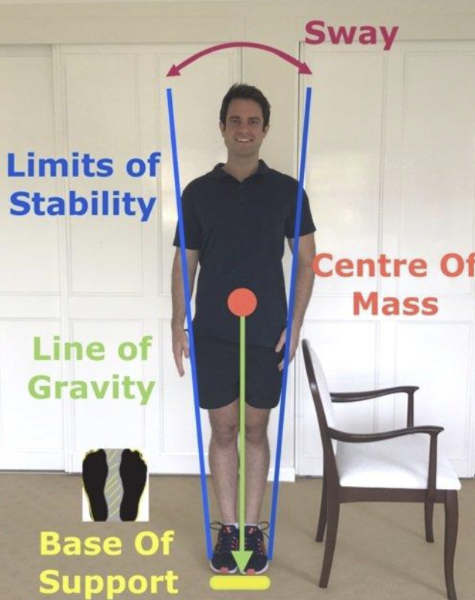
What is a base of support (BOS)?
boundary created by body part(s) in contact w/ supporting surface

What is center of mass (COM)?
mean location of total mass in the body (standing → 2/3 of body height above BOS)

What is center of gravity (COG)?
mean location of moments & forces acting on the body

What is a line of gravity (LOG)?
a vertical line passing from the center of gravity down to the ground
What is a center of pressure (COP)?
a point representing the average location of force being applied to the ground by the individual
What is a patient’s limits of stability?
furthest distance in any direction a person can lean without loss of balance or altering the original BOS (normative: 12 degree ant.-post., 16 degrees med.-lat w/ stance width of 4in)
What are different dynamic strategies for balance control?
ankle strategy
hip strategy
stepping strategy
When viewing posture from a lateral view, what are the significant landmark positions?
ears: positioned over shoulders
shoulders: level w/ chest open, not rounded forward
spine: normal curves
pelvis: neutral, no excessive tilt
knees: should be extended
feet: neutral
What is the normal position for pelvic alignment?
9 - 12 degrees of ant. pelvic tilt