Balance Wk 2 LG2 The Nephron & Tubular Physiology
 Call Kai
 Learn
Learn Practice Test
 Spaced Repetition
 Match
Match Flashcards
 Knowt Play
1/186

There's no tags or description
Looks like no tags are added yet.
Name | Mastery | Learn | Test | Matching | Spaced | Call with Kai | Chat |
|---|
No analytics yet
Send a link to your students to track their progress
187 Terms
What is the major job of the proximal tubule?
Answer: Bulk solute and water reabsorption.
Extra Information:
Most bulk reabsorption occurs early in the nephron.
The distal nephron performs regulated fine-tuning.
Where is essentially 100% of filtered glucose normally reabsorbed?
Answer: Proximal tubule.
Extra Information:
Glucose is normally almost completely reabsorbed here.
What percentage of filtered Na⁺ is reabsorbed in the proximal tubule?
Answer: About 67%.
Extra Information:
This represents the largest fraction of filtered sodium.
What percentage of filtered Na⁺ is reabsorbed in the ascending loop of Henle?
Answer: About 25%.
Extra Information:
This is another major site of sodium reabsorption.
What percentage of filtered Na⁺ is reabsorbed in the distal tubule?
Answer: About 4%.
Extra Information:
Distal handling involves smaller quantities but allows precise regulation.
What percentage of filtered Na⁺ is reabsorbed in the collecting duct?
Answer: About 3%.
Extra Information:
This small amount is highly regulated.
What percentage of filtered K⁺ is reabsorbed in the proximal tubule?
Answer: About 67%.
Extra Information:
Most potassium handling occurs before the regulated distal nephron.
What percentage of filtered K⁺ is reabsorbed in the ascending loop of Henle?
Answer: About 20%.
Extra Information:
Potassium participates in NKCC2 transport in the thick ascending limb.
What percentage of filtered K⁺ is handled in the collecting duct according to the slide map?
Answer: About 9%.
Extra Information:
Distal potassium handling is highly regulated.
What percentage of filtered Mg²⁺ is reabsorbed in the proximal tubule?
Answer: About 30%.
Extra Information:
The thick ascending limb reabsorbs an even larger fraction.
What percentage of filtered Mg²⁺ is reabsorbed in the ascending loop of Henle?
Answer: About 65%.
Extra Information:
- This is the major site of magnesium reabsorption.
What percentage of filtered Mg²⁺ is handled in the collecting duct according to the slide map?
Answer: About 1%.
Extra Information:
Most magnesium has already been reabsorbed upstream.
What is the overall pattern of nephron reabsorption?
Answer: Bulk reabsorption occurs early, while regulated fine-tuning occurs distally.
Extra Information:
The proximal tubule performs most bulk reabsorption.
The loop handles major electrolyte loads.
The distal nephron determines final excretion.
What transporter creates the Na⁺ gradient that drives proximal-tubule reabsorption?
Answer: Basolateral Na⁺/K⁺-ATPase.
Extra Information:
It maintains low intracellular Na⁺.
This Na⁺ gradient powers apical secondary active transport.
What type of transport does the Na⁺ gradient power in the proximal tubule?
Answer: Secondary active transport.
Extra Information:
The Na⁺/K⁺-ATPase itself is on the basolateral membrane.
What substances are coupled to Na⁺ entry in the early proximal tubule?
Answer: Glucose, amino acids, and other solutes.
Extra Information:
SGLT2 is shown as an important apical glucose transporter.
What happens to water when solutes are reabsorbed in the proximal tubule?
Answer: Water follows the solutes.
Extra Information:
This produces bulk water reabsorption along with sodium.
What type of reabsorption occurs in the proximal tubule with respect to osmolality?
Answer: Nearly isosmotic reabsorption.
Extra Information:
Solute and water are reabsorbed together.
Approximately how much filtered Na⁺ and water is recovered in the proximal tubule?
Answer: About two-thirds.
Extra Information:
The lecture emphasizes approximately 67%.
What is the major apical Na⁺ transporter in the thick ascending limb?
Answer: NKCC2.
Extra Information:
NKCC2 is the Na⁺-K⁺-2Cl⁻ cotransporter.
What ions does NKCC2 transport?
Answer: 1 Na⁺, 1 K⁺, and 2 Cl⁻.
Extra Information:
These ions move from the tubular lumen into the thick ascending limb cell.
What provides the driving force for NKCC2?
Answer: The Na⁺ gradient.
Extra Information:
Basolateral Na⁺/K⁺-ATPase maintains this gradient.
How does Na⁺ leave the thick ascending limb cell toward the blood?
Answer: Through basolateral Na⁺/K⁺-ATPase.
Extra Information:
This keeps intracellular Na⁺ low enough for continued NKCC2 transport.
How do Cl⁻ and K⁺ leave the thick ascending limb cell basolaterally?
Answer: Through channels down their electrochemical gradients.
Extra Information:
Na⁺ is extruded separately by Na⁺/K⁺-ATPase.
What is ROMK's role in the thick ascending limb?
Answer: It recycles K⁺ back into the tubular lumen.
Extra Information:
This supplies luminal K⁺ needed for continued NKCC2 activity.
Why must K⁺ recycle through ROMK?
Answer: To maintain luminal K⁺ for NKCC2.
Extra Information:
K⁺ recycling also contributes to a lumen-positive voltage.
What electrical potential does NKCC2 plus ROMK create in the thick ascending limb?
Answer: A lumen-positive potential.
Extra Information:
- The lumen becomes electrically positive relative to the interstitium.
What does the lumen-positive voltage in the thick ascending limb promote?
Answer: Paracellular Ca²⁺ and Mg²⁺ reabsorption.
Extra Information:
The positive lumen drives cations between the cells.
What does it mean that Na⁺ reabsorption in the thick ascending limb is load-dependent?
Answer: More delivered Na⁺ causes more Na⁺ reabsorption.
Extra Information:
The amount reabsorbed depends partly on the amount delivered to the segment.
What is the major apical Na⁺ transporter of the early distal convoluted tubule?
Answer: NCC.
Extra Information:
NCC is the Na⁺-Cl⁻ cotransporter.
What does NCC transport?
Answer: Na⁺ and Cl⁻.
Extra Information:
It transports two ions rather than the Na⁺, K⁺, and two Cl⁻ moved by NKCC2.
Is NCC electrogenic or electroneutral?
Answer: Electroneutral.
Extra Information:
It does not create the electrical effect produced by transport in the thick ascending limb.
How does NCC differ from NKCC2?
Answer: NCC moves Na⁺ and Cl⁻ and is electroneutral
NKCC2 moves Na⁺, K⁺, and 2Cl⁻.
Extra Information:
They are also inhibited by different classes of diuretics.
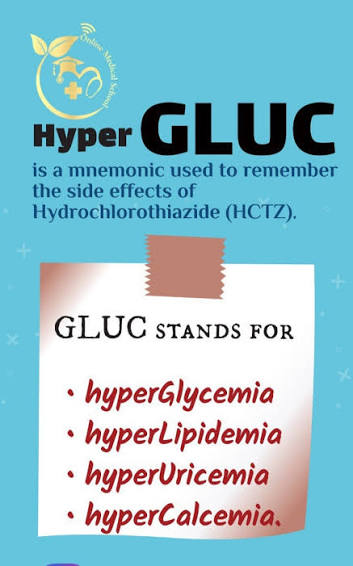
Which diuretics inhibit NCC?
Answer: Thiazide diuretics.
Extra Information:
Examples on the slide include chlorothiazide, hydrochlorothiazide, and metolazone.
Where do thiazides bind on NCC?
Answer: The Cl⁻ site.
Extra Information:
This prevents the cotransporter from cycling.
NaCl reabsorption in the early distal tubule decreases.
Is the early distal tubule permeable to water?
Answer: No.
Extra Information:
It reabsorbs solute while leaving water behind.
What happens to tubular-fluid osmolality in the early distal tubule?
Answer: It decreases.
Extra Information:
NaCl is removed without water.
The tubular fluid therefore becomes more dilute.
What are the two specialized collecting-duct cell types emphasized in the lecture?
Answer: Principal cells and α-intercalated cells.
Extra Information:
They perform the final regulated adjustments of urine composition.
How do principal cells handle Na⁺?
Answer: They reabsorb Na⁺ through ENaC on apical side
Extra Information:
ENaC is regulated by aldosterone.
How do principal cells handle K⁺?
Answer: They secrete K⁺ through ROMK.
Extra Information:
Distal potassium secretion is highly regulated.
How does ADH change principal-cell water handling?
Answer: It inserts apical aquaporin-2 channels.
Extra Information:
This increases water permeability and water reabsorption.
What do α-intercalated cells secrete?
Answer: H⁺.
Extra Information:
They contribute to acid-base regulation.
What can α-intercalated cells do with K⁺?
Answer: Reabsorb K⁺.
Extra Information:
This is particularly relevant to regulated distal potassium handling.

What substances do intercalated cells help regulate?
Answer: H⁺, bicarbonate, and K⁺.
Extra Information:
They therefore contribute to acid-base and potassium balance.
What does the collecting duct ultimately determine?
Answer: Final urine volume and composition.
Extra Information:
Small changes here can strongly affect final Na⁺, K⁺, H⁺, and water excretion.
What is transcellular movement?
Answer: Movement through the cell.
Extra Information:
A substance crosses both apical and basolateral membranes.
What is paracellular movement?
Answer: Movement between cells.
Extra Information:
Solutes pass through selective tight junctions.
What structures determine paracellular selectivity?
Answer: Claudin-containing tight junctions.
Extra Information:
Different claudins allow selective movement of different solutes.
What drives paracellular transport if no ATP-powered transporter is cycling?
Answer: Electrochemical or pressure gradients.
Extra Information:
Paracellular movement follows existing gradients.
Why is the proximal tubule suited for bulk paracellular reabsorption?
Answer: Its epithelium is relatively leaky.
Extra Information:
This supports high-volume bulk reabsorption.
What promotes paracellular cation reabsorption in the thick ascending limb?
Answer: The lumen-positive voltage.
Extra Information:
This favors Ca²⁺ and Mg²⁺ movement between cells.
What is glomerulotubular balance?
Answer: The proximal tubule reabsorbs a relatively constant fraction of filtered Na⁺ and water.
Extra Information:
This helps proximal reabsorption change appropriately when filtration changes.
What happens to proximal reabsorption when GFR increases?
Answer: It increases proportionally.
Extra Information:
The fraction reabsorbed remains relatively constant.
What helps move reabsorbed proximal-tubule fluid back into the circulation?
Answer: Peritubular Starling forces.
Extra Information:
These forces promote uptake into the peritubular capillaries.
How does angiotensin II affect proximal Na⁺ reabsorption?
Answer: It increases it.
Extra Information:
This effect is particularly important during volume depletion.
What is a major determinant of extracellular fluid volume?
Answer: Total-body sodium.
Extra Information:
Sodium balance therefore has major effects on body-fluid volume and blood pressure.
Which part of the nephron makes the final adjustment to Na⁺ excretion?
Answer: The distal nephron.
Extra Information:
Most Na⁺ has already been reabsorbed upstream.
Distal handling is highly regulated.
Which hormones favor Na⁺ retention in the lecture?
Answer: Aldosterone and angiotensin II.
Extra Information:
ADH primarily regulates water handling.
What is the normal plasma osmolality range given in the lecture?
Answer: About 285–295 mOsm/kg.
Extra Information:
Water balance keeps plasma osmolality near this range.
What range of urine osmolality can the kidney produce?
Answer: About 50–1200 mOsm/L.
Extra Information:
The kidney can therefore produce very dilute or highly concentrated urine.
What does isosmotic urine mean?
Answer: Urine osmolality equals blood osmolality.
Extra Information:
There is no major difference in osmolality between the two.
What does hyperosmotic urine mean?
Answer: Urine osmolality is higher than blood osmolality.
Extra Information:
The urine is more concentrated.
What does hyposmotic urine mean?
Answer: Urine osmolality is lower than blood osmolality.
Extra Information:
The urine is more dilute.
Where is final control of urine osmolality mainly exerted?
Answer: Late distal tubule and collecting duct.
Extra Information:
ADH-dependent water permeability is especially important here.
Is the ascending loop of Henle permeable to water?
Answer: No.
Extra Information:
It reabsorbs substantial sodium without water.
Is the distal convoluted tubule permeable to water?
Answer: No.
Extra Information:
NaCl removal without water further dilutes tubular fluid.
What happens when a nephron segment reabsorbs Na⁺ but not water?
Answer: Tubular fluid becomes more dilute.
Extra Information:
This occurs in the ascending loop and distal convoluted tubule.
What is the collecting duct's water permeability without ADH?
Answer: Low or relatively impermeable to water.
Extra Information:
Sodium can still be reabsorbed.
Tubular fluid can remain dilute.
What happens to collecting-duct water permeability when ADH is present?
Answer: It increases.
Extra Information:
- ADH promotes aquaporin-2 insertion.
- More water is reabsorbed.
What is the role of the vasa recta in the medulla?
Answer: Maintain the medullary osmotic gradient.
Extra Information:
- They use passive countercurrent exchange.
How does the vasa recta maintain the medullary gradient?
Answer: By passive countercurrent exchange.
Extra Information:
- It absorbs water leaving the descending limb.
- Solutes from the ascending limb diffuse in a way that helps preserve the gradient.
How much of inner-medullary osmolarity can urea contribute?
Answer: Up to 50%.
Extra Information:
- Urea is therefore an important contributor to the medullary gradient.
Where is urea initially filtered?
Answer: At the glomerulus.
Extra Information:
- Urea is freely filtered.
What happens to urea in the proximal tubule?
Answer: About 50% is reabsorbed by simple diffusion.
Extra Information:
- This is the first major step in renal urea handling.
What happens to urea in the thin descending limb?
Answer: Urea is secreted into the tubule.
Extra Information:
- Urea diffuses from the medullary interstitium into the nephron lumen.
How much urea is added back in the thin descending limb according to the slide?
Answer: About 60%.
Extra Information:
This contributes to urea recycling.
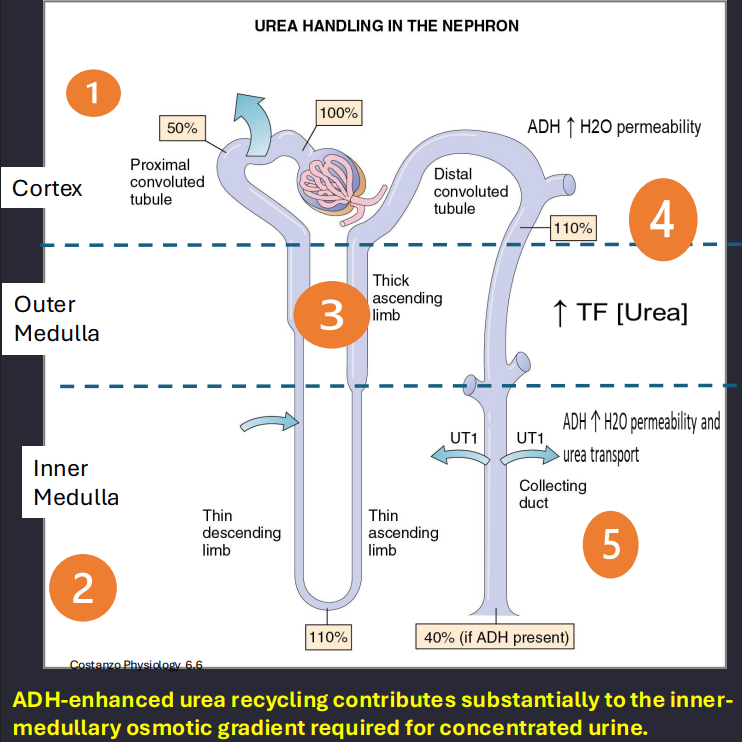
Which nephron regions are impermeable to urea?
Answer: Thick ascending limb, distal tubule, and cortical and outer medullary collecting ducts.
Extra Information:
Urea therefore remains in the tubular fluid as water is removed elsewhere.

What happens to tubular urea concentration when ADH causes water reabsorption?
Answer: It increases.
Extra Information:
- Water leaves while urea is initially left behind.
Which urea transporter is upregulated by ADH in the inner medullary collecting duct?
Answer: UT1.
Extra Information:
- It permits facilitated diffusion of urea.
How does ADH affect urea movement in the inner medullary collecting duct?
Answer: It increases facilitated urea diffusion into the interstitium.
Extra Information:
- ADH upregulates the urea transporter UT1.
Why is urea recycling important?
Answer: It helps maintain the inner-medullary osmotic gradient.
Extra Information:
- The gradient is necessary for water reabsorption and concentrated urine.
What happens to plasma osmolality when the body continuously loses water?
Answer: Plasma osmolality increases.
Extra Information:
- This initiates the ADH response.
What senses increased plasma osmolality?
Answer: Hypothalamic osmoreceptors.
Extra Information:
- They are extremely sensitive to small osmotic changes.
How sensitive are hypothalamic osmoreceptors according to the lecture?
Answer: About a 1 mOsm/L change.
Extra Information:
- Small increases in plasma osmolality can therefore stimulate the response.
What two responses are stimulated by hypothalamic osmoreceptors?
Answer: Thirst and ADH secretion.
Extra Information:
- Together they increase body water.
Where is ADH released from?
Answer: Posterior pituitary gland.
Extra Information:
- Hypothalamic osmoreceptors stimulate its release when plasma osmolality rises.
How does ADH change principal cells of the late distal tubule and collecting duct?
Answer: It increases their water permeability.
Extra Information:
- Aquaporin-2 channels are inserted into the apical membrane.
What happens to urine osmolality when ADH increases water reabsorption?
Answer: Urine osmolality increases.
Extra Information:
- The urine becomes more concentrated.
What happens to urine volume when ADH increases water reabsorption?
Answer: Urine volume decreases.
Extra Information:
- More filtered water is returned to the body.
How do ADH and thirst restore plasma osmolality?
Answer: They increase body water and lower plasma osmolality toward normal.
Extra Information:
- ADH retains water.
- Thirst promotes water intake.
In the ocean-water case, what is the first controlled variable being sensed?
Answer: Osmolality.
Extra Information:
- Ocean water is hypertonic.
- Serum sodium and serum osmolality increase.
What happens to ADH after consuming hypertonic ocean water?
Answer: ADH increases.
Extra Information:
- Increased serum osmolality stimulates ADH release.
What happens to extracellular fluid volume after consuming ocean water according to the case?
Answer: It increases.
Extra Information:
- Increased serum sodium expands extracellular fluid volume.
- Preload and cardiac output increase.
What happens to urine osmolality after consuming ocean water?
Answer: It increases.
Extra Information:
- Increased ADH promotes renal water reabsorption.
How does angiotensin II affect systemic vascular resistance?
Answer: It increases systemic vascular resistance.
Extra Information:
- Angiotensin II acts on arterioles.
- This helps defend blood pressure.
Which glomerular arteriole does angiotensin II constrict in low-volume states?
Answer: The efferent arteriole.
Extra Information:
- This helps maintain glomerular filtration pressure.
Why does angiotensin II constrict the efferent arteriole during low volume?
Answer: To help maintain GFR.
Extra Information:
- It supports filtration despite reduced renal perfusion.
How does angiotensin II affect proximal-tubule sodium handling?
Answer: It increases Na⁺ reabsorption.
Extra Information:
- This helps retain sodium and water during low-volume states.
How does angiotensin II affect aldosterone?
Answer: It increases aldosterone secretion.
Extra Information:
Aldosterone is released from the adrenal cortex.
